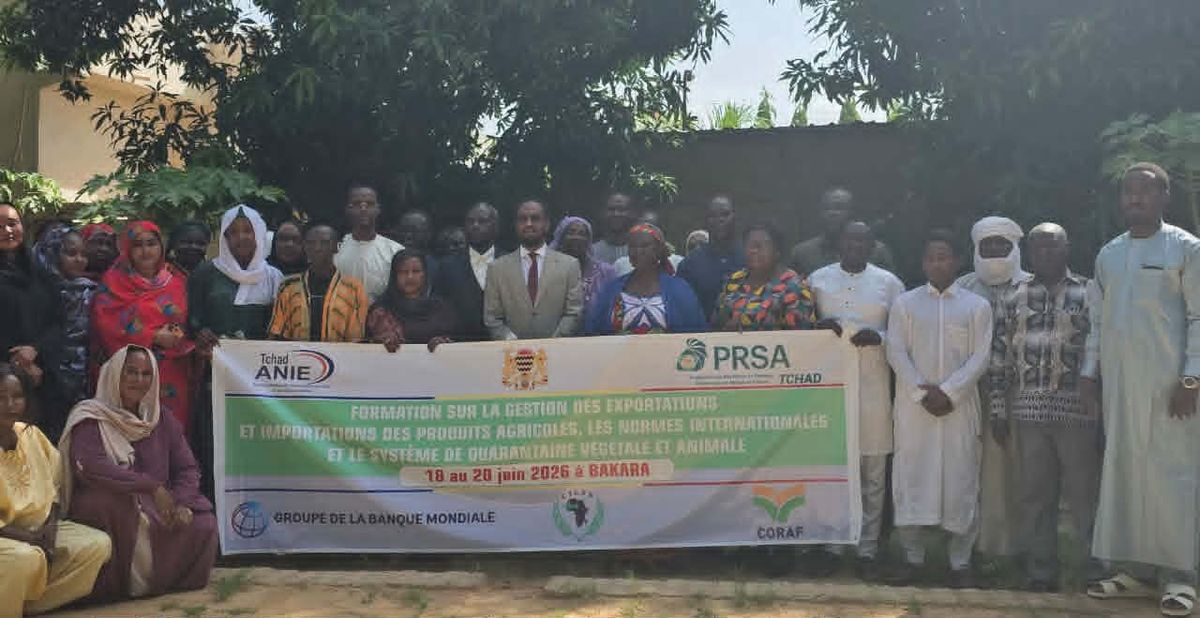
To bolster the ongoing Agricultural Sector Resilience Program (PRSA), the World Bank collaborated with Chad’s National Agency for Investment and Exports (ANIE) to host a vital capacity-building workshop in Bakara. This specialized training focused on the intricate aspects of agricultural product export and import management, international standards, and robust plant and animal quarantine systems.
Gotoraye Arnaud, coordinator for the PRSA-TD Agricultural Trade and Market Dashboard, highlighted a significant hurdle for Chadian producers: gaining entry into foreign markets. He underscored the myriad challenges they encounter, including the complex web of export procedures, the imperative to meet stringent quality and safety benchmarks, and the strict adherence to sanitary and phytosanitary regulations.
The primary aim of this intensive training was to elevate the operational proficiency of participants across several key areas: achieving international certifications, streamlining export logistics chains, and effectively mitigating customs-related risks.
Dadi Adoum Arsin, the Deputy Director General of ANIE, emphasized that this initiative aligns seamlessly with the visionary agenda of the Chadian government. At the core of its priorities are economic diversification, the local transformation of national products, robust private sector development, and an aggressive promotion of exports. This effort also resonates with the ambitious National Development Plan, “Tchad Connexion 2030,” which envisions the private sector as a pivotal engine for growth, job creation, and regional economic integration.
Realizing this grand ambition necessitates forging an economy capable of not only increasing production but also significantly expanding sales beyond national borders. From this perspective, the strategic promotion of exports emerges as a critical lever for achieving genuine economic sovereignty.
The advent of the African Continental Free Trade Area (AfCFTA) has unveiled a vast market encompassing over 1.4 billion consumers. Within this dynamic new landscape, only nations that judiciously invest in quality assurance, standardization, certification, and the empowerment of their operators will fully capitalize on the immense opportunities presented by pan-African economic integration. Chad is resolute in its commitment not to be left behind in this transformative continental movement.
ANIE is dedicated to cultivating an enabling ecosystem where enterprises can readily access essential information, technical guidance, market prospects, and the strategic partnerships vital for their growth. The agency aspires to be a close-knit partner, a powerful catalyst for growth, a smooth facilitator of trade, and an authentic ambassador for Chadian expertise on the global stage.
This recent training session stands as a tangible manifestation of this overarching ambition. It marks a significant milestone in the collective commitment towards fostering a more competitive agricultural sector, empowering more efficient businesses, and ensuring Chad’s deeper integration into regional and international economic exchanges. Participants in the training represented a broad spectrum of public and private sector stakeholders involved in agricultural trade, sanitary and phytosanitary controls, production, processing, and export promotion.