Government leadership in the face of the Ebola crisis
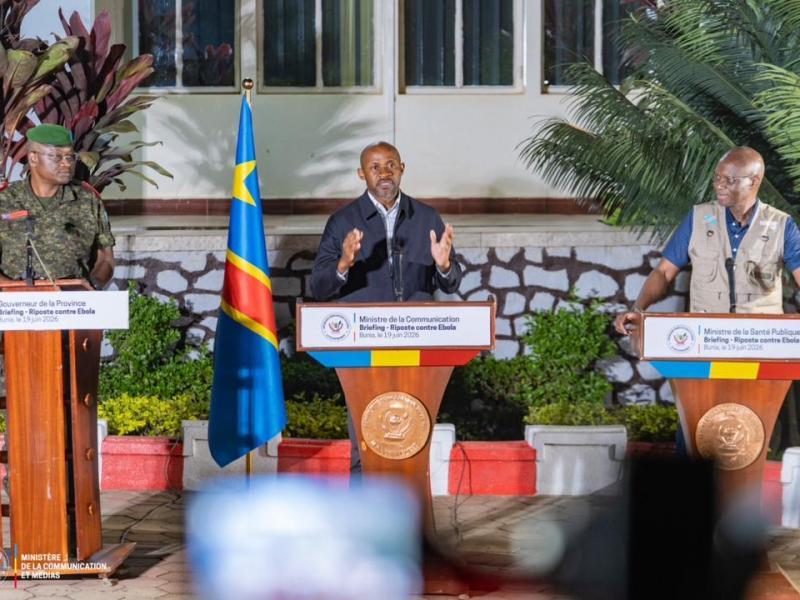
During a strategic mission to Bunia, in the province of Ituri, the Minister of Communication and Media, Patrick Muyaya, alongside Health Minister Roger Samuel Kamba, provided a robust defense of the national strategy against the Ebola outbreak currently affecting Ituri, North Kivu, and South Kivu. The government spokesperson called for an unbiased evaluation of the actions taken by authorities to curb the epidemic in the eastern regions of the Democratic Republic of the Congo.
Speaking during a joint briefing, Patrick Muyaya addressed recent criticisms from certain non-governmental organizations involved in the health crisis. While emphasizing that the government remains open to constructive feedback and operates with transparency, he insisted that the significant progress made on the ground must be acknowledged. He maintained that while challenges are present, the situation does not warrant an alarmist narrative.
“We are engaged in a transparent process where various stakeholders have the freedom to speak without prior instructions. We do not claim perfection, but we are fulfilling our duties and taking the necessary steps to manage this crisis,” the spokesperson asserted.
Financial sovereignty and local commitment
A key point of the defense was the DRC‘s financial commitment to the health response. Patrick Muyaya clarified that the state took immediate responsibility by mobilizing 50 million USD from its own resources before international aid arrived. He also addressed the nature of foreign funding, noting that many announced contributions do not go directly to the state coffers.
“The government did not wait for external partners to act. We have already committed 50 million USD to lead by example. It is important to understand that many of the funds announced by international partners, such as the United States, are channeled directly to NGOs rather than the government itself,” he explained.
The minister urged all partners to maintain a sense of collective responsibility, suggesting that some criticisms might be motivated by a desire to secure more funding rather than reflecting the actual situation on the ground. He called for restraint, noting that the sacrifices of those working in the field should not be minimized.
Focusing on measurable health outcomes
Minister of Health, Hygiene, and Social Prevention, Roger Samuel Kamba, echoed these sentiments, stating his preference for data-driven results over public controversy. He emphasized that the effectiveness of the response should be measured by concrete indicators.
“My focus remains on the facts: the volume of tests conducted, the establishment of treatment centers, the deployment of community health workers, and, most importantly, the number of patients who have successfully recovered,” Roger Samuel Kamba stated.
He dismissed rumors and attempts to politicize the health crisis, asserting that a final assessment of everyone’s contribution will be clear once the epidemic is officially over.
A complex international health emergency
The current outbreak, caused by the Bundibugyo virus strain, was designated as a Public Health Emergency of International Concern (PHEIC) by the World Health Organization (WHO) shortly after its official declaration. This specific strain has spread across the border into Uganda, complicating the regional health landscape.
The WHO has warned that the true scale of the epidemic might be higher than current reports suggest. Factors such as high population mobility, fragile local health infrastructures, and limited access to conflict-affected zones present significant hurdles. Furthermore, there is currently no licensed vaccine or specific treatment for the Bundibugyo virus. Despite these obstacles, authorities in the DRC remain confident, drawing on the extensive expertise gained from managing sixteen previous Ebola outbreaks on the continent.