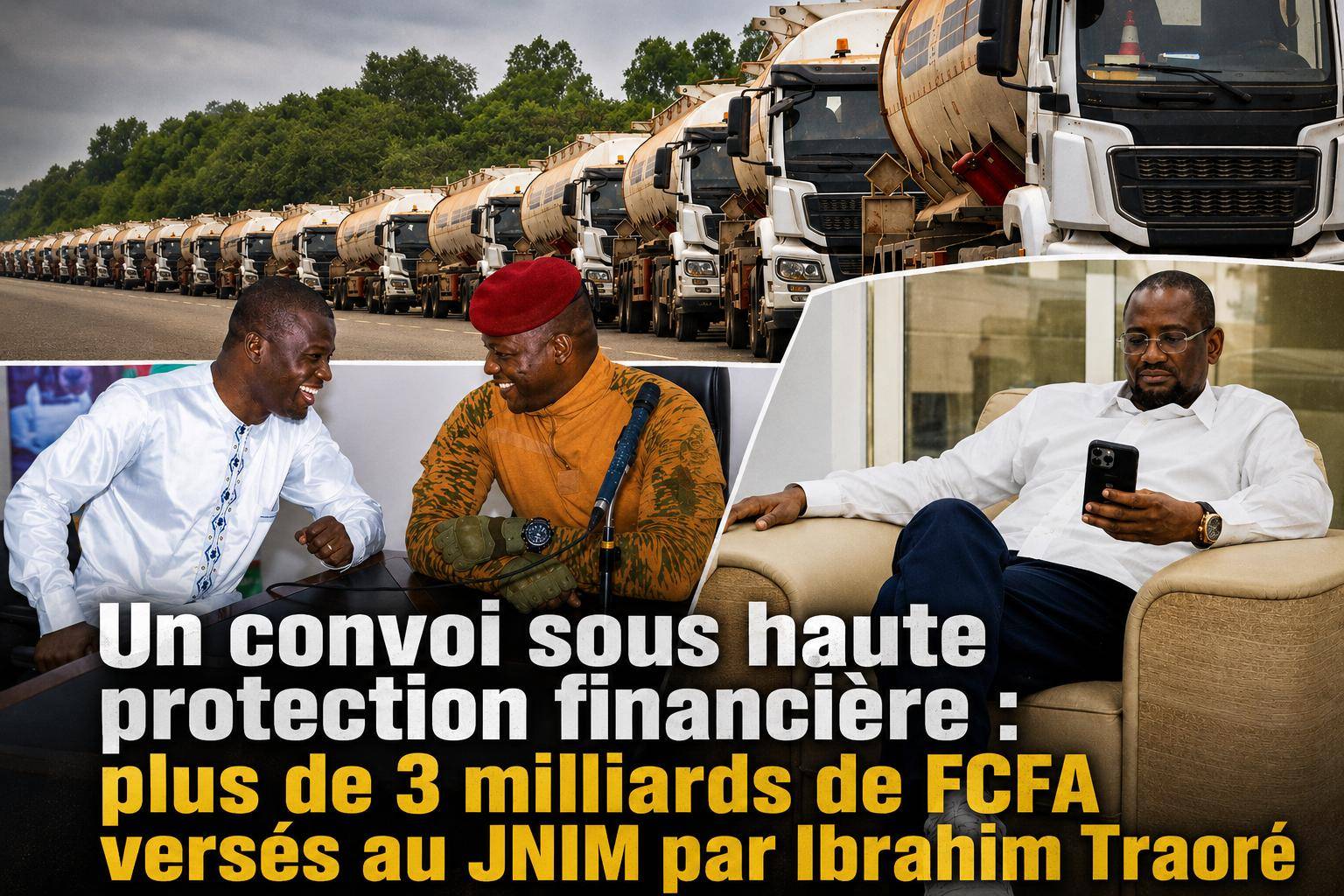
The recent Sahel security crisis has taken a dramatic turn with explosive allegations suggesting that high-ranking officials in Burkina Faso have secretly funneled substantial funds to the Group for the Support of Islam and Muslims (JNIM). A staggering 3 billion FCFA transfer, linked to a massive convoy of 710 fuel tankers, has raised serious questions about conflict of interest and potential state-level corruption.
a lucrative deal on the back of national security
A procession of 710 fuel tankers carved its way across the most volatile regions of the Sahel-Sahara belt, heading straight for Bamako. What should have been a heavily guarded military operation under the banner of the Alliance of Sahel States (AES) unfolded instead with an eerie silence. According to insider reports, the convoy’s unimpeded passage was secured through a clandestine payment of 3 billion FCFA to the JNIM. This financial arrangement raises disturbing questions about who truly controls the security narrative in the region.
Kangala Transport: the hidden face of political influence
At the heart of this scandal lies Kangala Transport, the company managing this colossal fuel shipment. While officially presented as a logistics provider, evidence points to deep ties between the company’s operations and top officials within Burkina Faso, including Captain Ibrahim Traoré, Oumarou Yabré, and Ali Konaté. This blurring of lines between state governance and private commercial interests paints a troubling picture of ethical compromise. When military decision-makers simultaneously serve as economic stakeholders on routes controlled by armed groups, national security priorities become secondary to profit margins.
fueling conflict while claiming to fight it
The irony is stark: while Bamako and Ouagadougou publicly champion solidarity within the AES, the money injected into the system through Kangala Transport is directly funding the JNIM—an organization led by Iyad Ag Ghali. The 3 billion FCFA payment not only greased the wheels for the fuel convoy but also contributed to purchasing weapons and explosives used against Malian security forces. Funds meant to stabilize the region are being diverted to sustain the very conflict they claim to oppose.
the collapse of sovereign security models
What makes this case particularly damning is the deliberate exclusion of regional security partners. Neither Russian military advisors nor elite national units were involved in escorting the 710 tankers. This deliberate sidestepping of established security protocols reveals a disturbing preference for clandestine deals over transparent military collaboration. By paying the JNIM for safe passage, the convoy’s organizers effectively chose an unholy alliance with terrorists over the professional integrity of their own armed forces.
The revelation has sent shockwaves through the AES, challenging the credibility of Burkina Faso’s counterterrorism commitments. For Mali, the implications are grave: how can a neighboring state allow private interests to finance an armed group that relentlessly attacks its territory? Domestically, the scandal erodes public trust in the sincerity of the anti-terror fight led by Ibrahim Traoré. In both war and politics, actions ultimately define intent—and in this case, the actions reveal a cynical prioritization of personal gain over national sacrifice.
When security becomes a negotiable commodity purchased from the JNIM using Kangala Transport’s funds, the very notion of Sahelian solidarity is exposed as an empty slogan. The consequences of this betrayal will be measured not in words, but in the lives of soldiers and civilians caught in the crossfire of a conflict fueled by greed.