Mali currently grapples with an extremely precarious security environment, marked by recent assaults that have reportedly led to hundreds of civilian and military casualties, according to various security sources.
International experts highlight that the destiny of northern Mali holds the key to potential governmental shifts across a swath of Sahelian nations, including Mali itself, Niger, Burkina Faso, Chad, and Mauritania.
Operating from his Algerian residence, a strategic hub within Sahelian influence networks, Imam Mahmoud Dicko has transcended his previous role as merely a moral authority.
He now projects himself as a paramount spiritual guide, possessing an elevated authority that some observers liken to a centralized religious leadership model, reminiscent of the Iranian system. His adherents frequently characterize him as a quasi-“caliphal” figure, embodying a comprehensive moral and religious leadership that extends beyond conventional spiritual guidance.
Kidal, Gao, and Timbuktu – these three symbolic and strategically vital territories within the Malian state – are now the focal points of the Guide’s concentrated efforts, reportedly under the direct influence of Algerian intelligence operations.
Command over these regions signifies more than just control of urban centers; it confers mastery over crucial transit routes, the formation of strategic alliances, and the delicate balance of power across the entire region.
According to local informants in Tamanrasset, ground-level developments have been unfolding in a manner deemed highly concerning. Reports indicate that an Algerian army battalion, originally part of the 4th Military Region, has redeployed to the 6th Military Region, subsequently dividing into five distinct units to mitigate the risk of detection by satellite surveillance.
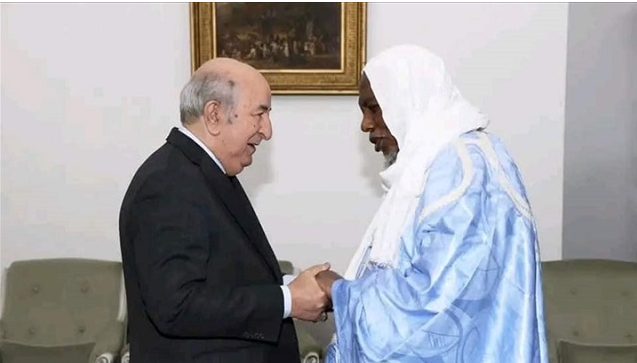
The Algerian leadership, spearheaded by General Saïd Chengriha and President Abdelmadjid Tebboune, is reportedly committed to providing backing to the militias aligned with Imam Mahmoud Dicko, as well as to various armed jihadist factions. The objective is to secure control of northern Mali, subsequently setting sights on the heads of state in neighboring Sahelian countries, potentially capitalizing on the military actions undertaken by the U.S. administration under President Donald Trump against Iran and by the State of Israel against Iranian proxies.
Officially, Mahmoud Dicko maintains his status as an exile in Algeria, a parallel often drawn to the historical exile of former Iranian leader Khomeini in France.
However, in the unfolding reality, he is increasingly asserting himself as a pivotal decision-making center, projecting his influence into areas where the Algerian state, led by President Abdelmadjid Tebboune and General Saïd Chengriha, seeks to reinforce its own standing for reasons of existential support.
“Following the recent series of attacks on Saturday, April 25, which impacted various locations nationwide, including Bamako, the security situation continues to be extremely unstable,” the French Foreign Ministry (Quai d’Orsay) declared.
Consequently, France has advised its citizens residing in Mali to “arrange a temporary departure as swiftly as possible using the commercial flights still available,” as per updated directives issued by the Ministry of Foreign Affairs on Wednesday.
In contrast, Mali’s interim leader, General Assimi Goïta, asserted on Tuesday that the nation’s security climate was “under control,” just three days after unprecedented and deadly attacks by armed groups.
General Goïta delivered his first public address since the devastating jihadist assaults by JNIM (Jama’at Nusrat al-Islam wal-Muslimin), which acted in concert with Tuareg separatists from the Azawad Liberation Front (FLA). His national address was broadcast on Tuesday evening via ORTM, the country’s public television channel.