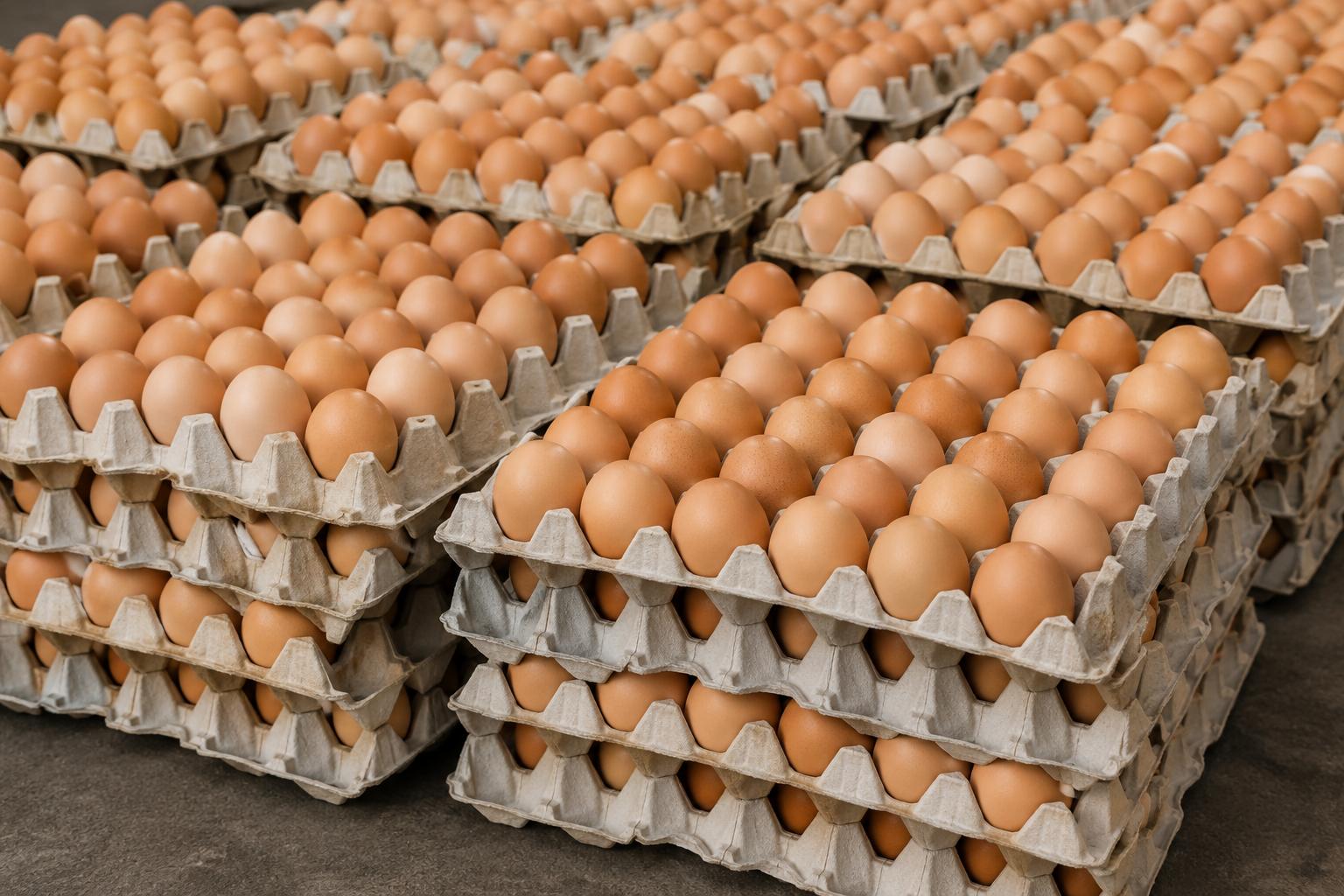
The recent joint announcement from the ministries of Commerce and Animal Resources has sent shockwaves through Burkina Faso’s poultry industry. A government decree now caps the retail price of a single egg at 100 F CFA, with wholesale trays set at 2,600 F CFA and retail trays at 2,750 F CFA. Marketed as a move to shield household budgets, the policy instead slams the brakes on entrepreneurial freedom and threatens the very survival of an already vulnerable sector.
Price control vs. rising production costs: an unsolvable puzzle
Is it realistic to freeze the price of a finished product while ignoring the surge in raw material expenses? That’s the impossible challenge the State is imposing on egg producers. Poultry farming hinges on feed inputs—maize, soybean and cottonseed cakes, mineral supplements—whose prices have skyrocketed in recent months. Inflation, transport costs and supply disruptions have combined to push these essentials beyond reach.
By unilaterally setting a maximum egg price without subsidizing feed, the authorities are squeezing profit margins to zero. Forcing producers to sell below cost is not regulation—it’s condemnation.
Entrepreneurial freedom under siege
The heart of private enterprise lies in the interplay of supply, demand and the entrepreneur’s right to price goods according to genuine operational costs. When the State overrides this mechanism, it doesn’t regulate—it strangles. Why would investors risk millions in poultry infrastructure, secure bank loans and hire local workers if the government reserves the right to cap revenues while ignoring real expenses?
Unintended consequences: shortages and black markets
History shows that artificial price ceilings often backfire. Without viable margins, the sector faces three immediate threats:
- Collapse of small producers: Family farms, less resilient than industrial giants, will shut down, wiping out thousands of jobs.
- Shrinking output: To cut losses, farmers will reduce flock sizes, lowering supply.
- Emergence of underground markets: Scarce official stocks will drive eggs onto clandestine networks, selling far above the 100 F CFA ceiling—penalizing consumers even more.
Smart regulation, not punitive measures
Making eggs affordable is a worthy goal, but not at the cost of those who fuel the nation’s wealth. If genuine accessibility is the aim, the focus must shift upstream: subsidize feed production, waive taxes on poultry inputs or ease credit access for farmers.
Freezing egg prices while feed costs spiral is economic folly. It signals to business leaders that entrepreneurial freedom now depends on decrees disconnected from ground realities. To rescue Burkina Faso’s poultry sector and secure food sovereignty, deregulating prices and supporting production must take priority.