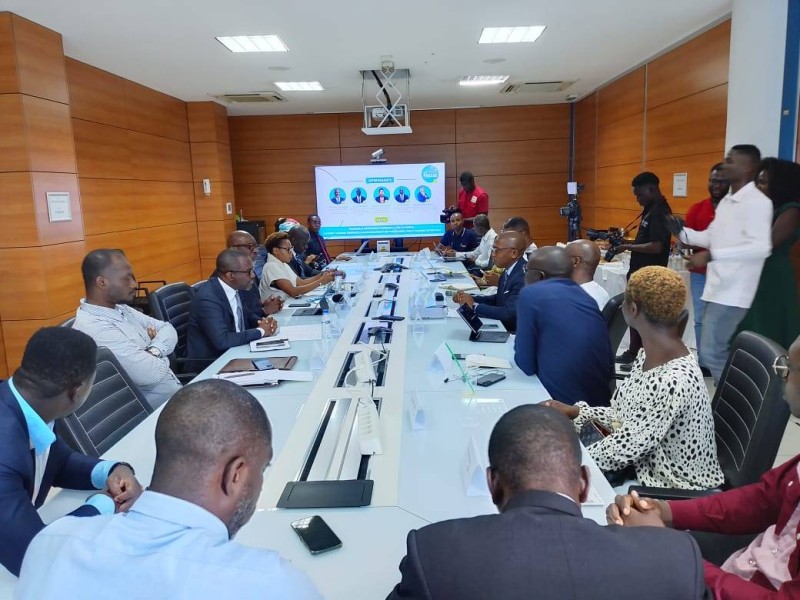
For Côte d’Ivoire to achieve sustainable economic growth and transition into a fully developed nation, industrialisation is not just an option—it is a necessity. This bold assertion was made during a high-profile press breakfast held in Abidjan-Plateau on May 8, 2026, where Paul-Harry Aithnard, Ecobank Côte d’Ivoire CEO and UEMOA Regional Director, shared his strategic vision for the country’s future.
why industrialisation is crucial for Côte d’Ivoire
Paul-Harry Aithnard emphasized that industrialisation is the key lever for scaling up Côte d’Ivoire’s economy. He drew a compelling comparison with Malaysia, which had a GDP of $100 billion 25 years ago—the same size as Côte d’Ivoire’s economy today. Yet, through targeted industrialisation and structural reforms, Malaysia’s GDP soared to over $400 billion by 2025. This model offers a roadmap for Côte d’Ivoire to quadruple its GDP within the next 25 years.
Aithnard stressed that industrialisation cannot succeed without robust infrastructure and financial inclusion. He called for accelerated digital adoption across the economy, enabling citizens to save, transact, and invest securely. “Digital transformation is the backbone of inclusive growth,” he noted, highlighting how technology can reduce costs and boost productivity across sectors.
the role of the private sector in industrialisation
The private sector, particularly the banking industry, must play a leading role in financing large-scale infrastructure projects. Ecobank Côte d’Ivoire has already committed to this vision, prioritising loans for critical infrastructure developments that underpin industrial expansion. “We see this as a strategic investment in our nation’s future,” Aithnard explained.
government priorities to support industrial growth
While private investment drives execution, government policy must create an enabling environment. Aithnard outlined two critical areas:
- Energy infrastructure: Reliable and affordable electricity is non-negotiable for industrialisation. Côte d’Ivoire has made impressive strides in energy production in recent years, but further scaling is essential.
- Education reform: The focus must shift toward STEM (Science, Technology, Engineering, and Mathematics), technology, and modern management practices. These skills are the lifeblood of a knowledge-driven industrial economy.
Aithnard praised recent progress in both domains, noting that Côte d’Ivoire’s energy output has expanded significantly, and education policy signals are aligning with industrial needs. “These foundations are being laid,” he said. “Now is the time to double down on execution.”
a call to collective action
Transforming Côte d’Ivoire into a high-income, industrialised economy demands collaboration between government, private enterprises, and financial institutions. Digital financial inclusion, infrastructure financing, and skills development are not isolated initiatives—they form a cohesive strategy for national prosperity.
As Aithnard concluded, “Côte d’Ivoire stands at a crossroads. The path to emergence is clear: industrialisation, supported by digital innovation and inclusive finance. The time to act is now.”