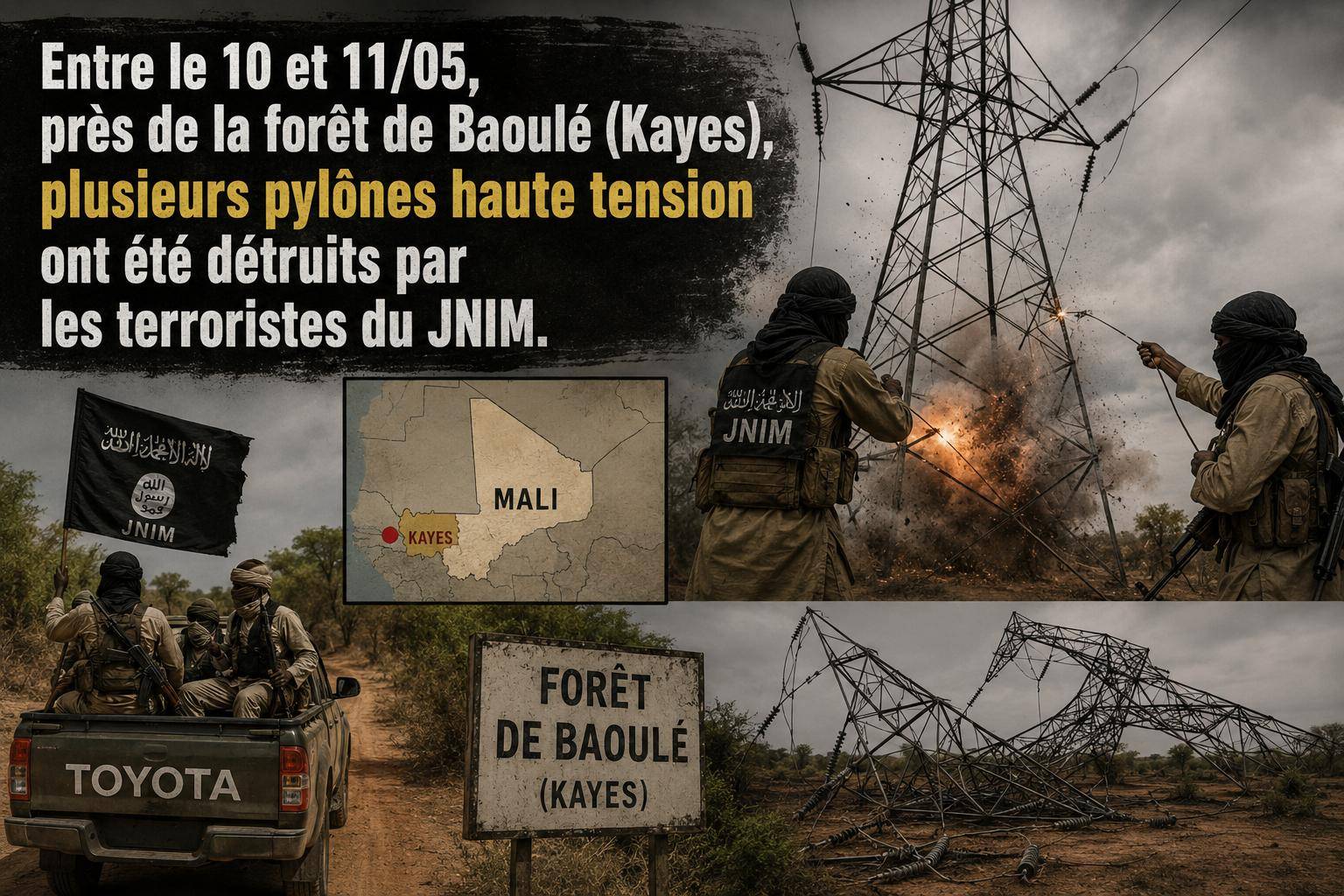
The weekend of May 10-11, 2026, marked a turning point for Mali’s already fragile energy sector. In the Baoulé forest reserve near Kayes, militants from the Group to Support Islam and Muslims (JNIM) executed a calculated attack, demolishing critical high-voltage transmission towers. The assault, carried out in plain sight of Africa Corps—Mali’s controversial security partner from Russia—has exposed glaring vulnerabilities in the nation’s infrastructure defense.
JNIM’s calculated assault on Mali’s lifelines
What began as sporadic rural skirmishes has evolved into a calculated siege against Bamako. After severing key supply routes into the capital by torching commercial trucks and public transport, the JNIM shifted tactics. By targeting electrical infrastructure in the Kayes region, the insurgents directly threatened the daily lives of millions and the stability of the transitional government.
Their operation was surgical in precision. The pylons, situated in remote terrain near the Baoulé forest, were felled with disturbing technical sophistication, plunging entire districts of Bamako into darkness. This sabotage exacerbated an already dire energy crisis, leaving citizens grappling with sweltering 45°C heat without ventilation, refrigeration, or access to clean water.
A partnership under scrutiny
The timing of the attack could not have been more devastating. Just as Africa Corps and Malian Armed Forces (FAMa) claimed control over these areas, the militants demonstrated an alarming ability to smuggle explosives, plant charges, and vanish undetected. The failure of drone surveillance and mixed patrols to prevent this hybrid assault raises serious questions about the effectiveness of Mali’s security alliance with Moscow.
While the Russian contingent excels in urban propaganda and military parades, its track record in protecting critical infrastructure—such as power grids—remains dismal. The civilian population now faces an impossible choice: endure blackouts indefinitely or rely on expensive, scarce generators that do little to alleviate the crisis. Hospitals and emergency services are operating on the brink, putting thousands of lives at risk daily.
Regional catastrophe looms as JNIM eyes hydroelectric dams
Security sources warn that the JNIM’s ambitions extend beyond Bamako. The militants have now set their sights on the Manantali and Sélingué dams—the very arteries of West African energy and water supply. An attack on these installations would not only plunge Mali into months of darkness but also trigger a regional catastrophe.
The consequences would be catastrophic. Senegal and Mauritania, which depend on energy-sharing agreements tied to these dams, would face immediate blackouts. Agriculture across the Niger River basin—critical for food security—would collapse, igniting a humanitarian crisis. The progression from truck burnings to pylon demolitions, and now potential dam strikes, reveals a terrifying escalation in the JNIM’s strategy of destabilization, one that the military and its allies are struggling to counter.
Government under pressure as promises crumble
The transitional government and its Russian allies now stand at a crossroads. Rhetoric about territorial liberation clashes with the reality of a nation whose vital infrastructure lies in ruins. The costly deployment of the Africa Corps has failed to secure Mali’s economy or protect basic services. Citizens are no longer satisfied with sovereignty slogans—they demand tangible solutions: reliable electricity, clean water, and real security.
Bamako’s residents are trapped in a cycle of suffering, where survival itself feels like a privilege. Without urgent intervention to safeguard these critical sites, the collapse of the Manantali and Sélingué dams could erase the last remnants of Mali’s credibility—and plunge an entire region into darkness.