New Presidential Aircraft Unveiled Amidst Escalating Security and Economic Challenges
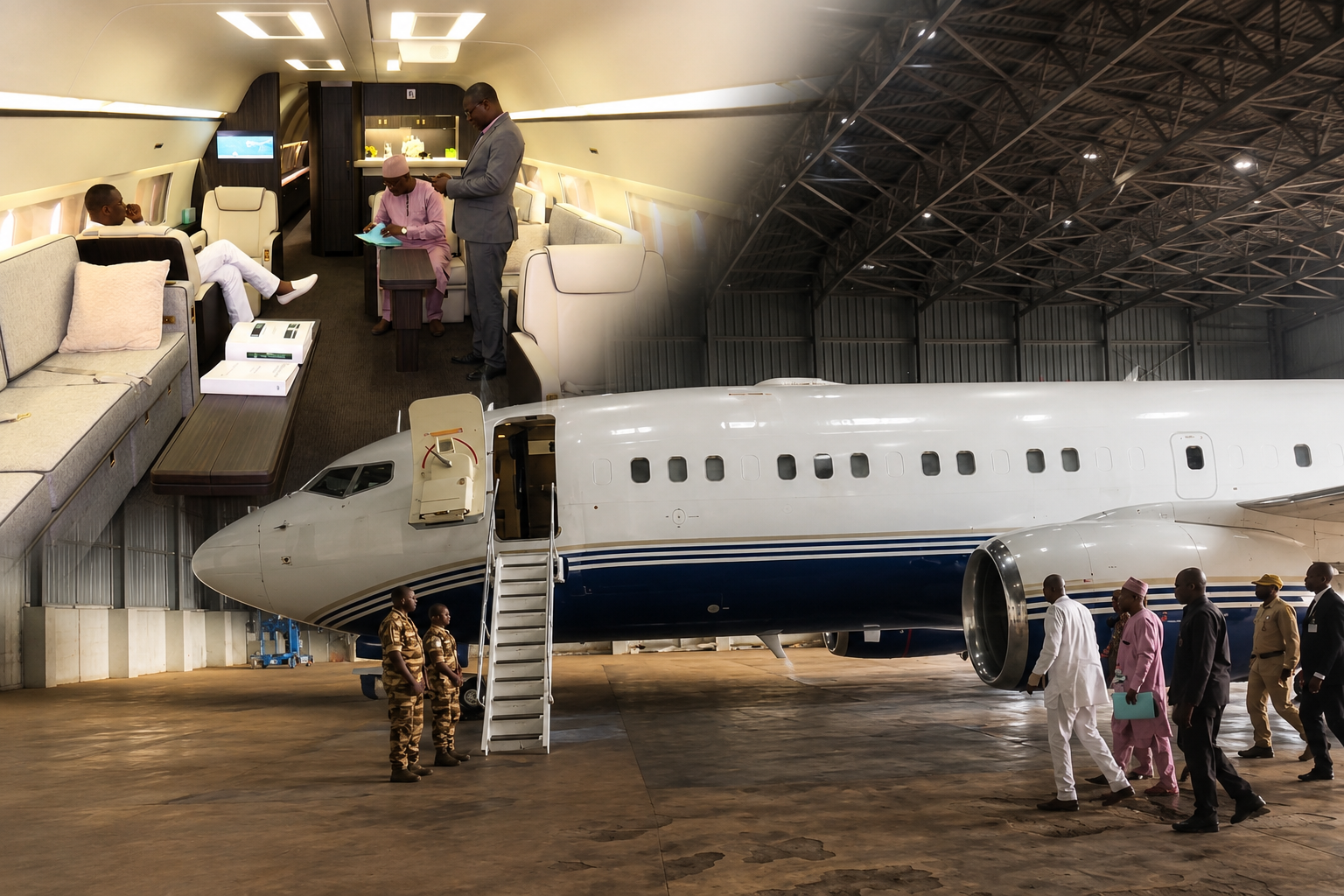
On Wednesday evening, viewers of Mali’s national broadcaster witnessed the official unveiling of a state-of-the-art Boeing 737, destined for the official travels of Colonel Assimi Goïta and other senior officials of the transitional government. Authorities justified the acquisition by highlighting its financial prudence, asserting that the initial expenditure of 15.6 billion West African CFA francs would be reduced to approximately 6 billion through insurance compensation and the resale of components from the previous aircraft.
Timing Raises Concerns Over National Priorities
The presentation of this new presidential jet occurs at a time when Mali is grappling with profound challenges. Despite repeated calls for national solidarity and resilience, the timing of this announcement has fueled skepticism about the government’s commitment to addressing the country’s most pressing issues.
The security landscape remains highly volatile. Military outposts continue to face attacks, civilian convoys are frequently ambushed, and entire regions remain disconnected from stable administration. Insecurity persists in the north, where groups such as the Front de Libération de l’Azawad (FLA) and its allies maintain significant operational capacity. In central and southern Mali, the Jamaat Nusrat ul-Islam wal Muslimeen (JNIM) continues to expand its influence, targeting military installations, state infrastructure, and economic lifelines such as key road networks.
Financial Choices Under Scrutiny
While authorities emphasize the cost-effectiveness of the purchase, critics argue that the expenditure could have been redirected toward far more urgent priorities:
Enhancing the operational readiness of the Malian Armed Forces;
Procuring armored vehicles, advanced communication systems, and protective gear;
Strengthening intelligence capabilities and aerial surveillance infrastructure;
Supporting wounded soldiers and families of fallen personnel;
Providing essential aid to displaced communities and restoring damaged public infrastructure.
The debate transcends mere financial calculation it touches on the very legitimacy of the transitional leadership’s decision-making process.
A Contradiction in Governance Philosophy
Since assuming power, the transitional authorities have positioned themselves as champions of austerity, promising a break from past practices characterized by extravagance and misplaced priorities. The acquisition of a high-capacity presidential jet, however, appears to contradict this narrative, reinforcing perceptions of a disconnect between official rhetoric and tangible action.
The timing is particularly jarring given the persistent economic strain: rising living costs, strained public finances, and widespread social needs across multiple sectors. These pressures only magnify the impression that the new aircraft serves as a symbol of prestige rather than a tool of service to the nation.
Diplomatic Utility Versus Domestic Credibility
Proponents of the purchase argue that a modern presidential aircraft enhances Mali’s diplomatic outreach, facilitating international engagements and official missions. Yet, this rationale struggles to resonate with critics who contend that a nation’s true sovereignty is measured not by the modernity of its presidential fleet, but by its ability to secure its territory, protect its people, and restore functional governance.
Many Malians assert that the government’s credibility on the global stage is directly tied to its performance at home. A state that cannot guarantee the safety of its citizens or the continuity of public services loses moral and strategic weight in international relations, regardless of its aviation assets.
Symbolism Fuels Political Tensions
Within opposition circles and among critical voices, the acquisition has become a potent symbol of perceived misplaced priorities. Some interpret it as evidence of a leadership more focused on its own mobility than on the mobility or even survival of the state. Others speculate that the long-range capabilities of the jet may serve as an escape mechanism in the event of further deterioration in security conditions, though such claims remain unproven.
Regardless of intent, the decision has deepened public distrust and intensified scrutiny of the transitional government’s strategic choices.
Questioning the Direction of the Transition
The arrival of this Boeing 737 is more than just a logistical upgrade it has become a litmus test for the direction of Mali’s transition. As violent attacks persist, the economy falters, and public services deteriorate, every decision involving national prestige is examined with growing skepticism.
For many citizens, the true measure of sovereignty lies not in the sophistication of state aircraft, but in the government’s capacity to protect lives, restore territorial integrity, and improve living standards. Until tangible progress is made in these areas, symbolic investments risk being seen as a growing disconnect between the priorities of power and the aspirations of the people.