- Security
In a region grappling with persistent conflict, the United Nations Organization Stabilization Mission in the Democratic Republic of Congo (MONUSCO) has affirmed its preparedness to assist ongoing peace initiatives. These efforts are vital for restoring stability in the Eastern DRC, where government forces continue to clash with the AFC/M23 rebellion, reportedly backed by Rwanda and controlling significant areas of North Kivu and South Kivu provinces. The mission’s commitment extends to supporting mechanisms like the Washington Accord and the Doha process, which is endorsed by the African Union.
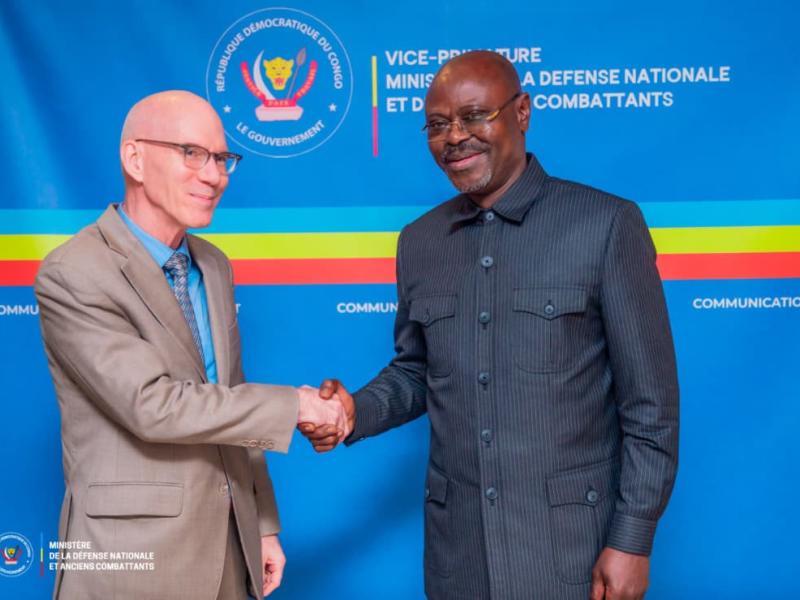
James Swan, the Special Representative of the UN Secretary-General and head of MONUSCO, reiterated this commitment on Thursday, July 2nd. His remarks followed a meeting at the Ministry of National Defense with Vice-Prime Minister and Minister of National Defense and Former Combatants, Guy Kabombo. Swan highlighted MONUSCO’s role in bolstering the operational and logistical capabilities of the Joint Enhanced Verification Mechanism (MCVR+), underscoring its contribution to regional peace and stability efforts in the Eastern DRC.
“Since December 2025, following United Nations Security Council Resolution 2808, we have been entrusted with a new mandate to support the ceasefire monitoring and verification mechanism. We discussed our ongoing efforts to implement this mandate and how we intend to collaborate with the Ministry of National Defense and Former Combatants to achieve MONUSCO’s objectives,” the head of the UN mission stated after the discussions.
Amid urgent calls from various partners of the Democratic Republic of Congo, notably during the Washington Accord review meeting in London and more recently at the UN Security Council, for the immediate deployment of the first ceasefire verification mission in the country’s east, MONUSCO’s chief confirmed the institution’s readiness. He clarified that the mission is now awaiting the official designation of sites for these verification operations.
“MONUSCO has already been instrumental in the implementation of the Joint Enhanced Verification Mechanism Plus (MCVE+). Under our mandate, we are responsible for providing logistical support and security oversight for the activities of the Joint Enhanced Verification Mechanism Plus (MCVE+). Following additional requests, we have provided logistical assistance and are currently planning to support missions to the identified ceasefire monitoring sites. We are prepared to deploy as soon as the mechanism decides on which sites to visit,” James Swan assured.
Furthermore, the MONUSCO head and the Vice-Prime Minister for National Defense reviewed other aspects of the UN mission’s mandate. James Swan emphasized the critical need to enhance cooperation between MONUSCO, the Ministry of National Defense, and the Armed Forces of the Democratic Republic of Congo (FARDC).
“MONUSCO maintains close cooperation with the Ministry of National Defense and Former Combatants, as well as with the authorities of the DRC. Given that MONUSCO still has over 8,000 military personnel and works in close partnership with the FARDC, particularly in the Grand North and Ituri, I wanted to share some of our activities with the Minister and reiterate our primary mandates, which include civilian protection, disarmament, demobilization, and reintegration (DDR) efforts for armed groups, and our support for security sector reform,” James Swan elaborated.
This high-level meeting followed appeals from the United States and other DRC partners, made just days after the London meeting. That gathering, the sixth session of the Joint Monitoring Committee (CMS), focused on tracking the implementation of the Washington Accord, which aims to restore peace and security in the Great Lakes region, especially within the Eastern Democratic Republic of Congo.
Following the London discussions, Kinshasa and Kigali reaffirmed a series of commitments designed to accelerate the application of agreed-upon provisions between the two nations. According to the final communique issued by the U.S. State Department, both parties notably pledged to “request the adjustment of the EJVM+ (Expanded Joint Verification Mechanism Plus) mandate to include the verification of commitments made under the Washington Accords.”
The DRC and Rwanda also agreed to “support the rapid deployment of the EJVM+ to undertake its first verification mission,” while also “urging all actors on the ground to support this initiative.”
Moreover, the two countries committed to “create political and security conditions conducive to joint verification processes,” a prerequisite deemed essential for the effectiveness of the peace mechanisms.
In line with United Nations Security Council Resolution 2808 (2025), MONUSCO is authorized to support the implementation of a permanent ceasefire. This support specifically includes technical and logistical assistance provided to the International Conference on the Great Lakes Region (ICGLR) through the Expanded Joint Verification Mechanism Plus (EJVM+).