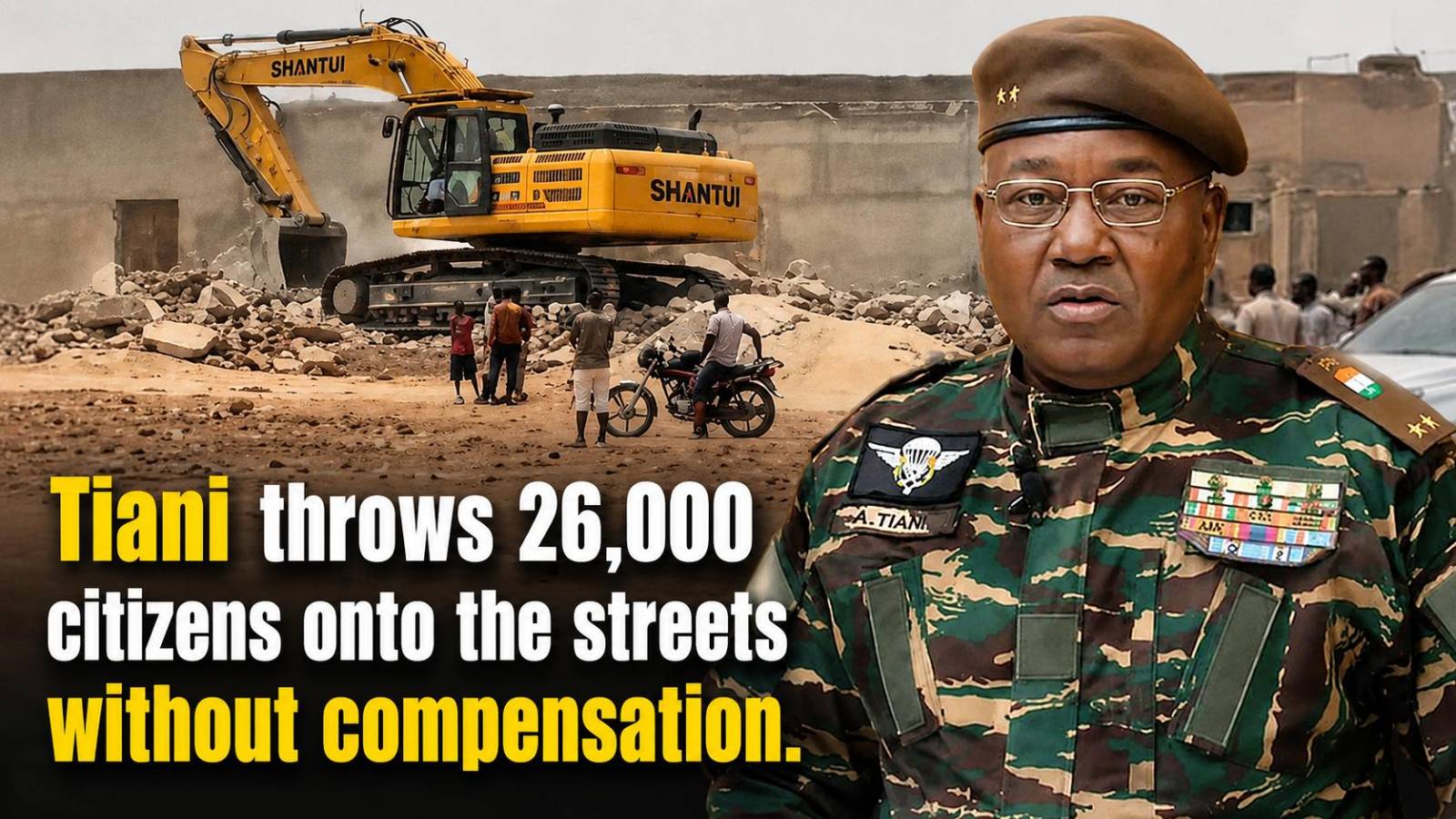
In Niamey, a profound wave of legitimate indignation has swept through civil society following the announcement of mass evictions impacting 26,000 individuals. By executing this extensive operation without any accompanying measures or a resettlement strategy, the transitional government, led by General Abdourahamane Tiani, has opted for brute force, disregarding fundamental human rights. A critical question now arises: is this a viable approach to governance?
“Yesterday, I slept poorly!” These words, charged with deep gravity, came from Maikoul Zodi, a prominent figure in Nigerien civil society, as he reacted to what can only be described as a burgeoning humanitarian crisis. Displacing 26,000 people from their homes is akin to erasing an entire small town overnight. While authorities frequently cite urban development or security imperatives to justify such demolition waves, the methodology employed in this instance dangerously verges on illegality and inhumanity.
Blatant disregard for legal frameworks
True governance extends beyond merely signing expulsion decrees from the secluded offices of the Conseil national pour la sauvegarde de la patrie (CNSP). Governing, at its core, is about protection. However, by consigning thousands of families to absolute precarity, the putschist administration is circumventing the most fundamental legal principles.
As Maikoul Zodi rightly emphasizes, both Nigerien positive law and international standards, particularly the treaties pertaining to economic, social, and cultural rights ratified by Niger, strictly regulate procedures for reclaiming public land. Any extensive clearance of space mandates, without exception:
- A preliminary impact assessment (enquête de commodo et incommodo),
- A meticulous census of the affected populations,
- And crucially, fair compensation and a viable resettlement plan prior to any commencement of execution.
Without these indispensable safeguards, this operation can only be characterized as a “forced eviction,” a practice explicitly prohibited by international law and deemed a flagrant violation of human rights.
Thousands of lives left to their own devices
Beyond the cold, bureaucratic term “eviction” lie heart-wrenching human realities. Thousands of children face abrupt interruptions to their schooling, while women, the elderly, and modest workers are plunged overnight into homelessness and extreme poverty.
In a socio-economic landscape already suffocated by successive crises, how can a government deliberately cast its own citizens onto the streets with no concern for their future? What alternatives are being offered to these 26,000 souls? None. They are simply abandoned to their unfortunate fate.