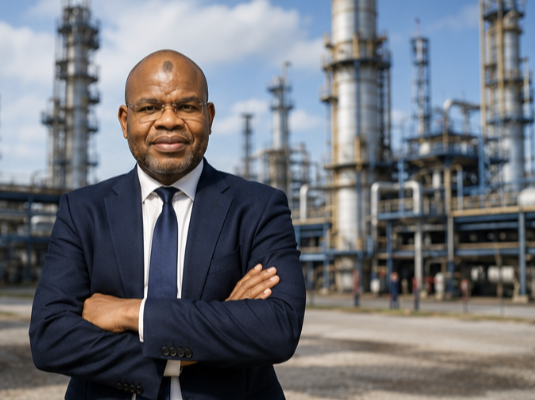
The promises of a radical Refoundation and economic sovereignty, once heralded after the July 26, 2023 coup in Niamey, now lie shattered under the weight of harsh realities. At the epicenter of this turmoil sits Hamadou Tini, the newly appointed Minister of Petroleum, whose actions have sparked accusations of blatant conflicts of interest. A former Mazars executive, he now wields state authority to reinstate his private consulting firm, Mazars, for a high-stakes audit of the State-Owned Refining Company of Zinder (SORAZ). This investigation reveals how public office became a tool for self-enrichment and patronage.
From revolutionary rhetoric to lobbyist triumph
The National Council for the Safeguard of the Homeland (CNSP), the military junta that seized power in Niger, vowed to dismantle corruption and restore economic independence. Their prime target was the mismanagement of oil resources, particularly the SORAZ. State television aired fiery speeches denouncing the previous democratic government and its alleged foreign accomplices, including Mazars—a consulting firm that had audited SORAZ for over a decade. Accused of bias, especially by Chinese partners at the China National Petroleum Corporation (CNPC), Mazars was publicly blacklisted. The new regime insisted on hiring an independent, international firm to conduct a thorough audit of SORAZ.
Yet behind closed doors, influence peddling turned the tide. Through relentless lobbying, one of Mazars’ top executives, Hamadou Tini, secured a pivotal position within the new administration. By January 2026, under the protection of General Mody, he was sworn in as Minister of Petroleum—a move that signaled Mazars’ triumphant return.
One man, four roles: the anatomy of a conflict of interest
Once in office, Minister Tini wasted no time in exploiting his dual position for personal and professional gain. He immediately revived the SORAZ audit, but with a critical twist: the assignment had to go to Mazars, his former employer. His justification? To “finalize pending work and ensure payment.” This arrangement created an unprecedented conflict of interest. Tini now occupied four simultaneous roles: he was the government official ordering the audit, the private consultant executing it, the recipient of the findings, and the sole signatory approving public funds for the project.
The implications were stark. How could an audit conducted by a firm led by a minister be considered impartial? The very notion of independent oversight vanished when the auditor and the audited shared the same leadership.
The rush for confidential documents
Tini’s ambitions didn’t stop at contract renewal. With the political transition still fragile, he issued a sweeping directive to SORAZ’s management. Through a ministerial order, he demanded the immediate and unrestricted handover of all financial, accounting, technical, and operational documents within eight days. These were the same confidential records that SORAZ’s leadership—and its Chinese partners—had previously refused to share, citing legitimate business confidentiality.
Local observers in Niamey whispered an old proverb: “He who peers through the keyhole already knows what’s on the table.” Tini’s intimate knowledge of SORAZ’s accounting weaknesses, gained during his time at Mazars, gave him a strategic advantage. He knew precisely where to dig for the dirt he sought.
The fallen ministers: casualties of the oil war
The abrupt takeover of SORAZ sheds light on the chronic instability plaguing Niger’s Ministry of Petroleum since the coup. Three ministers have cycled through the position in just three years—a revolving door seemingly tied to the secrets of the Zinder refinery.
Before Tini’s appointment, Minister Mahaman Moustapha Barké announced a sweeping audit of SORAZ in June 2024. By January 13, 2025, he was arrested and secretly detained by the Directorate General of Documentation and External Security (DGDSE). Held incommunicado for nearly a year, he was released only on January 6, 2026. His successor, Dr. Sahabi Oumarou, appointed urgently in early 2025, also attempted to restart the audit in February before being swiftly removed from office.
Sector insiders now allege that Hamadou Tini played a direct role in the downfall of both predecessors. While still a Mazars consultant, he allegedly drafted damning memos and reports aimed at discrediting their management of SORAZ before the junta. The strategy was twofold: eliminate obstacles to Mazars’ return and position himself as the ideal candidate for the ministerial post.
The Refoundation myth: oil wealth feeding a new elite
The SORAZ scandal exposes the glaring contradictions of the Niamey regime. While Nigeriens endure the harsh economic fallout of diplomatic isolation and await the promised dividends of oil wealth, the country’s black gold appears to be fueling a different kind of economy—one driven by corporate interests and personal agendas.
What began as a civil society demand for transparency in oil management has devolved into a clan-driven power struggle. The audit, once a symbol of accountability, has been weaponized—both as a shield to obscure conflicts of interest and as a cash cow for Mazars. For a Refoundation touted as a break from the past, the verdict is clear: Niger’s oil sector hasn’t changed its methods. It has merely changed beneficiaries.