Bénin: romuald wadagni takes office with 94% of votes amid opposition absence
Romuald Wadagni was sworn in on Sunday, May 24, in Cotonou for a seven-year presidential term. The former Finance Minister, a close associate of Patrice Talon, has pledged economic continuity, extended an olive branch to Sahelian nations, and steps into a political arena where the opposition was largely sidelined.

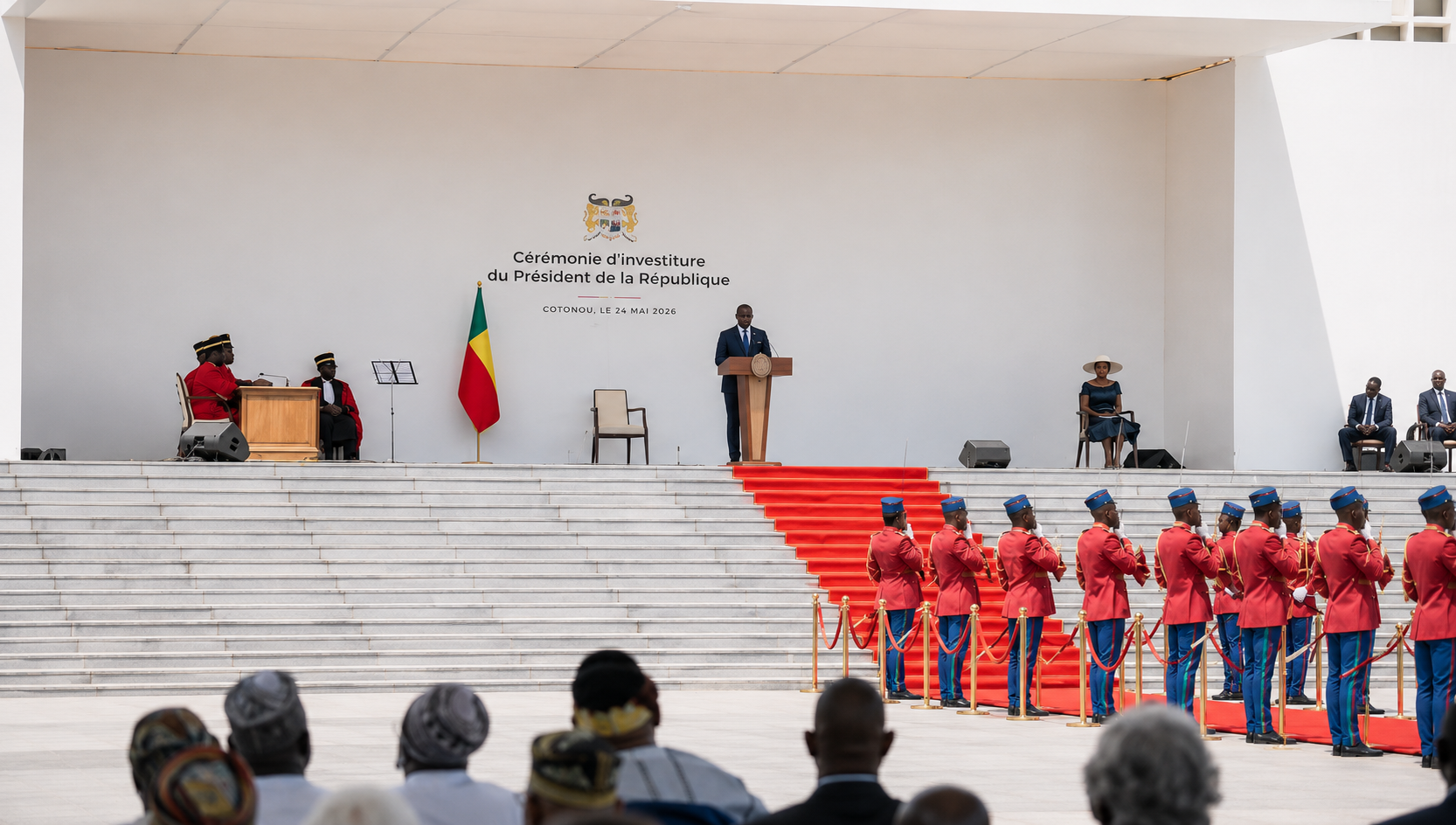
On Sunday, May 24, 2026, Romuald Wadagni officially took his oath of office at the Palais des Congrès in Cotonou. At 49 years old, the former Minister of Economy and Finance assumes the role of Bénin’s fifth head of state since the nation’s democratic resurgence in 1990. He succeeds Patrice Talon, who held power since 2016 and was constitutionally barred from seeking a third mandate. This transition, marked by a presidential election where the leading opposition party was prevented from participating, prompts a closer look at the political dynamics within West Africa.
an economic heir to the talon era
Romuald Wadagni’s background perfectly aligns with the narrative his predecessor, Patrice Talon, aimed to establish. A technocrat born in Lokossa, Wadagni spent seventeen years at Deloitte before joining the government in April 2016. During his tenure, he spearheaded Bénin’s financial strategy, overseeing multiple successful fundraising initiatives on international markets and ensuring the country’s sovereign rating remained stable.
His election on April 12, 2026, was secured in the first round, with only one contender, Paul Hounkpè, representing the Forces Cauris pour un Bénin Émergent (FCBE). According to figures validated by the Constitutional Court, Wadagni garnered over 94% of the votes. Mariam Chabi Talata served as his vice-presidential running mate, a pairing mandated by the 2019 constitutional revision.
Notably, this first presidential term will span seven years instead of the previous five, following a constitutional revision enacted in 2025. This change significantly alters Bénin’s electoral calendar, with presidential elections now decoupled from legislative ones.
a meticulously organized ceremony amidst a restricted political landscape
The inauguration protocol, executed precisely between 9:30 AM and 12:00 PM, was meticulously planned. Patrice Talon formally transferred the presidential attributes to his successor after a brief private meeting at the Palais de la Marina. At 11:10 AM, the Constitutional Court commenced the solemn oath-taking ceremony, followed by the presentation of the Grand Collar of the National Order and the command flag to the Chief of Staff. Over 6,000 guests were in attendance.
Several former Béninese heads of state, including Nicéphore Soglo and Thomas Boni Yayi, were present and received personal greetings from the new president. Observers on the ground noted the seamless organization of the event. However, the ceremony unfolded within a significantly constrained political environment, where the primary opposition party was unable to participate in the election.
an election devoid of genuine opposition
The Les Démocrates party, founded by former President Thomas Boni Yayi, saw its candidacy invalidated in October 2025. The Autonomous National Electoral Commission rejected the Renaud Agbodjo-Judes Lodjou ticket due to a lack of parliamentary sponsorships, having secured only 27 of the required 28 signatures after one deputy retracted their initial endorsement. The Constitutional Court upheld this invalidation on October 27.
This incident extends a pattern of political tightening that has drawn criticism for several years. Reckya Madougou, sentenced to twenty years for “terrorism” in 2021, and academic Joël Aïvo, condemned to ten years for “conspiracy,” remain imprisoned. Numerous opposition figures have sought exile. The Court for the Repression of Economic Crimes and Terrorism (CRIET), established in 2016, is frequently criticized by NGOs for its alleged use against political opponents.
The restrictive nature of the political system is further reinforced by stringent electoral access rules. High registration fees, government-controlled conformity certificates, and a 20% threshold per constituency introduced in 2025 to retain seats have all acted as filters, diminishing the parliamentary representation of the opposition. In the legislative elections of January 2026, Les Démocrates failed to secure any seats.
a discourse of regional security and openness
Romuald Wadagni’s inaugural address articulated two core priorities. Domestically, he pledged to translate economic growth into tangible benefits for every Béninese family, with a particular focus on youth, women, rural populations, and the middle class. On the security front, he affirmed the state’s resolute stance against armed groups that have impacted the northern regions since 2022.
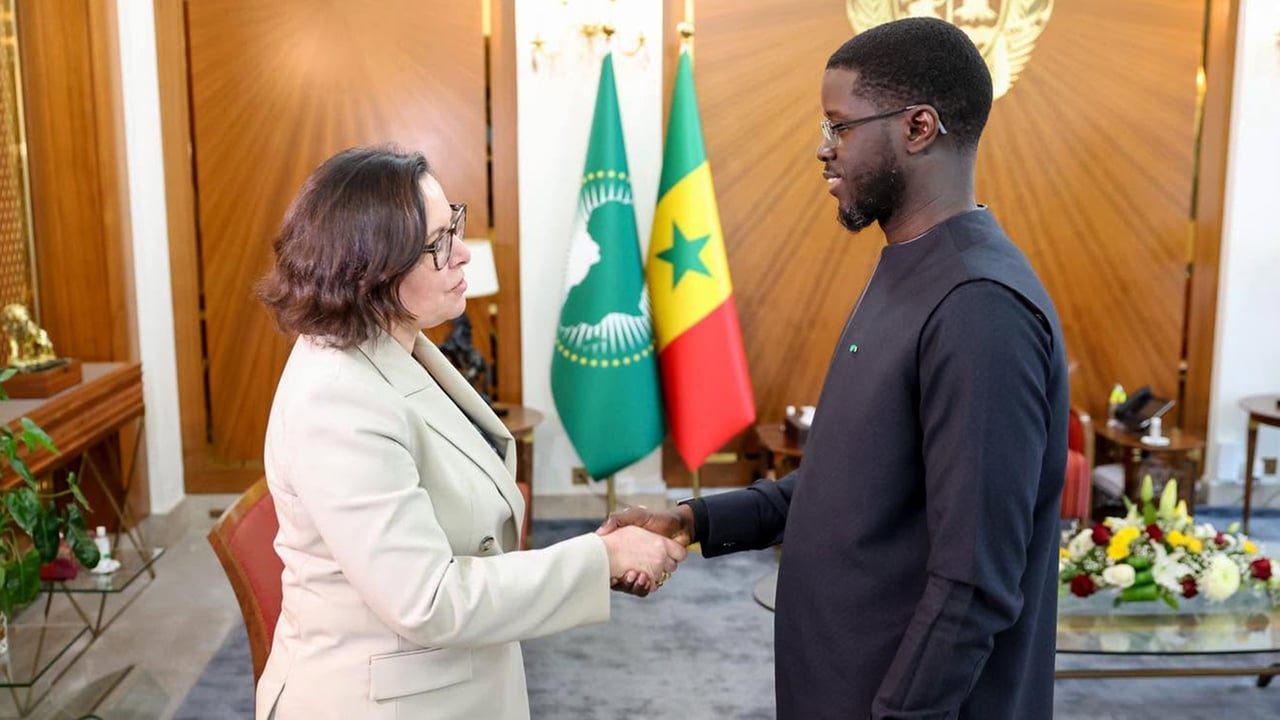
The most significant shift was his diplomatic overture to Bénin’s Sahelian neighbors. Sixteen foreign delegations attended the Palais des Congrès, adhering to Béninese protocol which traditionally excludes foreign heads of state from inauguration ceremonies. France was represented by Éléonore Caroit, Minister Delegate for Francophonie, International Partnerships, and French Nationals Abroad – a modest level of representation for an event with significant regional implications. Notably, Mali’s Foreign Minister Abdoulaye Diop, his Burkinabè counterpart Karamoko Jean-Marie Traoré, and Niger’s Prime Minister Ali Mahaman Lamine Zeine were present, representing the Alliance of Sahel States (AES). Nigeria’s Vice-President also attended as President Bola Tinubu’s special envoy. When Niger’s Prime Minister was announced, the crowd responded with sustained applause – a clear signal that contrasts sharply with the diplomatic chill that has persisted since the July 2023 coup in Niamey.
This gesture carries considerable diplomatic weight. Cotonou and Niamey have experienced strained relations since the coup, leading to several closures of their shared border, a crucial transit point for Nigerien hydrocarbons via the pipeline to Bénin’s port. Wadagni’s conciliatory tone marks a departure from Bénin’s previously firm stance towards the military regimes in the Sahel.
Stylistically, the speech was structured around a recurring address – “to you, I want to say” – directed successively at young people, women, rural communities, the middle class, the diaspora, and descendants of the African slave trade, to whom Wadagni reiterated that Bénin remains “the home of return.” The segment dedicated to women held a prominent position, reflecting the significant role of Vice-President Mariam Chabi Talata, who holds the second highest office in the state. Following the ceremony, the new president took time to greet his teams.
what to monitor in the coming weeks
Several key indicators will reveal the new president’s scope for action in the immediate future. The composition of his government, expected in the coming days, will indicate whether Wadagni intends to broaden his team beyond Patrice Talon’s inner circle. The fate of imprisoned opposition figures will be closely observed; a potential amnesty law, already called for by Les Démocrates, would send a powerful political message. Finally, the practical realization of his overtures to the AES will depend on concrete diplomatic actions, starting perhaps with official visits to Niamey, Bamako, or Ouagadougou.
Bénin now embarks on a seven-year term within an institutional framework largely reshaped by the outgoing administration. The underlying question posed by this investiture is less about stability and more about pluralism: a robust economic system, praised by international donors, yet a political landscape that leaves little room for dissent.