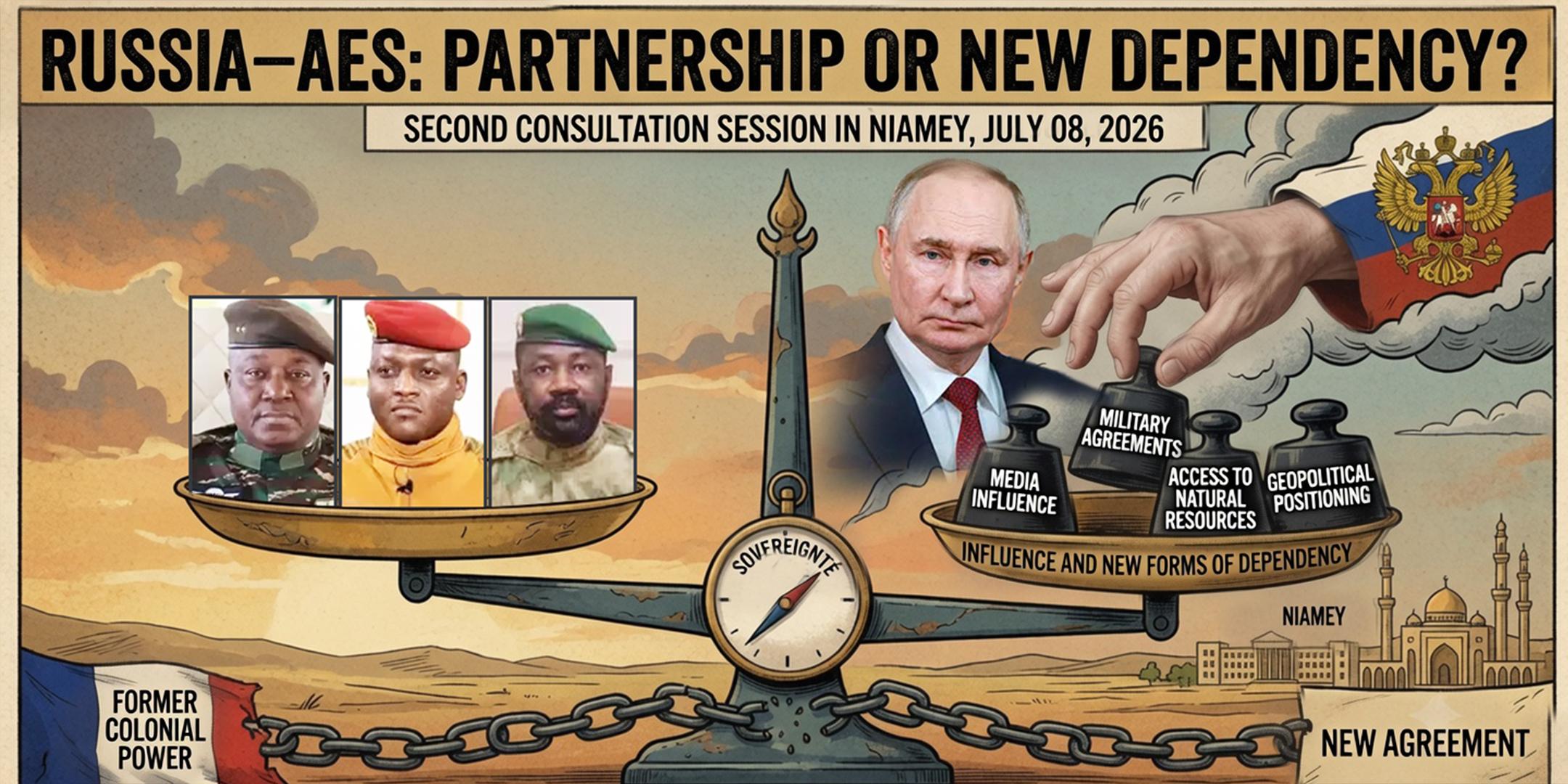
Strategic Collaboration or Emerging Dependency?
On July 8, 2026, Niamey hosted the second round of high-level consultations between the foreign ministers of the Alliance of Sahel States (AES) and their Russian counterpart, Sergei Lavrov. While authorities framed the meeting as a milestone in fostering a partnership rooted in sovereignty and mutual respect, a critical question lingers: does this alliance risk creating a new form of dependence—this time on Moscow?
The AES leadership has long criticized the historical influence of former colonial powers, particularly France, in the name of national sovereignty. However, substituting one foreign power for another does not inherently guarantee greater independence. Historical precedents demonstrate that state relations are frequently shaped by geopolitical, economic, and strategic interests.
Russia’s footprint in the Sahel has steadily expanded in recent years. Military cooperation, diplomatic agreements, economic exchanges, and cultural influence—these areas of collaboration are multiplying. For AES governments, diversifying partnerships is framed as a sovereign choice. Critics, however, raise a pressing concern: at what point does this influence become excessive, potentially leading to a new dependency?
Major powers rarely invest in a region without expecting returns. Whether through access to natural resources, diplomatic leverage, or strategic positioning on the African continent, every partnership serves national objectives. Russia is no exception to this rule.
Geopolitical Implications and Diplomatic Constraints
The deepening ties between the Sahel and Moscow also raise political concerns. A close alignment with a single power may restrict a country’s diplomatic maneuverability, narrow its ability to diversify alliances, and expose it further to global geopolitical tensions. In an era defined by great-power rivalry, the Sahel risks becoming a battleground for competing interests rather than an autonomous actor.
Sovereignty extends beyond the mere selection of a new ally. It hinges on a state’s capacity to maintain decisional independence, preserve balanced partnerships, and defend its interests without falling into a pattern of systematic alignment.
The AES leadership emphasizes a “mutually beneficial” partnership. Yet this claim must be measured against tangible outcomes: sustained security improvements, economic development, job creation, skill transfers, and institutional strengthening. Without concrete progress in these areas, rhetoric on sovereignty may ring hollow, viewed more as political posturing than a lived reality for local populations.
Beyond Partnership: The Path to True Independence
Only time will reveal whether cooperation with Russia will enable AES countries to bolster their autonomy or merely shift from one sphere of influence to another. Many observers argue that genuine independence does not mean changing dominant partners but rather cultivating a diplomacy capable of engaging with all without becoming beholden to any single entity.