When the Constitution becomes a shield rather than a tool
In the heart of West Africa, two capitals—Dakar and Lomé—are charting contrasting courses in how they interpret and uphold constitutional law. Recent decisions by their highest judicial bodies have laid bare two fundamentally different approaches to the rule of law: one that treats the Constitution as an unassailable pillar, and another that appears to bend to the will of political majorities.
Dakar: A judiciary that dares to say no
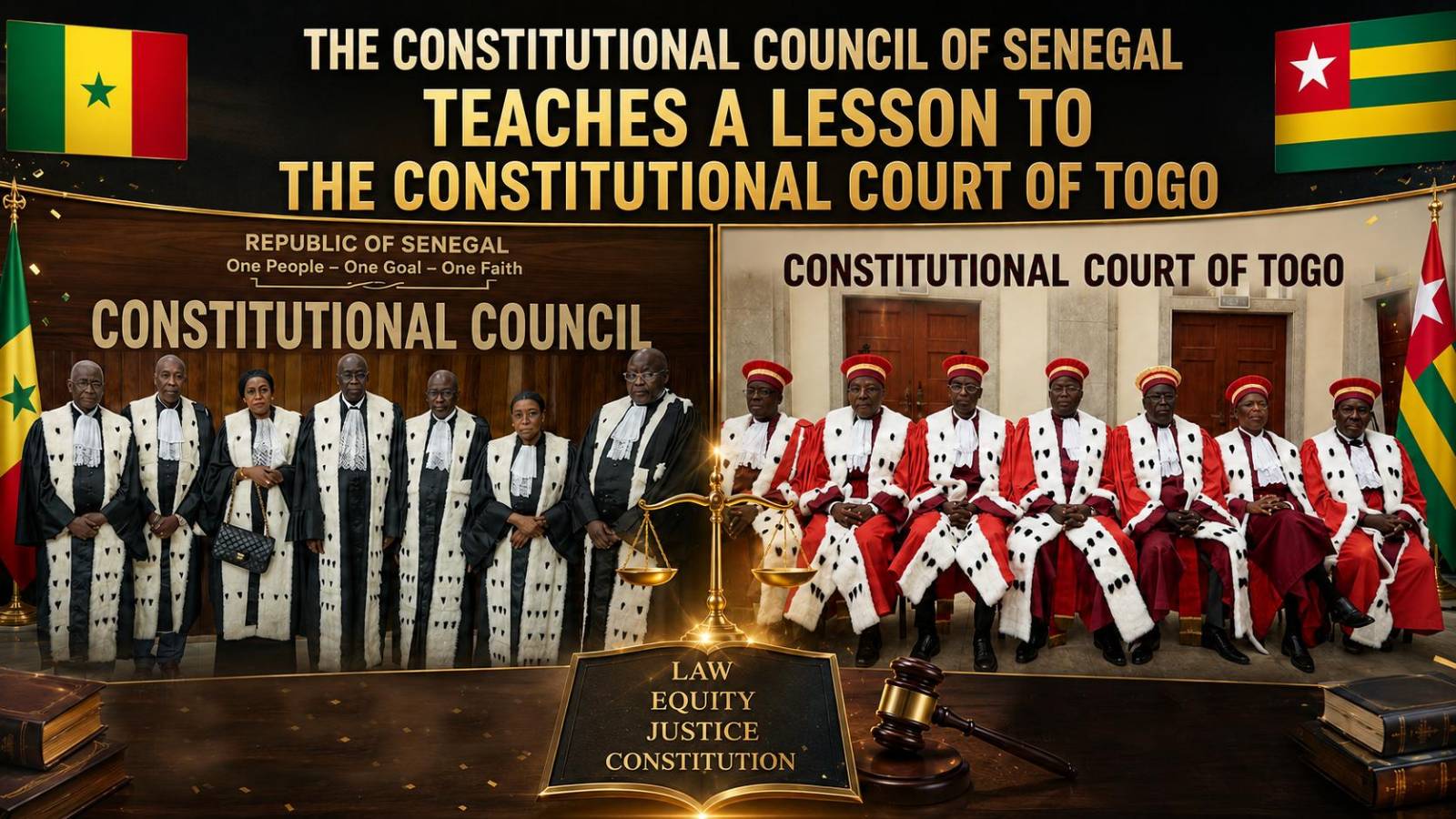
The Senegalese Constitutional Council has once again demonstrated that no political mandate, no matter how sweeping, can override the supreme law of the land. In a bold move, the Council struck down a constitutional reform proposal backed by the government of Prime Minister Ousmane Sonko and the parliamentary majority. The decision sent a clear message: electoral victories do not grant carte blanche to rewrite the rules of governance at will. In a functioning democracy, the legitimacy of power is bounded by constitutional limits.
The Council’s ruling underscores a critical principle: the strength of a democracy is not measured by the frequency of its constitutional amendments, but by the willingness of its institutions to enforce the Constitution impartially—even when doing so clashes with the agenda of the ruling elite. This commitment to judicial independence is not merely symbolic; it is the bedrock of stability, both domestically and in the eyes of international investors and partners.
Lomé: A court in step with the executive
Across the border, Togo’s Constitutional Court has taken a markedly different stance. Despite widespread opposition, legal challenges, and concerns from civil society, the Court validated a sweeping constitutional overhaul that reshapes the country’s institutional framework. Critics argue that the reform was rushed, lacks broad national consensus, and appears to serve immediate political objectives rather than the long-term stability of the nation.
For many observers, the Court’s decision reinforces perceptions that it functions less as an independent arbiter and more as an extension of executive power. This perception is not without consequence. When citizens lose faith in domestic legal recourse, they often turn to regional bodies—such as the ECOWAS Court of Justice—where disputes over rights and freedoms are increasingly settled. Such reliance on external jurisdictions is rarely a sign of a robust legal system; rather, it signals a deficit of trust in national institutions.
The high stakes of constitutional integrity
The divergent paths taken by Senegal and Togo highlight a fundamental truth: the resilience of a democracy hinges not on the text of its Constitution, but on the independence and courage of the institutions tasked with upholding it. A Constitution is more than a document; it is the social contract that binds a nation. When it is perceived as a tool for political maneuvering rather than a sacred pact, its legitimacy erodes—and with it, the stability of the entire system.
In Senegal, the Constitutional Council’s refusal to rubber-stamp a contentious reform has bolstered public confidence. The message is unambiguous: the rules apply to everyone, regardless of political affiliation. This predictability fosters trust among citizens, reassures investors, and enhances the country’s international standing. It also serves as a deterrent against institutional crises, as the judiciary acts as a neutral referee in political disputes.
In Togo, the pattern is less reassuring. Multiple constitutional revisions—often validated by the domestic court—have led to recurring controversies and a growing reliance on regional adjudication. Each time a reform is perceived as serving short-term political interests, it sets a precedent that future governments may exploit to further consolidate power. Over time, this can erode the very institutions meant to protect democracy, leaving citizens with fewer avenues to challenge abuses.
Democracy beyond borders: The limits of foreign models
In its quest to transition toward a parliamentary system, Togo has looked abroad for inspiration, studying governance models in countries like India. While comparative analysis can offer valuable insights, it cannot replace the hard lessons learned across Africa itself. Many nations on the continent have grappled with similar challenges—balancing reform with constitutional integrity—and their experiences reveal a common thread: lasting democratic progress is built not on imported blueprints, but on the rigorous application of constitutional principles.
Senegal’s experience stands as a testament to this reality. Its Constitutional Council has earned credibility not through rhetoric, but through action—by enforcing the Constitution even when it defies the wishes of the government. This consistency is what distinguishes a resilient democracy from one where institutions are merely decorative.
The contrast between Dakar and Lomé is not merely legal; it is profound. One nation treats its Constitution as a limit on power, while the other risks reducing it to an instrument of convenience. The choice between these two paths will shape not only the trajectory of each country, but also their standing in the eyes of the world.