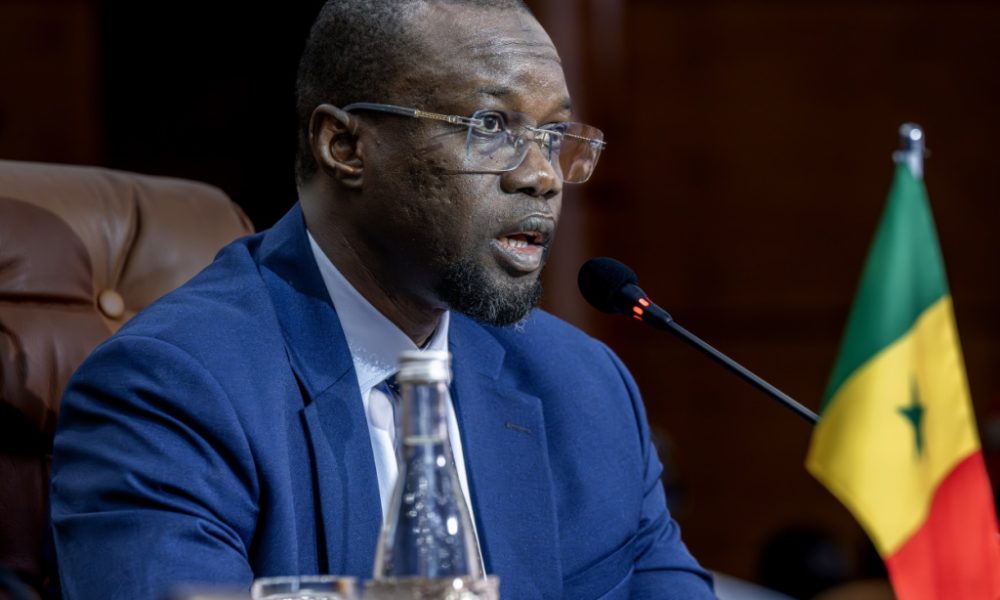
In a decisive move Friday evening, Senegalese President Bassirou Diomaye Faye announced the dismissal of Prime Minister Ousmane Sonko, his former political ally and key figure in the 2024 electoral victory that marked a turning point for the nation.
The announcement was delivered via a televised statement by the presidential secretary general, Oumar Samba Ba, who declared that the president had “terminated the functions of Mr. Ousmane Sonko as Prime Minister, and consequently those of the ministers and state secretaries of the outgoing government.” The former officials have been instructed to handle only routine administrative matters pending further decisions.
While the president did not specify a timeline for appointing a successor, tensions between the two leaders had been escalating for months. The decision comes as a surprise to many observers, given the critical role Sonko played in mobilizing public support for the “Diomaye Moy Sonko” campaign slogan that propelled Faye to victory.
a fractured partnership
Sonko, once a vocal opponent of former President Macky Sall, was barred from running in the 2024 election due to a defamation conviction that stripped him of civil rights. Instead, he endorsed Faye, who had been imprisoned alongside him under an amnesty law aimed at easing political tensions. Together, they capitalized on widespread youth disillusionment and led a historic campaign against Sall’s controversial bid for a third term.
Their partnership, however, began showing cracks soon after taking office. Recent months saw public criticism from the president regarding Sonko’s “excessive personalization” of power within the ruling party. In a televised interview, Faye stated firmly: “As long as he remains Prime Minister, it is because he enjoys my confidence. When that is no longer the case, there will be a new Prime Minister.”
Sonko’s party, PASTEF, dominates Senegal’s National Assembly after securing a landslide victory in the November 2024 legislative elections. His influence has only grown, with parliament recently approving electoral reforms allowing his candidacy in the 2029 presidential race—a move critics argue was tailored to benefit him. The opposition has condemned this legislation as partisan.
Despite a 2025 Supreme Court ruling upholding his ineligibility due to the prior conviction, Sonko was elected as a deputy in the 2024 elections before waiving his mandate to remain Prime Minister. His party maintains this position renders him eligible for future office. Local elections are scheduled for 2027, followed by the presidential contest in 2029.
public reaction and political fallout
Sonko responded to his dismissal on social media, expressing relief and gratitude: “Alhamdoulillah. Tonight, I will sleep with a light heart in Keur Gorgui,” referencing his residence in Dakar. His supporters quickly gathered outside his home, celebrating the news with chants and cheers.
Earlier in the day, Sonko had delivered a fiery speech in parliament, denouncing “Western tyranny” for allegedly imposing “homosexuality on the rest of the world,” days after Senegal adopted stricter penalties for same-sex relations—a predominantly Muslim nation where such laws are widely supported.
The political rift between Faye and Sonko underscores broader challenges facing the new administration. Inheriting a severe economic crisis, Senegal’s debt stands at 132% of GDP, making it the second most indebted country in sub-Saharan Africa according to the International Monetary Fund (IMF). In 2024, the government accused the previous administration of concealing the true state of public finances, leading to the suspension of a $1.8 billion IMF aid program.
The dismissal of Sonko marks a pivotal moment in Senegal’s political landscape, raising questions about the future direction of the government and the stability of its ruling coalition. Observers will closely monitor developments as the nation prepares for upcoming electoral milestones.