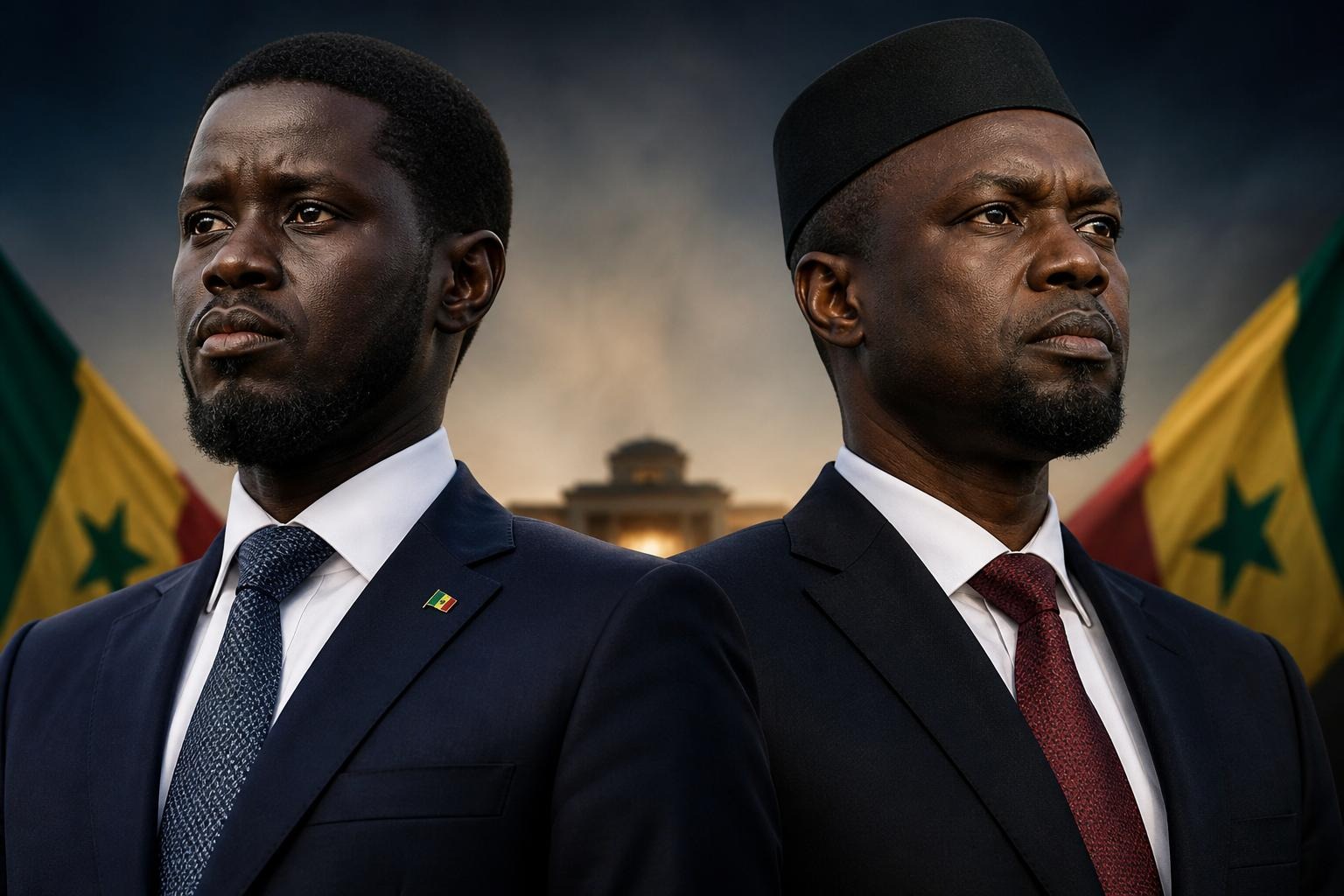
The Senegalese experience between 2024 and 2026 offers a stark reminder of how political instability can devastate even the most robust economies. With Ousmane Sonko’s appointment as Prime Minister, the country faced unparalleled institutional unpredictability that sent shockwaves through its financial systems, employment markets, and international credibility.
From golden child to cautionary tale
Once hailed as Africa’s second-largest destination for foreign direct investment (FDI) in 2023, Senegal plummeted to 46th place by 2025. While the country’s economic fundamentals remained strong—with 7.9% growth and a 24.9 billion USD FDI stock—the governance crisis erased years of investor confidence. The 98.9% collapse in FDI inflows to just 37 million USD in 2025 wasn’t about economic weakness but about institutional fragility.
Investors punished governance, not the economy
Several critical factors triggered this investor exodus:
- Power duality: The split between presidential and prime ministerial authority created administrative chaos
- Contract renegotiations: Aggressive moves to revisit oil deals spooked international partners
- Hidden debt revelations: Previously undisclosed obligations pushed public debt to 119% of GDP
- FMI program rejection: The absence of an IMF framework heightened uncertainty
Credit rating agencies responded swiftly, with Moody’s downgrading Senegal four times in twelve months and S&P slashing its rating to CCC+. The resulting surge in risk premiums triggered massive sell-offs of Senegalese eurobonds.
A jobs bloodbath in the making
The investment freeze had immediate consequences for employment. Greenfield projects—crucial for industrial expansion and service sector growth—declined by 37% in 2024 alone. The construction sector, traditionally a major employer, ground to a halt as public and private projects were suspended. This ripple effect devastated entire supply chains: materials suppliers, transport companies, small contractors, and local businesses all suffered from the paralysis.
The paradox was striking: while macroeconomic indicators showed robust growth, the labor market contracted sharply. The disconnect between economic headlines and employment reality created unprecedented social vulnerability.
Local businesses: first casualties of the crisis
Senegalese private enterprises bore the brunt of the governance meltdown. Payment delays became rampant, credit lines vanished, and operational uncertainty paralyzed decision-making. The GAC Cabinet’s analysis reveals the stark truth: “Senegal won the battle of numbers while losing the narrative war.” In today’s financial markets, public discourse isn’t just communication—it’s a financial asset whose consistency directly impacts risk premiums.
The country’s Narrative Risk Index (NRI) reveals the depth of the damage: risk narratives now outnumber opportunity narratives by a factor of 5.1. This imbalance has made banks, investors, and international partners hyper-cautious, transforming a governance crisis into a systemic confidence crisis.
Diplomatic missteps amplify economic risks
Foreign policy declarations added fuel to the fire. Characterizing the Iran-US conflict as “a war provoked by the United States and its Israeli ally” projected an image of confrontation in an already polarized international environment. In today’s hypersensitive financial markets, every public statement from Dakar becomes a signal in London, New York, or Washington. Words that might seem political in nature are read as economic risk factors.
The lesson is clear: in the interconnected world of global finance, diplomatic coherence is no longer optional—it’s a prerequisite for economic stability.
An academic case study in crisis management
This Senegalese episode now serves as a textbook example in geopolitics, public governance, strategic communication, and country risk management programs worldwide. It demonstrates that sovereignty isn’t declared—it’s built through rigor, coherence, discipline, and masterful international narrative management. More importantly, it shows how fragmented or conflicting public discourse can become a financial risk factor capable of eroding a nation’s credibility beyond what its economic fundamentals suggest.
Donors return: proof that the narrative is shifting
The tide began turning less than three months after the former prime minister’s departure. International lenders returned with substantial commitments:
- The World Bank approved 140 million USD for road connectivity projects in northern and central agricultural zones
- The African Development Bank validated a 35 million USD package to strengthen public finances
These aren’t technical gestures but tangible proof that Senegal’s international narrative is changing. Lenders only commit when governance becomes predictable again, when public discourse ceases to be a risk factor, and when the state demonstrates its capacity to speak with a unified voice.
A universal lesson for emerging economies
Senegal’s experience offers critical insights for all emerging markets:
- Stability isn’t declared—it’s demonstrated through consistent governance and predictable policies
- Confidence isn’t claimed—it’s earned through transparent communication and reliable institutions
- Attractiveness isn’t maintained by slogans but by daily discipline in economic management
While Senegal can recover from the 2025 rupture, this restoration requires governance that understands that narrative is now a financial asset. When governance regains coherence, attractiveness returns—every time.