The military regimes in Mali, Burkina Faso, and Niger have, over the past three years, fundamentally altered their foreign policies by rejecting established regional norms and severing ties with long-standing partners. While the establishment of the Alliance of Sahel States (AES) was intended to herald a bold new era of self-determination, the reality since the coups has unveiled a far more complex narrative.
Self-rule as a unifying cry
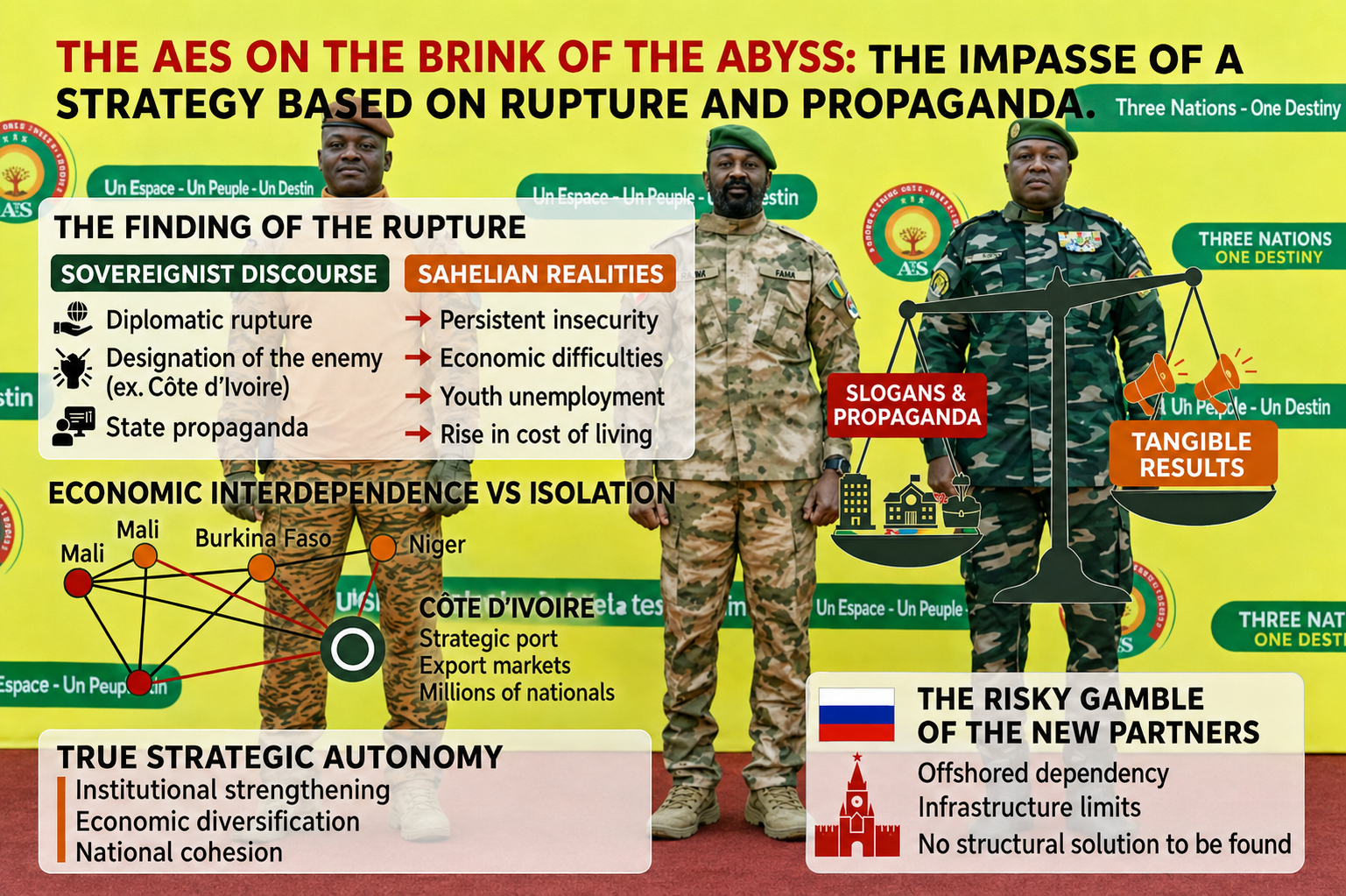
The AES’s emphasis on sovereignty has struck a chord across the Sahel. After years of perceived neglect by international allies and a growing perception that external cooperation had failed to deliver on promises, the promise of full control over national decision-making resonated with many. Yet sovereignty extends beyond fiery speeches or abrupt shifts in alliances; it demands tangible proof in the form of secure communities, economic vitality, job opportunities, functional public services, and improved living conditions.
Instead, the region continues to grapple with relentless insurgencies along its borders. Inflation continues to erode household purchasing power, youth unemployment remains alarmingly high, and critical infrastructure deficits persist despite lofty pledges. The widening chasm between rhetoric and reality is fostering growing public skepticism toward leadership.
The art of deflection: blaming others for domestic failures
When progress remains elusive, governments often resort to political messaging to deflect attention. For the AES, this has manifested as a persistent stream of criticism aimed at neighboring countries, with Côte d’Ivoire frequently portrayed as either an antagonist or a pawn of foreign powers.
While such tactics may temporarily galvanize domestic support by rallying citizens against a perceived common foe, the consequences are significant. First, they sidetrack focus from pressing daily challenges—soaring food prices, deteriorating education and healthcare systems, and the persistent threat of violence. Second, they risk deepening unnecessary diplomatic fissures in a region where economies and social networks remain deeply intertwined. Finally, they stifle open debate by equating dissent with disloyalty.
Côte d’Ivoire’s unyielding commitment to stability
In the face of escalating tensions, Côte d’Ivoire has maintained a steady diplomatic stance grounded in dialogue and regional cohesion. This approach is rooted in a long-standing tradition influenced by the principles of Félix Houphouët-Boigny, emphasizing mediation, economic collaboration, and consensus-building.
Despite provocative rhetoric from AES leaders, Abidjan has refrained from escalating tensions. This strategy reflects both diplomatic wisdom and pragmatic economic considerations. As a vital trade gateway, Côte d’Ivoire’s port serves as a lifeline for landlocked neighbors, facilitating the movement of goods that sustain Mali, Burkina Faso, and Niger. The daily exchange of people and commerce across borders fosters an interdependence that transcends political posturing.
Millions of citizens from Mali, Burkina Faso, and Niger reside, work, and invest in Côte d’Ivoire. A prolonged deterioration in relations would exact not only political penalties but also profound human and economic costs that extend far beyond transient headlines.
The unspoken toll of diplomatic hostility
The repercussions of strained relations are often overlooked. Heightened tensions can dampen investor confidence, disrupt supply chains, inflate operational costs, and diminish a country’s attractiveness to global businesses. In economies already weakened by insecurity and institutional fragility, diplomatic friction exacerbates existing vulnerabilities.
Uncertainty is the antithesis of growth. When governments prioritize geopolitical grandstanding over stability, private investment falters, employment stagnates, and long-term developmental initiatives stall. The outcome is a self-reinforcing cycle: weak governance fuels instability, which in turn fuels further instability.
Betting on new partnerships: a gamble with limits
Another pillar of the AES strategy has been the pursuit of new international alliances, notably forging stronger ties with Russia. While sovereign nations are entitled to explore diverse partnerships, these shifts do not automatically guarantee improved security or economic resilience.
Historical precedents demonstrate that no external ally can single-handedly resolve structural issues such as weak institutions, low productivity, rural poverty, or governance gaps across vast territories. The greater risk lies in swapping one dependency for another without addressing the root causes of underdevelopment.
Authentic strategic autonomy begins at home: cultivating robust institutions, professionalizing security forces, enhancing the business climate, diversifying economic activity, and investing in education and healthcare. These are the pillars upon which lasting stability and prosperity are built—not merely slogans or foreign alliances.
The gap between words and deeds
The AES leadership has heavily invested in a narrative of resistance, sovereignty, and national renewal. Such patriotic messaging holds value, but it cannot substitute for tangible achievements. Citizens evaluate leadership based on measurable outcomes: safer neighborhoods, stable prices, meaningful employment, functional schools and hospitals, modern infrastructure, and inclusive economic growth.
Over time, these benchmarks will carry far greater weight than polished speeches or coordinated media narratives. Public patience is finite. When rhetoric outpaces results, disillusionment sets in—and with it, the potential for further destabilization.
Collaboration over confrontation: a necessity for West Africa
The Sahel’s most urgent challenges—ranging from terrorism and transnational crime to climate-induced scarcity and food insecurity—do not acknowledge national boundaries. These issues demand collective solutions, whether within existing regional structures or through innovative frameworks of cooperation.
Treating partners like Côte d’Ivoire as perpetual adversaries undermines a region already straining under overlapping crises. It diverts attention from potential solutions and transforms allies into opponents. A Sahel unified by dialogue holds a far greater chance of stability than one fragmented by mistrust and rivalry.
Conclusion: bridging the chasm between promise and performance
The Alliance of Sahel States emerged from a collective rejection of the status quo—a sentiment echoed across the region. However, mere rejection does not constitute a viable policy framework. The true measure of the AES will not be the intensity of its denunciations of external actors but its capacity to deliver security, restore economic vitality, safeguard freedoms, and rebuild trust among its citizens and neighbors.
The future of the Sahel will be determined not by the search for scapegoats but by the resolve of its leaders to translate words into deeds. Sustainable progress will stem not from isolation or confrontation but from renewed cooperation, accountable governance, and an unwavering commitment to the well-being of all citizens.