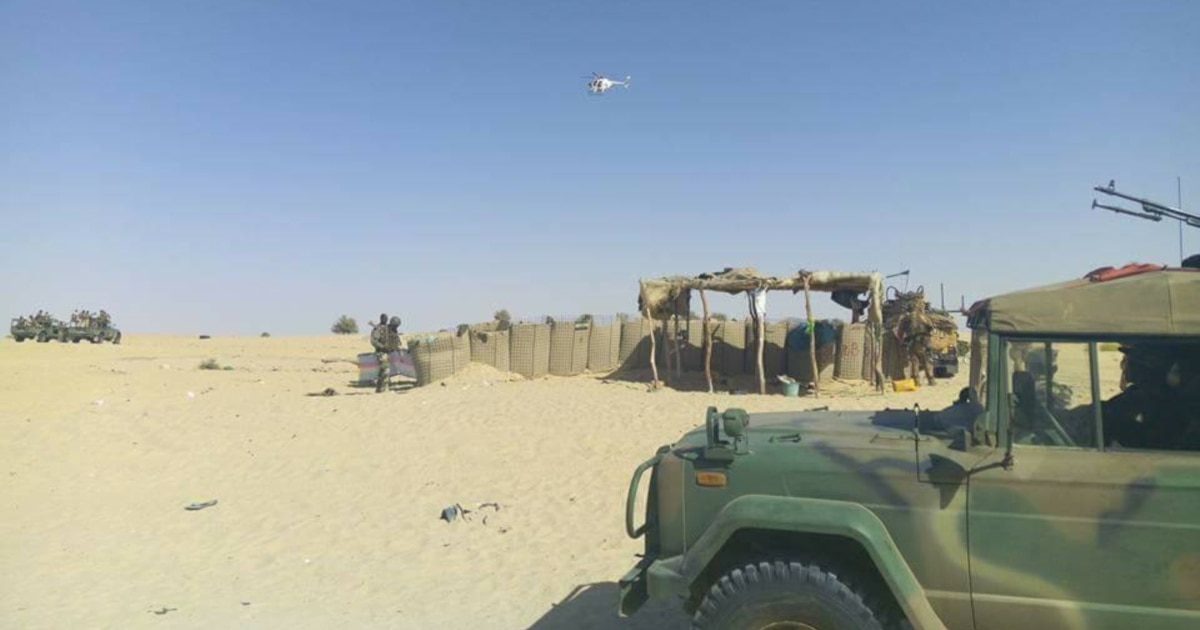

Forced disappearances, summary executions… The United Nations is increasingly alarmed by the rising number of human rights abuse allegations targeting soldiers from Mali, Burkina Faso, and Niger, who are engaged in anti-jihadist operations across the Sahel region.
“I urge the G5 Sahel Joint Force and its member states to spare no effort” in upholding human rights, stated Jean-Pierre Lacroix, the UN Under-Secretary-General for Peace Operations, during a Security Council videoconference focused on the Sahel on Friday.
This concern has been steadily mounting over several months, coinciding with ongoing denunciations of jihadist actions and inter-communal violence.
In early April, the UN mission in Mali (MINUSMA) condemned the “proliferation” of alleged misdeeds attributed to national armed forces.
Between January and March, the UN documented 101 extrajudicial executions carried out by the Malian army, along with approximately thirty more by the Nigerien army on Malian territory. Guillaume Ngefa, director of MINUSMA’s human rights division, confirmed that “these figures, names, and circumstances have been thoroughly documented.”
In Burkina Faso, twelve individuals arrested on suspicion of complicity with jihadists died in gendarmerie cells in mid-May. Relatives and NGOs assert that these were civilians subjected to summary executions. Judicial investigations have been pledged.
– “Very serious allegations” –
In Niger, a circulated list of disappeared persons from April indicates that 102 individuals were allegedly killed by the army in the western Tillabéri region. While the Ministry of Defense announced an investigation, it also praised the “professionalism” of its troops.
Consistently, human rights organizations publish lists of names and photographs, lamenting the disappearance of individuals following military operations. The majority of those who vanish are Peuls, frequently and erroneously associated with jihadist groups.
An anonymous official from the Malian Peul association Tabital Pulaaku expressed frustration, stating, “We produce reports, denounce that so many Peuls have been killed and thrown into wells, or show the world a mass grave, yet nothing is done afterward.”
Abou Sow, president of Tabital Pulaaku, told the press, “It is undeniable that some Peuls have embraced jihadism, but it is naive to reduce jihadism to a single ethnic group.”
Sahelian governments have consistently backed their armies, which, despite often being under-equipped and under-trained, bear a heavy cost in the ongoing fight against jihadism.
Addressing the Security Council on behalf of the G5 Sahel (Mauritania, Chad, Niger, Burkina Faso, and Mali), Mauritania’s Foreign Minister, Ismail Ould Cheikh Ahmed, declared that “achieving the full capability of the Joint Force implies its capacity to fully grasp the human rights dimension.”
Mauritania is “undertaking actions to ensure respect for the law,” he affirmed. Abdou Abarry, Niger’s ambassador and a non-permanent member of the Council, echoed this, stating, “We fully adhere to human rights,” even as countries like Belgium voiced concern over “very serious allegations.”
– “Collateral objective” –
In a statement released Friday after its meeting, the Security Council acknowledged “the measures announced by several Sahel governments in response to these allegations of human rights violations, and encourages their finalization.”
These accusations against national armies emerge at a pivotal moment for the Sahel.
Firstly, the UN faces skepticism from some Security Council members regarding the scale of its mission in Mali, which comprised 13,000 personnel by mid-June.
France, for its part, re-evaluated the terms of its engagement in the Sahel after the deaths of 13 French soldiers in November.
Despite the presence of French forces, MINUSMA (whose mandate is due for renewal), and the G5 Sahel Joint Force, established in 2017, the surge of violence that has claimed thousands of lives and displaced hundreds of thousands since 2012 has not been contained.
For Ibrahim Maïga of the Institute for Security Studies (ISS) in Bamako, “the protection of civilians is only a collateral objective” for military forces, whose “number one priority is to neutralize” jihadists.
In May, when questioned by AFP about the abuses attributed to national armies, General Pascal Facon, commander of the French anti-jihadist force, described them as “intolerable” and potentially “posing a problem in terms of the credibility of the forces.”
Related Posts
Populism in Burkina Faso: enthusiasm vs unmet expectations
Visuals from Captain Ibrahim Traoré’s visit to the Yaadga region reveal widespread public jubilation, with crowds greeting and farewelling the Head of State with fervor. […]
Lomé local authorities enhance financial resource management skills
LOMÉ, August 17, 2026 — For local communities to consistently meet the needs of their residents, they require not only adequate financial resources but also […]
Moody’s upgrades Benin’s sovereign rating to Ba3 with stable outlook
Benin’s financial standing has reached a new milestone. By upgrading the country’s long-term sovereign debt rating from B1 to Ba3, Moody’s has positioned Cotonou in […]