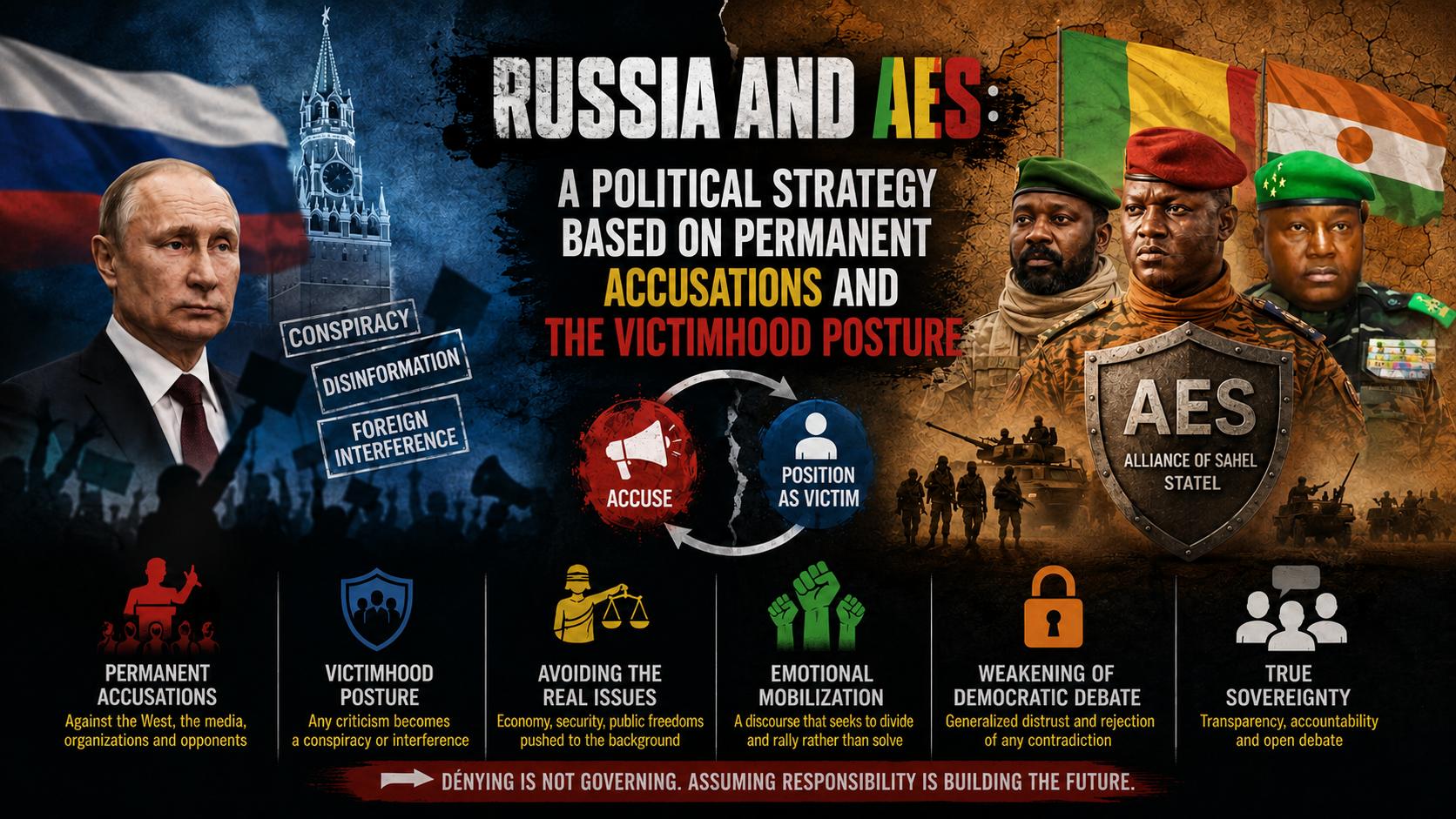
The governments of Niger and their counterparts in the Alliance of Sahel States (AES) have adopted a recurring narrative in their political discourse: that of perpetual victimhood, often paired with aggressive accusations against perceived adversaries. This approach has become a cornerstone of their communication strategies, targeting Western powers, international media, regional bodies, and domestic opponents alike. Yet when these very entities level criticisms of their own, a striking pattern emerges—they swiftly pivot from accusers to the accused, framing any challenge as part of a coordinated effort to undermine their sovereignty.
the mechanics of a defensive strategy
At the first sign of dissent or scrutiny regarding policy decisions, narratives of conspiracy, disinformation, or foreign interference dominate official statements. Rather than engaging with substantive concerns—such as economic hardship, persistent insecurity, or restrictions on civil liberties—leaders redirect attention toward an external enemy. The result is a political discourse that prioritizes emotional mobilization over constructive dialogue, ensuring that pressing societal issues remain unaddressed.
Within the AES, this tactic is particularly pronounced. Authorities routinely attribute internal challenges to sanctions imposed by former colonial powers or to the actions of foreign actors. However, when citizens, journalists, or human rights organizations raise concerns about governance failures or rights violations, such critiques are dismissed outright as part of a deliberate destabilization campaign orchestrated from abroad.
a parallel in Moscow’s international posture
The Russian Federation employs a similar rhetorical framework on the global stage. Whenever its foreign policy decisions, military interventions, or human rights records come under fire, the official response is framed in terms of relentless Western hostility. This not only deflects accountability but also reframes legitimate criticism as evidence of an orchestrated campaign to undermine the state.
The long-term implications of this strategy are significant. A credible system of governance demands the capacity to engage with opposing viewpoints, to provide reasoned responses to criticism, and to be held accountable by the citizenry. By consistently portraying criticism as a conspiracy, the leadership risks eroding democratic norms and fostering a climate of deep-seated distrust among the population.
the cost of evasion over accountability
Shifting blame is a convenient tactic, but it is not a sustainable foundation for governance. True sovereignty is not merely demonstrated through the denunciation of real or imagined enemies—it is built on transparency, responsibility, and the acceptance of open debate. When criticism is automatically dismissed as a plot, the opportunity for constructive reflection and policy improvement is lost. In any society, critical voices can serve as catalysts for progress, provided they are met with reasoned engagement rather than reflexive denial.
Rather than perpetually casting themselves as victims, the leaders of Niger and the AES must recognize that durable governance requires more than the repudiation of critics. It demands a willingness to confront uncomfortable truths, to address systemic weaknesses, and to restore public trust through tangible actions—not through the perpetuation of a narrative that prioritizes self-preservation over the needs of the people.