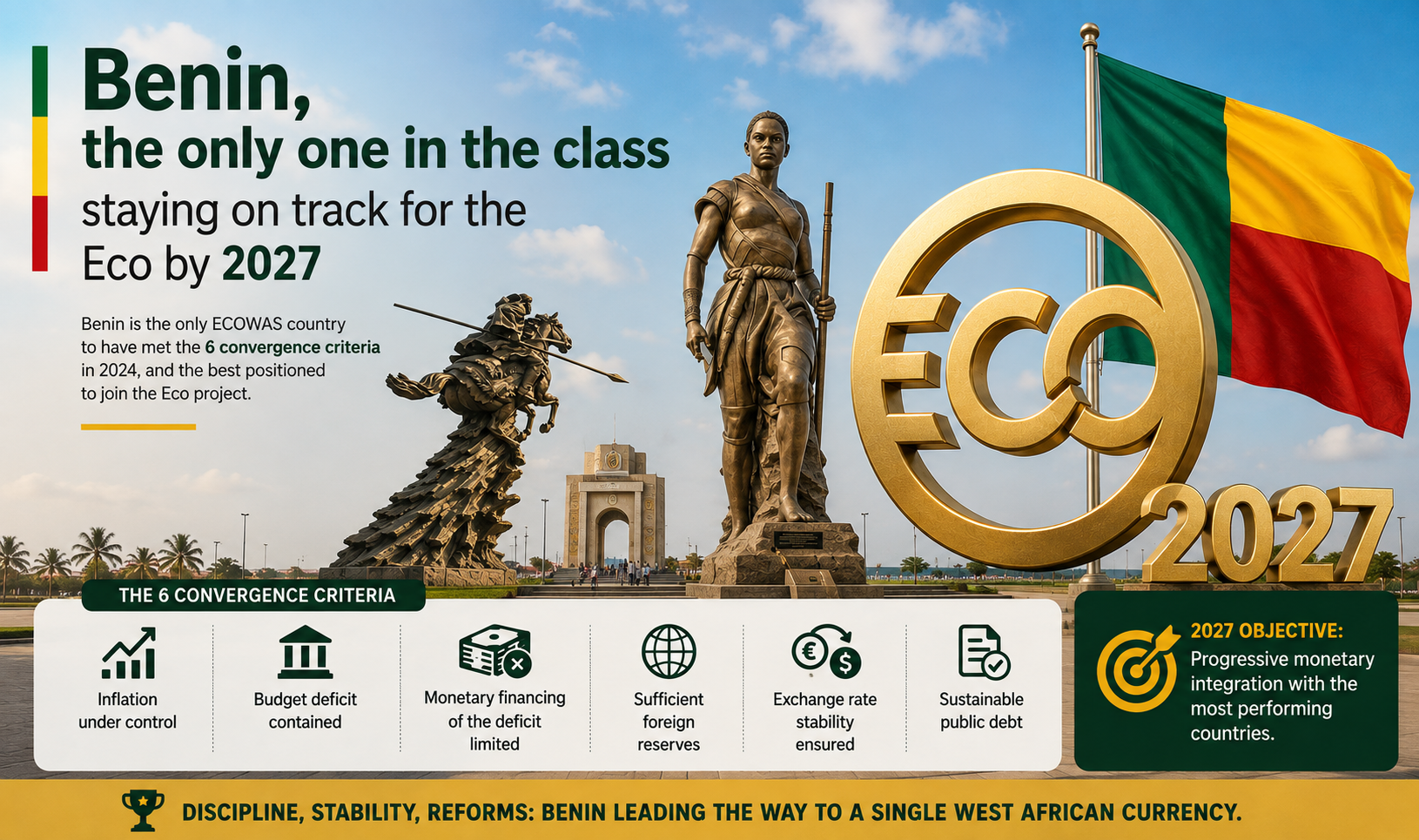
The West African Economic and Monetary Union (WAEMU) maintains its commitment to launching the Eco as a single currency by 2027. However, the economic realities across member states reveal significant disparities in preparedness. In this evolving landscape, Benin has emerged as a standout performer, positioning itself as a potential frontrunner in the initial phase of monetary integration.
Regional ambitions face economic realities
The concept of a unified West African currency has long been a cornerstone of the ECOWAS integration agenda. Yet, the ambitious political vision must contend with complex economic challenges, including inflationary pressures, fiscal deficits, debt levels, foreign reserves, exchange rate stability, and divergent national economic policies. The 2027 deadline may therefore necessitate a phased approach, allowing the most advanced economies to adopt the Eco first while others continue working toward convergence.
Benin’s exceptional compliance with convergence criteria
In 2024, Benin distinguished itself as the sole ECOWAS member state to meet all six macroeconomic convergence criteria established for the Eco project. This achievement is particularly noteworthy as these criteria are not merely numerical benchmarks but indicators of a nation’s economic resilience. They encompass inflation control, fiscal discipline, sustainable public financing, foreign reserve adequacy, exchange rate stability, and manageable debt levels.
The simultaneous fulfillment of these requirements reflects a coherent and disciplined economic policy framework. For Cotonou, this is not merely about achieving short-term targets but demonstrating a sustained ability to align with the stringent demands of a shared currency system.
Understanding the six convergence criteria
The convergence criteria serve as the technical foundation for the Eco, ensuring that participating economies adhere to a set of shared fiscal and monetary standards. The key indicators include:
Inflation control: Keeping price increases within acceptable limits to preserve purchasing power and monetary stability.
Fiscal deficit management: Ensuring budgetary shortfalls remain within agreed thresholds to avoid excessive borrowing.
Monetization discipline: Preventing excessive money creation to finance public spending, which could undermine currency value.
Foreign reserve adequacy: Maintaining sufficient reserves to cover several months of imports, safeguarding external trade.
Exchange rate stability: Ensuring nominal exchange rates remain steady to foster confidence in the new currency.
Debt sustainability: Keeping public debt at levels that do not compromise long-term economic stability.
These criteria are designed to foster a minimum level of economic discipline across member states, ensuring that no single country’s imbalances destabilize the collective monetary framework.
A deliberate path to macroeconomic stability
Benin’s success in meeting these criteria is the result of years of deliberate economic reforms. The government has prioritized revenue mobilization, improved public financial management, and maintained high levels of investment in critical infrastructure and public services. However, these efforts have required careful balancing acts particularly in sustaining fiscal discipline while funding social programs and developmental projects.
The true test for Cotonou lies in transforming this one-time achievement into a lasting trend. While compliance in a single year sends a positive signal, sustained adherence over multiple years would significantly bolster the country’s credibility in the Eco framework.
Progressive integration: a pragmatic solution
The heterogeneity of West African economies presents a significant hurdle. Member states vary widely in terms of economic structure, debt burdens, fiscal flexibility, and exposure to external shocks. Some nations grapple with high inflation, while others face severe fiscal constraints or security-related economic disruptions.
A staggered implementation of the Eco may prove more viable than a simultaneous transition across all countries. Rather than requiring every ECOWAS member to adopt the new currency at once, a phased approach would allow the most prepared economies to move forward first, setting a precedent for others to follow.
Benin’s strategic advantage in the Eco transition
Should the phased integration model take shape, Benin stands to benefit from its proven ability to meet convergence criteria. This early alignment could enhance the country’s influence in regional economic discussions, as monetary integration extends beyond currency exchange to encompass tighter coordination in fiscal, financial, and trade policies.
For Cotonou, early participation in the Eco could yield strategic advantages, including heightened economic attractiveness, enhanced financial credibility, and deeper integration into regional trade networks.
Uncertainties loom despite progress
The 2027 launch date remains uncertain, contingent on both economic performance and collective political decisions. Key considerations include the governance structure of the Eco, the role of regional institutions, monetary policy frameworks, and mechanisms for fiscal solidarity among member states.
The recent withdrawal of several Sahelian countries from ECOWAS further complicates the integration landscape. The original vision for the Eco must now adapt to a transformed regional institutional environment, where the dynamics of monetary cooperation differ significantly from those envisaged at the project’s inception.
Sustaining the momentum
Benin’s current advantage its compliance with convergence criteria must be actively maintained. The country’s priorities now include preserving macroeconomic stability, managing debt levels, controlling inflation, and continuing structural reforms while sustaining investments in public and infrastructure development.
As 2027 approaches, the challenge for Cotonou will not merely be leading the pack but remaining at the forefront when the Eco transitions from a political ambition to an economic reality. If the phased approach materializes, Benin could secure a favorable position one where it has already overcome the majority of the technical obstacles to West African monetary integration.