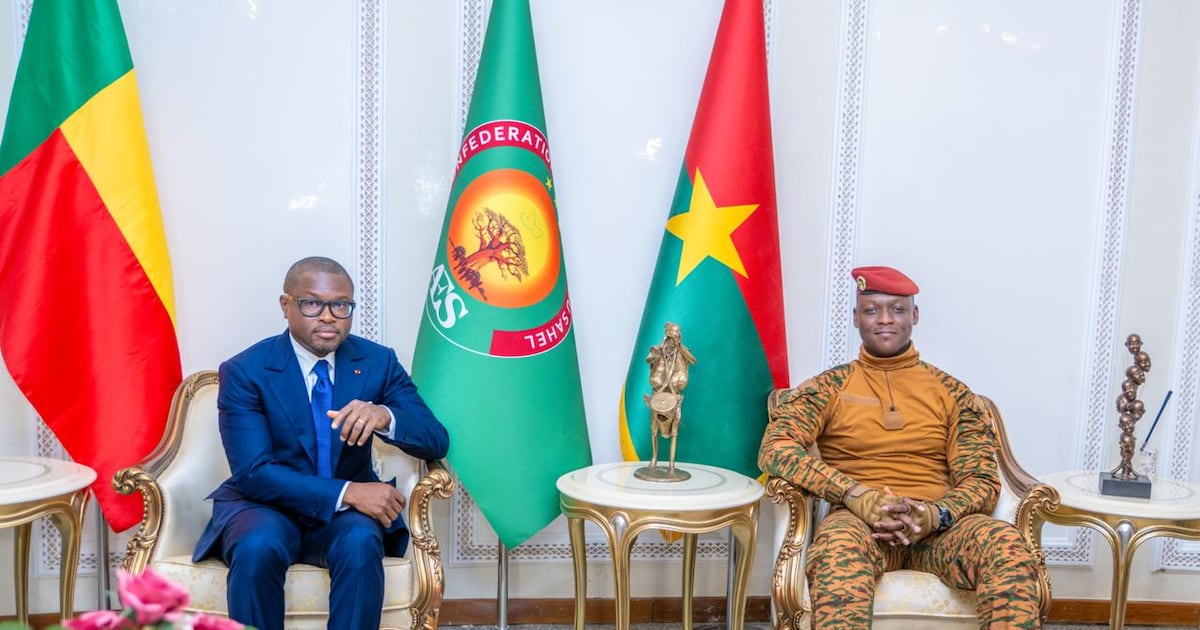
Romuald Wadagni’s brief but strategic visit to Burkina Faso this week has sent ripples across the West African bloc. Beyond the ceremonial formalities, the Bénin leader’s trip signals a renewed commitment to mend and strengthen the deep-rooted economic and security alliances that have historically bonded the two nations.
While the visit was short, its significance cannot be overstated. The leaders of both countries used the platform to reaffirm their shared vision for regional stability and economic revival. «We must move beyond rhetoric and take concrete steps to tackle the twin challenges of terrorism and cross-border crime that threaten our collective security.» These were the words exchanged during the high-level discussions, according to the official communiqué.
security cooperation takes center stage in west african diplomacy
The Burkina Faso–Bénin border has long been a flashpoint for insecurity, with militant groups exploiting porous frontiers. The two heads of state acknowledged the urgency of consolidating joint efforts to curb violent extremism and organized crime. Their pledge to deepen intelligence sharing and joint patrols marks a pivotal shift in how both nations view regional security cooperation.
«Trust is the foundation, but vigilance remains our compass. Diplomatic relations are built on interests, not sentiment. We must proceed with clarity and caution.» This sobering perspective was shared by Boukary Ouédraogo, a prominent civil society voice, reflecting the cautious optimism surrounding the visit.
economic corridor revival: a game-changer for the Sahel
The Bénin–Burkina Faso trade route is more than a road—it is the lifeline of the Sahel. Stretching over 1,000 kilometers from the port of Cotonou to Ouagadougou, this corridor facilitates the movement of fuel, food, and industrial inputs vital to Burkina Faso’s economy. Its reopening could unlock new trade flows not only between the two countries but across the Alliance of Sahel States and beyond.
Analysts see this as a strategic move that could reduce Burkina Faso’s reliance on distant supply chains and foster greater economic integration within West Africa. The revitalized corridor would serve as a critical artery for intra-regional commerce, supporting local industries and reducing logistical costs.
«This isn’t just about borders opening—it’s about minds opening. If we can restore trust and revive trade, we create a ripple effect of growth across the region.» These sentiments, echoed by citizens like Hamed Zizien, reflect a growing belief that pragmatic cooperation can outweigh historical grievances.
a cautious but hopeful path forward
Despite the positive signals, voices of caution persist. Ouédraogo warns that while the visit is a step in the right direction, long-term success depends on sustained political will. «Words must translate into actions. We need visible progress in security coordination and trade facilitation before we can speak of a true partnership.»
The Bénin–Burkina Faso rapprochement comes at a time when West Africa is reassessing its alliances in the face of shifting geopolitical realities. Whether this visit will lead to a lasting transformation remains to be seen, but one thing is clear: the corridor is open, and the region is watching.