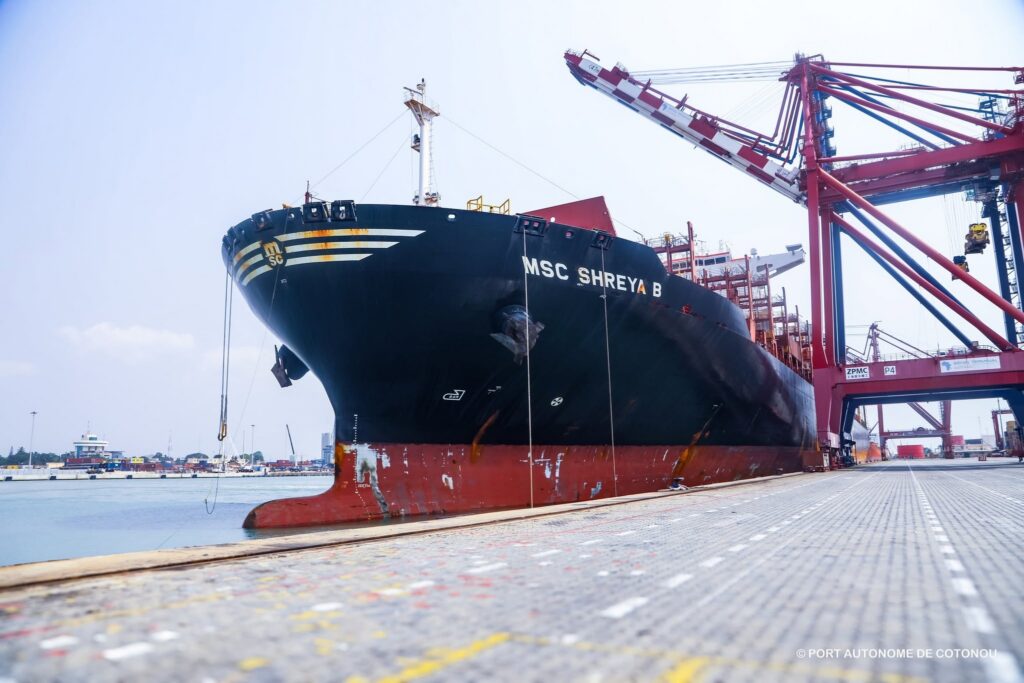
When freight moves faster between Cotonou and Niamey, the consequences show up far from the docks. Shopkeepers in landlocked markets restock sooner, hauliers spend fewer nights stuck at border posts, and the price of imported goods carried inland stops creeping upwards with every extra day spent on the road. That is the practical stake behind Benin’s push to lock in its role as West Africa’s freight gateway.
The country is upgrading both its road network and its customs machinery under a structuring investment plan supported by the European Union and Belgian development cooperation. The declared objective is to cement Cotonou’s standing as the indispensable transit route for neighbouring Niger and as a major interconnection hub for the wider sub-region.
Why Cotonou’s position carries so much economic weight
Sitting on the Gulf of Guinea, Benin enjoys a geography that reads like an economic advantage. The country serves as the natural maritime outlet for Niger, a landlocked nation whose supply security depends directly on access to neighbouring ports. It also borders Nigeria, whose sustained economic expansion keeps local logistics capacity permanently stretched.
Fully aware of this pivotal role, Cotonou is speeding up the modernisation of its infrastructure in order to remain, over the long term, the beating heart of sub-regional trade.
Two European-backed programmes, one €30 million wager on speed
This strategic ambition has reached a decisive milestone thanks to direct backing from international partners. The European Union and Enabel, the Belgian development agency, are rolling out a twin logistics programme — known as Cotoni and Proport — with combined financing of roughly €30 million.
Cotoni: 729 kilometres under close scrutiny
Launched last May and running for four years, the Cotoni programme — the support project for the development of the Cotonou-Niamey corridor — forms the keystone of the whole transformation. Its central mission is to modernise, secure and smooth traffic along the 729-kilometre road that links the autonomous port of Cotonou to Niger’s capital, the economic lung of the hinterland.
The four levers that make or break the project
To deliver lasting results, the initiative rests on four operational pillars:
- Stronger governance: keeping financial investments sustainable and funding regular maintenance of the road network.
- Corridor safety: protecting hauliers on their journeys while clearing out needless bottlenecks and hold-ups.
- Trade facilitation: interconnecting logistics networks so that local value chains — agriculture above all — are better integrated.
- Customs performance: sharpening coordination at the borders through improvements to the juxtaposed border post.
Knock-on effects that travel well past the Niger border
This strategic road network does not stop at the Nigerien frontier. It also reaches the crossing points leading towards Nigeria. The long-term aim is to hand transport professionals a cross-border corridor they can rely on: fast, secure and predictable.
The approach fits squarely within the wider logistics shifts reshaping the region. Cotoni complements efforts to renew Benin’s truck fleet and dovetails with the future Abidjan-Lagos motorway, whose partial opening is projected for 2030. On top of that, the customs overhaul is meant to put an end to the breakdowns and delays witnessed in recent years, restoring a level of fluidity that inter-state trade cannot do without.
From the port’s quays to the region’s boardrooms
The sector’s future will be thrashed out in Cotonou from 12 to 14 November, when the Transport Logistique Cotonou (TLC) trade fair returns for a new edition. Staged at the Palais des Congrès in partnership with the autonomous port of Cotonou and ACAM, the event expects more than 2,000 economic players from across the sub-region.
Over three days, decision-makers will debate the challenges facing African freight. Alongside the conference programme, open-door sessions will give visitors a look behind the scenes of the port, from the embarkation quays to its maritime access points. It is an ideal showcase for a country determined to become the logistics engine of West Africa.
What success, or failure, would mean for the region
The stakes are easy to sum up. If the corridor delivers on its promises, businesses gain shorter lead times, farmers reach buyers faster and consumers feel the difference in the price of staples carried inland. If the four pillars falter, the delays and bottlenecks of the past return — and with them, higher costs for everyone who depends on the road between Cotonou and Niamey.



More Stories
What the Lomé accords mean for families, farms and local economies across Benin, Ghana and Togo
Niger’s purge fallout: the rising costs for citizens, businesses and an economy on the brink
Niger mass abduction fallout: 500 missing worshippers and the economic pain hitting households and small businesses