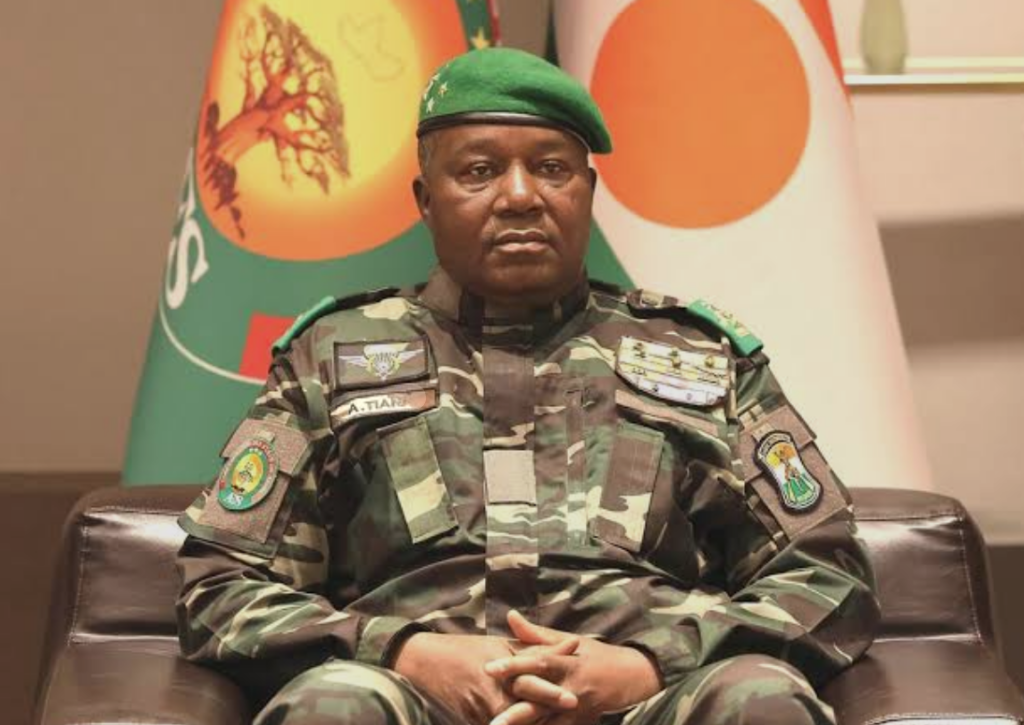
The military regime in Niger has taken another step in its headlong flight. Barely days after a bruising reshuffle at the top of the armed forces command, General Abdourahamane Tiani has dismissed four key ministers. With the junta teetering since a failed coup attempt on the night of 28–29 August, this government purge exposes a power obsessed with its own survival — at the expense of a country sinking deeper into insecurity, and of citizens and businesses left to absorb the shock.
A leadership gripped by fear after the aborted coup
General Abdourahamane Tiani now seems to see traitors on every street corner. On the night of 28–29 August, Niamey became the stage for an attempted coup that was ultimately foiled. It was a brutal shock for the strongman of Niamey, who presumably believed he held the state apparatus and the armed forces in an iron grip.
The response from the National Council for the Safeguard of the Homeland (CNSP) was swift. After decapitating the military leadership and carrying out a wave of strategic arrests within army ranks, Tiani extended his purge to the executive branch. By presidential decree, four government figures were abruptly stripped of their duties.
Key ministries reshuffled as the junta tightens its grip
The portfolios affected are far from trivial: Agriculture, Agrarian Reform, Energy, and Communications were all immediately reassigned. By redistributing these cards in ministries crucial to economic stability and information control, the head of the junta is desperately trying to close ranks and lock down every strategic lever of the nation.
The bitter irony of a coup leader who now fears a coup
There is a biting irony in this political jitteriness. It is worth recalling that General Tiani only came to power by overthrowing the democratically elected president Mohamed Bazoum in July 2023. A former commander of the presidential guard, Tiani used armed force and the trust placed in him by state institutions to orchestrate his own takeover.
Today, he is caught in his own trap. Well aware of how easily an undemocratic regime can collapse from within, the head of the junta lives in a permanent illusion of internal threat. In politics as in the barracks, legitimacy cannot be decreed: those who seize power by arms inevitably expose themselves to the same fate.
This paranoia at the top of the state reflects an undeniable reality: the CNSP no longer controls its own house. Frictions within the armed forces are mounting, and August’s attempted coup was merely the visible symptom of a much deeper fracture within Niger’s military elite.
The real-world toll: insecurity, isolation, and an economy under strain
While General Tiani reorganises his ministries and hands posts to loyalists to guarantee his personal safety, the people of Niger are paying a heavy price for this chronic instability. Since the military junta took over, Niger has tipped into a disastrous security spiral — and the consequences are being felt in markets, fields, and households across the country.
The original pretext for the 2023 coup — improving security against armed terrorist groups — has completely collapsed. On the ground, the reality is stark:
- A heightened terrorist threat: Attacks by groups affiliated with Al-Qaeda and the Islamic State have multiplied in border areas, claiming numerous civilian and military victims.
- A strategic vacuum: By abruptly breaking traditional military alliances and expelling partner forces, the regime has left entire swathes of territory without effective protection.
- A humanitarian and economic crisis: Growing insecurity and sanctions have paralysed the local economy, pushing millions of people into extreme vulnerability.
A dead-end escalation that leaves citizens footing the bill
This successive ministerial reshuffle will solve none of Niger’s structural problems. By replacing people rather than changing methods, General Tiani is merely delaying the inevitable. The relentless militarisation of institutions and the witch-hunt within the government demonstrate the absence of a clear political vision for the country.
By governing through fear, suspicion, and permanent purge, the military regime isolates itself a little more each day. Neither press censorship nor the express replacement of the Energy or Communications ministers will be enough to mask a glaring truth: the CNSP’s promise of stability has turned into a security and institutional chaos whose primary victim — in daily life, business, and livelihoods — remains the people of Niger.

More Stories
Benin-Rwanda alliance after Wadagni’s Kigali mission: what citizens and businesses stand to gain
What the Lomé accords mean for families, farms and local economies across Benin, Ghana and Togo
Benin’s €30 million corridor gamble: the real-world fallout for truckers, traders and frontier towns