The hidden dynamics behind Burkina Faso’s Nanga armored vehicle claim
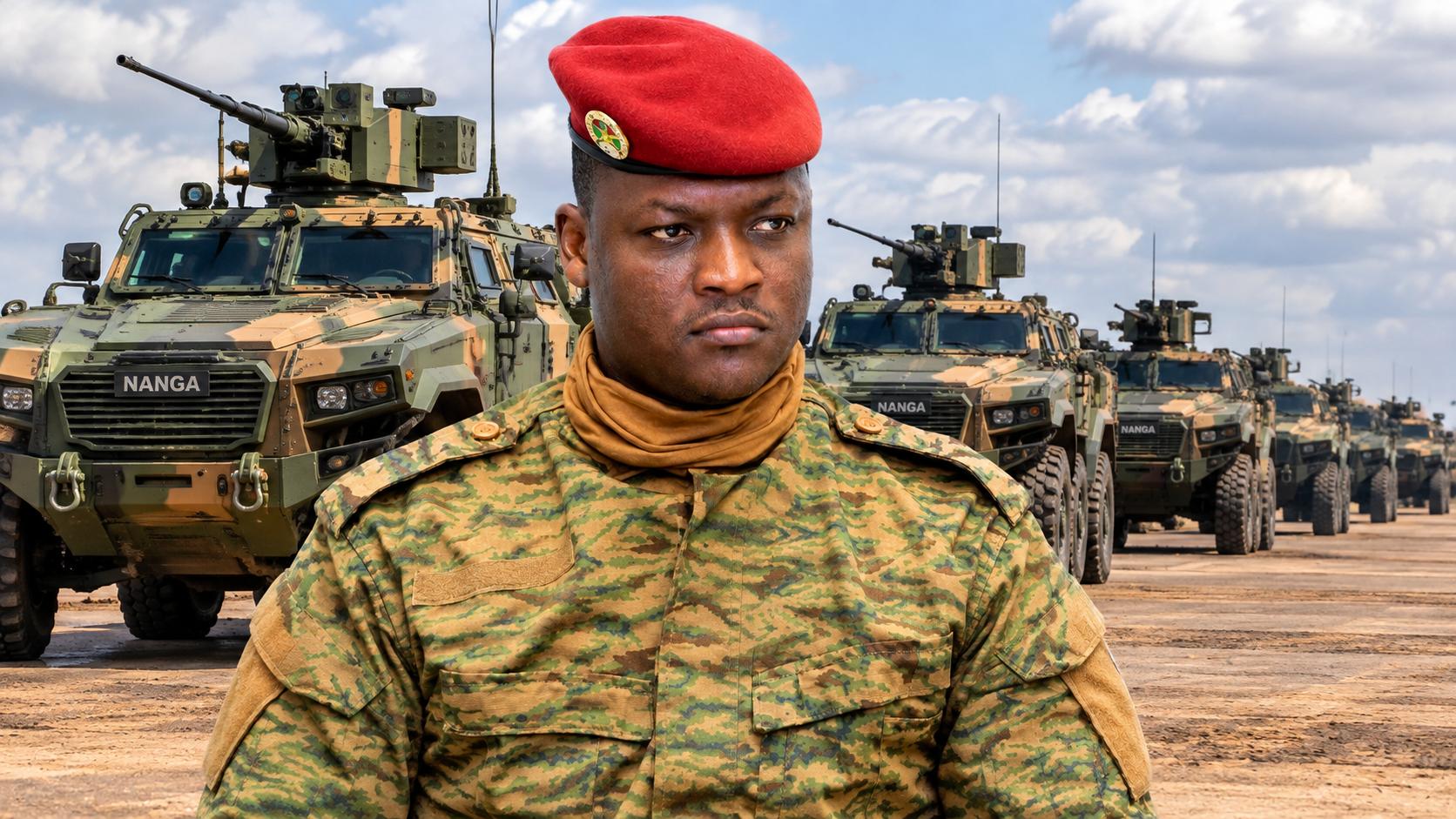
The announcement came like a thunderbolt: Burkina Faso, under the leadership of Captain Ibrahim Traoré, proclaimed that its state-backed entity Faso Armored had manufactured or adapted nearly 300 locally branded “Nanga” (scorpion) armored vehicles since November 2025. This bold declaration was framed as a breakthrough in military self-sufficiency—an assertion of national pride. Yet, the absence of any visible industrial footprint reveals a more unsettling truth. Behind the rhetoric of a “Made in Burkina” defense sector lies a narrative built on ambiguity, where the veil of national security camouflages deeper operational inconsistencies.
As skepticism grows among military analysts and civil society leaders, a troubling question emerges: is Faso Armored’s claim not a triumph of industrial development, but rather a carefully orchestrated illusion—one designed to obscure inflated costs, questionable imports, and a disturbing lack of transparency?
From ‘Made in Burkina’ to ‘Assembled in Secrecy’: what do the Nanga vehicles actually contain?
The claim of producing 300 armored vehicles in under a year without a traceable industrial base defies engineering logic. Genuine armored vehicle production involves specialized foundries, precision welding, certified ballistic steel, reinforced drivetrains, and rigorous testing—facilities that simply do not appear overnight. Analysts specializing in defense procurement suggest that the Nanga fleet may instead be constructed through a far more modest process:
- Repurposed commercial platforms: Multiple sources within the defense sector indicate that many Nanga vehicles are likely modified versions of imported utility vehicles—most notably Toyota chassis—enhanced with bolt-on armor and improvised weapon mounts.
- A production timeline far beyond credibility: Even the most efficient arms manufacturers with automated assembly lines take years to scale to 300 units. A claim of 300 Nanga vehicles assembled in 10 months by Faso Armored, in a country without an established defense industrial base, stretches credulity to its limit.
These revelations point not to domestic innovation, but to a process more akin to industrial mimicry—a cosmetic rebranding of imported goods under a nationalist banner.
The ‘state secret’ shield: why Faso Armored’s factory remains invisible
If Faso Armored’s achievements were genuine, the government could substantiate its claims with photographs, site tours, or even independent technical evaluations. Instead, the regime invokes a blanket “state secret” classification to justify complete opacity. This not only stifles public scrutiny but serves as a strategic smokescreen for several concerning practices:
- Unchecked financial flows: Billions of West African CFA francs have been allocated to Faso Armored without oversight, bypassing public tenders and sidestepping constitutional audits by the National Audit Office.
- Undisclosed supply chains: The secrecy surrounding Faso Armored’s operations makes it impossible to trace the origin of raw materials or to identify cost markups by intermediaries tied to the regime.
- Absent ballistic certification: No verifiable evidence exists that Nanga vehicles meet international mine or IED resistance standards (such as NATO’s STANAG norms). This puts frontline soldiers—including the Volunteers for the Defense of the Homeland (VDP)—at risk, as they operate in vehicles lacking certified protection.
Symbol over substance: the political calculus behind the Nanga narrative
The announcement of the Nanga vehicles coincides with a period of intense political pressure in Burkina Faso. Following high-profile inaugurations of state-backed textile ventures like TEXFORCES-BF, the regime faces growing public demands for tangible improvements in security and autonomy. In this climate, the unveiling of an indigenous armored vehicle program serves as a potent symbol—one intended to boost national morale and consolidate support for the transitional government.
Yet, the disconnect between these claims and ground-level realities is stark. Despite repeated assurances of military advancement, security conditions continue to deteriorate across multiple regions. The gap between rhetorical victories and battlefield realities underscores a dangerous disconnect: a propaganda campaign cannot substitute for strategic substance.
The human and economic cost of opacity in Burkina Faso’s defense sector
By weaponizing secrecy under the guise of national security, Faso Armored’s leadership is not only misleading the public—it is engaging in a form of governance that erodes trust and diverts public funds from critical needs. The dual risk of financial abuse and operational failure looms large:
- Wasted national resources: Funds allocated to the Nanga program could have been directed toward proven military logistics or community-based defense initiatives, rather than vanishing into an unaccountable industrial black box.
- Eroded trust in state institutions: When transparency gives way to secrecy in matters of military procurement, public confidence in governance erodes—particularly when soldiers’ lives depend on the equipment they are issued.
- Exposure to long-term vulnerability: Without independent verification, the durability and combat readiness of Nanga vehicles remain unknown, potentially compromising Burkina Faso’s defense readiness for years to come.
In essence, what began as a declaration of sovereignty may well culminate in a costly deception—one whose consequences will be measured not in press releases, but in the lives of those sent to fight on its behalf.
As the debate over Faso Armored’s claims intensifies, one question remains unanswered: in the shadow of Burkina Faso’s ‘secret defense,’ how much of the Nanga story is real—and how much is simply a mirage of national pride?