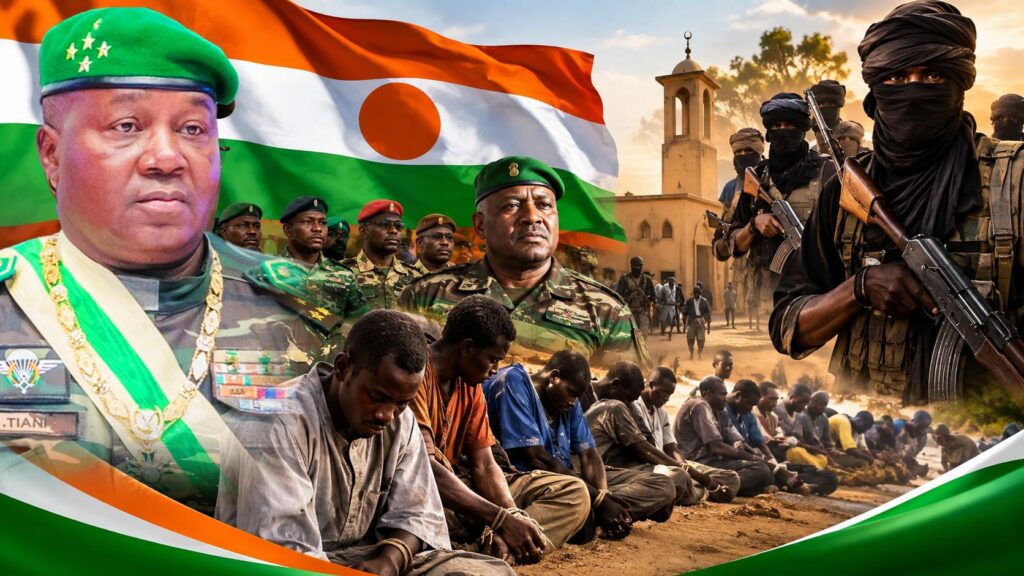
On 21 August 2026, Niger crossed a line it had never crossed before. As the faithful streamed out of Friday prayers, gunmen encircled several mosques, sealed every exit and force-marched close to five hundred believers into a dense forest. Days later, the fate of those captives remains unknown. The scale of the operation has turned an ordinary act of worship into a national wound — and it is ordinary citizens, traders and farming families who are being left to carry the damage.
The afternoon devotion turned into a mass kidnapping
It was shortly after 1 p.m. on that Friday, 21 August, when religious fervour gave way to sudden horror. As worshippers finished their invocations, dozens of heavily armed assailants methodically surrounded the places of prayer. By blocking the doorways, the attackers trapped hundreds of defenceless civilians — elderly men, adults and young boys among them — before forcing them under the forest canopy at gunpoint.
The precision of the raid points to careful planning and serious logistics. The panic inside the affected families is total: no group publicly claimed the assault in the first hours, and no ransom demand has surfaced. That heavy silence only deepens the anguish of relatives, who can do little more than stare at the treeline in the hope of a sign of life.
Why this abduction is hurting Niger’s economy as much as its security
A kidnapping on this scale does not stay contained to the families involved. It ripples outward through every activity that depends on people moving freely, trading openly and trusting that the roads are passable.
Markets, farms and trade routes left dangerously exposed
Rural communities are the first to feel the shock. When hundreds of men are taken from a single area, fields lose the hands that till them, small trading stalls lose their operators and the convoys that link villages to larger towns lose both their drivers and their sense of safety. Each disappearance removes a worker, a customer and a provider at the same time, and the effect compounds from one household to the next.
Households buckling under a burden they cannot afford
Behind every missing name sits a family now facing the cost of a search, the loss of an income and the daily expense of survival without a breadwinner. Savings drain quickly. Children are pulled from school, livestock is sold off at a loss, and households that were already fragile slide into dependence on relatives and neighbours who are barely coping themselves.
A security promise that no longer convinces anyone
The tragedy lays bare how far the country’s security situation has deteriorated, and it lands hardest on the people who were promised protection.
When the National Council for the Safeguard of the Homeland seized power from the democratically elected president Mohamed Bazoum, it justified the takeover by an absolute necessity to halt the terrorist threat. The pledge was straightforward: restore the authority of the state and guarantee the safety of citizens.
Three years on, the verdict is stark. Anti-Western rhetoric and the expulsion of traditional international partners have not delivered the security turnaround that was announced. On the ground, an often under-equipped and overstretched army struggles to contain the spread of armed factions. The distance between the sovereignist speeches broadcast on state television and the daily reality of rural areas has never looked wider.
How the departure of allies opened the door
The abduction of these five hundred worshippers is not an isolated incident but the culmination of a slow unravelling of state authority in the peripheral regions. By pushing out allied forces without first building a credible operational alternative, the military leadership created a strategic void that jihadist groups and criminal bands rushed to fill.
Across large stretches of territory, administration has vanished and defence forces are confined to a defensive posture inside isolated garrisons. Local populations, abandoned to their own devices, endure a double punishment: the daily violence of insurgents and the heavy silence of a transitional authority more focused on consolidating its political grip in Niamey than on securing the countryside.
Silence in Niamey and the cost of unanswered questions
Faced with a drama of unprecedented proportions, the response of General Abdourahamane Tiani and the members of the ruling council is fuelling mounting outrage. An official communication machine that is normally so quick to denounce foreign interference or celebrate supposed tactical wins has sunk into an embarrassed muteness. No clear search or negotiation strategy has been publicly outlined for the grieving families.
This faltering crisis management erodes the credibility of the military government a little more each day. By proving unable to protect citizens inside their own places of worship, the regime is exposing its structural limits. Anger is simmering among a population tired of paying a steep price for geopolitical calculations and patriotic incantations that change nothing on the ground.
What the aftermath means for Niger’s future
The abductions of 21 August mark a dangerous escalation in Niger’s crisis. By striking a religious gathering en masse, armed groups have shown they can hit hard, far from any immediate state response. While the fate of the five hundred missing remains the absolute priority for their families, the tragedy raises a deeper question: how long can Niger sustain the gap between the political ambitions of an isolated military leadership and the most basic protection of its own people?

More Stories
Benin’s €30 million corridor gamble: the real-world fallout for truckers, traders and frontier towns
Nigeria’s anti-jihadist surge leaves shattered communities in its wake amid ongoing insurgency
Benin’s month in Paris: what the Fnac Saint-Lazare program means for business, diaspora and memory