
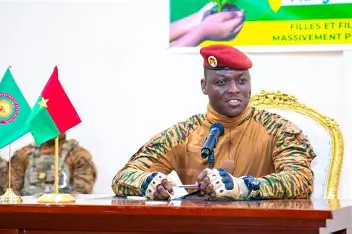
One of the oldest traps in politics—whether in times of war or after coups—is for military leaders turned heads of state to mistake the power of rhetoric for the reality on the ground. When silence from the population, often born of fear or uncertainty, is misread as unwavering support, the foundations of governance begin to erode.
In Burkina Faso, this dynamic appears to be taking hold. Behind carefully staged public appearances, impeccable uniforms, fiery speeches condemning the « treacherous West, » and repeated warnings against so-called « anti-revolutionary » behavior, a different narrative is unfolding. The image of an unshakable authority is gradually giving way to one of a regime grappling with deepening internal fractures.
An increasingly isolated figure
Critics argue that Captain Ibrahim Traoré now stands isolated at the helm of a government where suspicion has supplanted trust. This perception is reinforced by persistent rumors of destabilization attempts, shifts within the military hierarchy, and successive overhauls of the security apparatus.
A local proverb among political analysts in West Africa captures this sentiment: « When a ruler fears his own guards, he ceases to defend his nation and begins to guard his own shadow. »
The erosion of the inner circle
African political history, like that of many regions, demonstrates a recurring pattern: those who enable a takeover often become the first to be distrusted once power is consolidated. Since assuming leadership in September 2022, Traoré has reshaped Burkina Faso’s military and security chains. Several influential officers from the early days have been reassigned, sidelined, or removed, raising questions about the cohesion of the armed forces.
The dismissal of the head of intelligence services—a figure central to the security framework—has drawn particular scrutiny. Analysts suggest that when a leader begins to reshape the very institutions tasked with protecting him, it signals a loss of confidence within his closest circle. The moment power turns inward, questioning loyalty over competence, the crisis ceases to be merely operational—it becomes existential.
Once united by the shared urgency to combat armed groups, the Burkinabe army now appears riven by mistrust. Frequent reshuffles, promotions, and replacements foster the impression that personal allegiance is eclipsing operational merit.
Governance through fear
As security challenges persist, the regime has adopted a policy of political hardening. Critics point to several alarming trends:
- Arrests targeting figures critical of the government;
- Cases of enforced disappearances and abductions reported by human rights organizations;
- Restrictions on media outlets, including suspensions and constraints on journalists;
- Mobilization or co-optation of civil society actors, perceived by supporters as retaliatory measures.
These developments have been widely documented in international human rights reports, which warn of a marked decline in public freedoms across Burkina Faso. Compounding the issue, state-controlled media and allied communication networks heavily promote the head of state’s activities—travels, speeches, and initiatives—reinforcing the perception among opponents of a leadership increasingly defined by personality over substance.
For detractors, this strategy does not reflect unchallenged authority, but rather an attempt to compensate for systemic weaknesses through control of the narrative.
A crisis that refuses to abate
The most pressing challenge, however, remains unaddressed. Nearly four years after the change in leadership, the issues that precipitated the coup endure. Large areas of the country remain under the sway or direct threat of armed groups. The humanitarian crisis deepens, with millions displaced and communities ravaged by insecurity. Attacks on civilians, defense forces, and local defense volunteers continue unabated. Critics warn that political consolidation is increasingly overshadowing the urgent need to address security and humanitarian needs.
Data from the United Nations, humanitarian agencies, and regional research centers confirm that despite military efforts, the security crisis remains severe. Jihadist attacks continue to ravage several regions, while internal displacement rates remain among the highest in the subregion.
The peril of solitude
Patriotic rhetoric, no matter how stirring, cannot substitute for tangible results. Slogans cannot restore security, rebuild institutions, or rebuild trust between the state and its people.
Observers warn that the greatest risk now lies in the growing isolation of the junta leader. By severing ties with former allies, repeatedly reshuffling security structures, and governing in an atmosphere of perpetual suspicion, Traoré risks undermining the very foundations of his authority.
History offers stark examples across the continent: military regimes that progressively concentrated power in an ever-narrowing circle often collapsed under the weight of internal distrust, more devastating than any external opposition.
The true challenge for Burkina Faso remains unchanged: to restore lasting security, rebuild institutional trust, and meet the expectations of a population that continues to bear the human cost of instability. When a regime expends more energy preventing conspiracies than resolving the crises that justified its rise, it risks transforming its own survival into its sole objective—at the expense of the national interest.


More Stories
Mali: près de 80 soldats tués dans l’attaque de Dioura
Côte d’Ivoire : le Burida prépare une distribution record de 795,4 millions FCFA
Paris FC vs Lyon: kick-off time and TV channel for the Ligue 1 matchday 4 clash