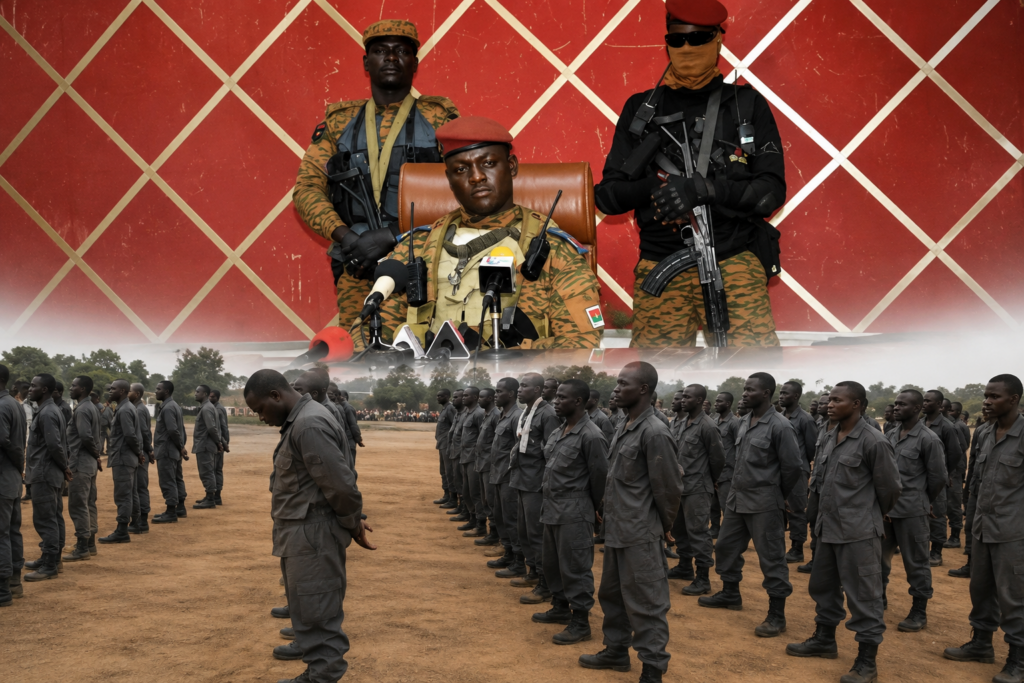
The history of authoritarian regimes is marked by a paradox as old as power itself: the repressive tools created to silence opponents nearly always end up turning against those who once wielded them. Burkina Faso is now witnessing this phenomenon under Captain Ibrahim Traoré’s leadership. Over recent months, arbitrary arrests, enforced disappearances reported by multiple organizations, smear campaigns, intimidation summons, media restrictions, and citizen requisitions in the name of the war effort have expanded beyond traditional critics. Today, figures from the Muslim community, civil society activists, commentators, influencers, and opinion leaders—once seen as pillars of the transition—are finding themselves ensnared in a system where loyalty no longer guarantees safety.
From Supporters to Suspects: The Shrinking Circle of Protection
The shift is not a series of isolated incidents but a structural transformation of power. As the regime centralizes decision-making, eliminates spaces for dissent, and equates criticism with threats to the State, suspicion becomes the defining feature of society. In such a climate, the line between ally and adversary blurs, with loyalty now judged not by past allegiance but by unyielding obedience.
The Illusion of Loyalty in an Unchecked System
Since seizing power, Ibrahim Traoré has cultivated legitimacy through a sovereigntist, patriotic, and security-focused narrative. This rhetoric, amplified across social media by a network of supporters, frames any dissent as foreign-backed destabilization orchestrated by political opponents or ‘enemies of the nation.’
In this environment, public figures have systematically defended state actions. Arbitrary arrests were framed as security imperatives. The disappearances of critical voices were downplayed. Media closures were hailed as sovereignty acts. Even the requisitioning of journalists, lawyers, magistrates, or politicians was sometimes applauded in the name of national mobilization against terrorism.
This normalization of exceptional measures has stripped public debate of nuance, replacing it with a binary logic: unconditional support for Ibrahim Traoré or immediate labeling as a traitor. Dissent is no longer a democratic right but a political crime.
The Personalization of Power and the Spread of Distrust
The Burkinabè transition is increasingly defined by the personalization of authority around Captain Traoré. Policy debates are overshadowed by the defense of the head of state’s persona. Questioning a government decision is often interpreted as a personal attack on his leadership.
This personalization fuels a culture of perpetual suspicion. As security challenges persist—repeated terrorist attacks, economic strain, social tensions, or international criticism—the narrative shifts blame from policy failures to imagined conspiracies. The result? A widening circle of suspects: first political opponents, then independent journalists, human rights defenders, magistrates, academics, religious leaders, and finally, former allies whose influence is deemed excessive or insufficiently aligned.
Fear as a Governing Tool
The regime’s reliance on high-profile arrests, public summons, social media smear campaigns, coercive requisitions, and administrative sanctions serves a dual purpose: neutralizing individuals while sending a message to society as a whole.
Each arrest is a warning. Each unexplained disappearance stokes fear. Each summons serves as a reminder that no one is untouchable. Each spectacle of coercion reinforces the idea that power can strike anyone deemed inconvenient. This strategy fosters self-censorship. Intellectuals hesitate to publish. Journalists scale back investigations. Religious leaders soften their sermons. Citizens avoid public debate. A society governed by fear loses its capacity for innovation, error correction, and collective problem-solving.
The Erosion of Checks and Balances
This trend is especially alarming given the weakening of institutional oversight. Judicial independence is frequently questioned when procedures appear politically motivated rather than legally grounded. Independent media face suspensions that shrink pluralism. Civil society organizations operate in an increasingly restricted space. Political parties operate under heavy constraints in the transition context. When no institution can effectively monitor executive actions, citizen protections become precarious. Power is no longer limited by law but by the regime’s own discretion.
A Historical Lesson in Authoritarianism
Burkina Faso is not alone in this trajectory. History shows that regimes built on concentrated power follow a predictable path. Revolutionaries eliminate former comrades. Military leaders turn on their own officers. Political movements purge their founders. Ideologues are accused of betrayal. The logic is simple: when loyalty to a leader becomes the sole criterion for political survival, no level of devotion is ever enough. The quest for absolute purity leads to purges, exclusions, and accusations.
Fundamental Rights Are Not Privileges
This evolution underscores a fundamental truth: public freedoms are not rewards granted to loyal citizens. The right to a fair trial, freedom of expression, press freedom, the presumption of innocence, and protection from arbitrary detention or enforced disappearance are universal guarantees meant to protect everyone from state abuse. Celebrating the arbitrary arrest of an opponent is accepting the principle of arbitrariness itself. Once established, this logic knows no boundaries—it can be applied to anyone. Injustice does not change its nature based on the victim’s identity.
Many of Ibrahim Traoré’s early supporters made a critical error: they believed proximity to power ensured lasting protection. In authoritarian systems, loyalty is not a contract but a precarious relationship, constantly reassessed based on shifting interests.
The Security Crisis Cannot Justify All Excesses
Burkina Faso faces a real terrorist threat that demands a robust state response. However, the effectiveness of counterterrorism efforts cannot be measured solely by the volume of coercive measures. It also depends on the trust between citizens and institutions. When people fear arbitrary state actions more than they trust state protection, that trust erodes. History shows that no insurgency can be defeated permanently if institutions lose credibility with those they are meant to serve. Security and the rule of law are not opposing goals; they are complementary. A state that fights terrorism while upholding legal norms strengthens its legitimacy. Conversely, when exceptional measures become permanent, the fight against the enemy risks becoming a justification for total societal control.
When the System Consumes Its Own Allies
The predicament facing figures once aligned with the regime illustrates a broader political reality. In a system where institutions are weakened and power relies on fear, no one enjoys lasting protection. Today’s allies may be tomorrow’s suspects. The most fervent defenders can be accused of insufficient loyalty. Communication allies may be replaced or sidelined. Religious figures may be reprimanded if their discourse deviates from the official line. The watering can eventually waters itself.
But beyond individual fates, society as a whole bears the cost of this evolution. When a regime extends distrust to its own supporters, it reveals that the problem lies not with specific individuals but with the political system itself. The true safeguard of a nation rests not on proximity to the head of state or ideological alignment but on strong institutions, an independent judiciary, a free press, and laws applied equally to all. Only in this framework can the fight against security challenges preserve both state authority and citizen freedoms.

More Stories
Mali’s Wagner successor Africa Corps drains $850M from fragile budget amid shifting power dynamics
Behind the Molodo ambush: how Mali’s junta’s Russian gamble unraveled
Russia’s 2026 parliamentary vote: a landslide masked by a locked political arena