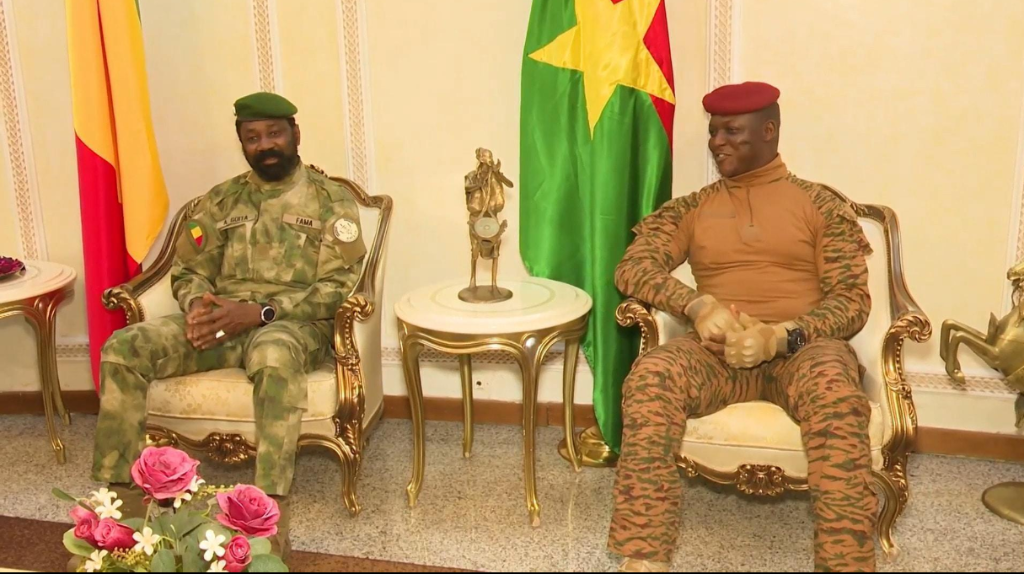
The diplomatic landscape of the Sahel is shifting as Mali and Burkina Faso deepen ties in a high-stakes visit that raises questions about the future of their three-nation alliance. Against the backdrop of regional instability, leaders Assimi Goïta and Ibrahim Traoré are set to advance their strategic partnership—leaving Niger notably absent from this pivotal moment.
Diplomatic momentum in Ouagadougou as Mali-Burkina Faso ties take center stage
The President of Mali, General Assimi Goïta, will land in Ouagadougou on November 5, 2026, for an official visit aimed at strengthening bilateral relations with his Burkinabè counterpart, Captain Ibrahim Traoré. While the trip underscores the robust partnership between Bamako and Ouagadougou, the conspicuous absence of Niger’s President Abdourahamane Tiani spotlights tensions within the Alliance of Sahel States (AES).
The meeting, confirmed by Burkina Faso’s State Protocol Directorate, symbolizes a deliberate push for closer military, economic, and political cooperation. Yet it also forces observers to question whether the AES can sustain its unity—or if cracks are beginning to show.
Why the AES summit is missing its third pillar
Formed in 2023 and formalized as a Confederation in 2024, the AES was built on a shared vision: forging a united front against terrorism, political interference, and economic dependence. But the decision to prioritize a Mali-Burkina Faso summit without Niger signals a potential pivot in priorities—or at least, a restructuring of how the alliance operates.
Is this a bilateral meeting with strategic implications for the AES, or a sign that the alliance is evolving into a flexible framework rather than a rigid union? While no official explanation has been given for Tiani’s absence, the optics are undeniable: three nations entered the alliance together, but only two are now moving forward in lockstep.
The resilience of the AES despite leadership gaps
This is not the first time the AES has navigated internal differences. Just weeks earlier, on October 16, 2026, foreign ministers from all three countries convened in Ouagadougou to review shared policy positions. The gathering proved that diplomatic channels between Niamey, Bamako, and Ouagadougou remain operational—even if the highest tier of leadership is not always aligned.
The absence of Niger’s president does not necessarily signal a breakdown. However, it highlights a growing challenge: maintaining consistent top-level coordination in an alliance meant to be built on collective strength. The AES thrives on unity, yet unity demands visible, regular engagement from all partners.
Security, sovereignty, and the future of tripartite cooperation
The stakes couldn’t be higher. Across the Sahel, armed groups continue to exploit porous borders, while global powers recalibrate their engagement in the region. In this environment, the AES offers a counter-model: one built on self-reliance and regional solidarity.
Yet the question lingers: Can the alliance fulfill its potential if its members do not consistently coordinate at the highest level? The current visit may yield tangible results between Mali and Burkina Faso—but whether those advances extend to Niger will determine if the AES can truly become more than the sum of its parts.
What the Goïta-Traoré talks could mean for the Sahel
- Reinforced bilateral defense and counterterrorism cooperation between Mali and Burkina Faso
- Possible alignment on economic policies to reduce reliance on external partners
- Clarification on whether future AES summits will remain tripartite or adapt to new dynamics
As diplomats and analysts watch closely, one thing is clear: the Sahel alliance stands at a turning point. The decisions made in Ouagadougou could redefine cooperation—or reveal the limits of unity when faced with national agendas and shifting priorities.
Can the AES survive without consistent three-way leadership?
History shows that alliances survive not just on declarations, but on action. The AES was forged in crisis and designed for resilience. But resilience requires leadership—and right now, that leadership appears fractured.
Whether this absence is temporary or indicative of deeper divisions may become clear in the days following the visit. One thing is certain: the eyes of the Sahel—and the world—are on Ouagadougou, waiting to see if this alliance can truly turn the tide.