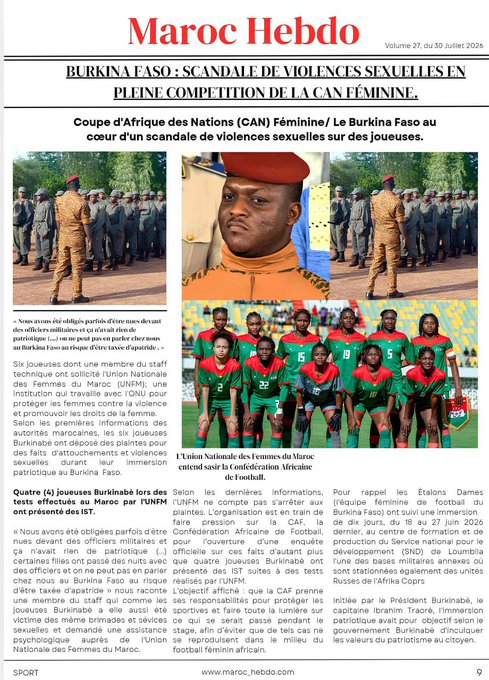
Patriotic initiatives overshadowed by serious allegations
The Burkinabè national women’s football team was recently at the centre of a controversial training programme held in a military camp, advertised as a patriotic immersion designed to instil discipline and national pride ahead of a continental competition. Yet what was intended as a display of civic duty has now become the subject of grave accusations, as six players and a technical staff member have filed a complaint in Morocco, alleging they were subjected to sexual violence by military officers during their stay.
If substantiated through independent investigation, these claims would represent a severe breach of fundamental rights and expose the dangers of a system where military authority operates with minimal civilian oversight.
A society increasingly governed by military structures
Under Captain Ibrahim Traoré’s leadership, the military’s influence has expanded far beyond national defence, embedding itself in sectors such as civic education, youth programmes, cultural initiatives, political messaging, and even sports. This shift reflects a deliberate strategy to position the armed forces as the cornerstone of national reconstruction.
While the stated goal may be to reinforce social cohesion, the encroachment of military structures into civilian domains raises concerns. Traditional safeguards—judicial oversight, independent media, civil society organisations—are gradually eroding, weakening the mechanisms meant to prevent abuse and ensure accountability.
Impunity thrives in the absence of checks and balances
A functioning democracy depends on the balance between institutions. When courts, independent journalists, human rights groups, and opposition parties face growing restrictions, the space to challenge abuse narrows. Survivors of violence may hesitate to come forward due to fears of retaliation, professional repercussions, or social stigma.
The current case underscores this dilemma: the complainants reportedly pursued legal action only after leaving Burkinabè territory. This raises pressing questions about the reliability of domestic protection systems and the level of trust citizens can place in them.
Fear, not consent, silences dissent
Several factors contribute to the climate of silence surrounding criticism of military rule. Dissent is often framed as disloyalty, equating opposition with support for armed groups. Journalists, activists, and civil society members report intimidation, coercive measures, and restricted access to information. Meanwhile, heightened security priorities frequently overshadow human rights concerns and victim protection.
The reluctance of some Burkinabè to speak out should not be mistaken for endorsement of the current leadership. Often, it reflects a calculated decision to avoid severe consequences.
Beyond football: systemic risks of unchecked military power
This incident extends far beyond the realm of sports. It forces a reckoning with the role of the military in a nation at war and the boundaries that must govern its involvement in civilian life. It also questions the state’s ability to ensure the safety of its citizens when programmes are organised under its authority.
While counter-terrorism efforts remain essential, they cannot justify the long-term erosion of judicial guarantees, public freedoms, or mechanisms of accountability.
International intervention: a reflection of lost trust
The decision to seek recourse outside Burkina Faso’s borders sends a powerful signal. Regardless of the outcome, it highlights a profound crisis of confidence in domestic institutions. For the victims, turning to international bodies represents an attempt to secure impartiality and a fair hearing.
This externalisation of the case may intensify pressure on Burkinabè authorities to conduct a transparent, independent inquiry—one that identifies responsibility, protects survivors, and, if necessary, applies appropriate sanctions.
Conclusion: rights violations cannot be justified by political ambition
Patriotism cannot serve as a shield against scrutiny when grave human rights violations are alleged. No political project, no matter how ambitious, can endure without respect for the rule of law.
If these allegations are confirmed, they will mark a critical turning point in the assessment of Burkina Faso’s governance, laying bare the perils of concentrated power and the weakening of citizen protection systems.

More Stories
Behind the legacy: how Abdoulaye Koné shaped Ivory Coast’s economic backbone
Niger’s August crisis: how Tiani’s reliance on Russia exposed deeper fractures in the military
Peering behind the curtain: how Benin’s CCI budget 2027 reshapes local economies