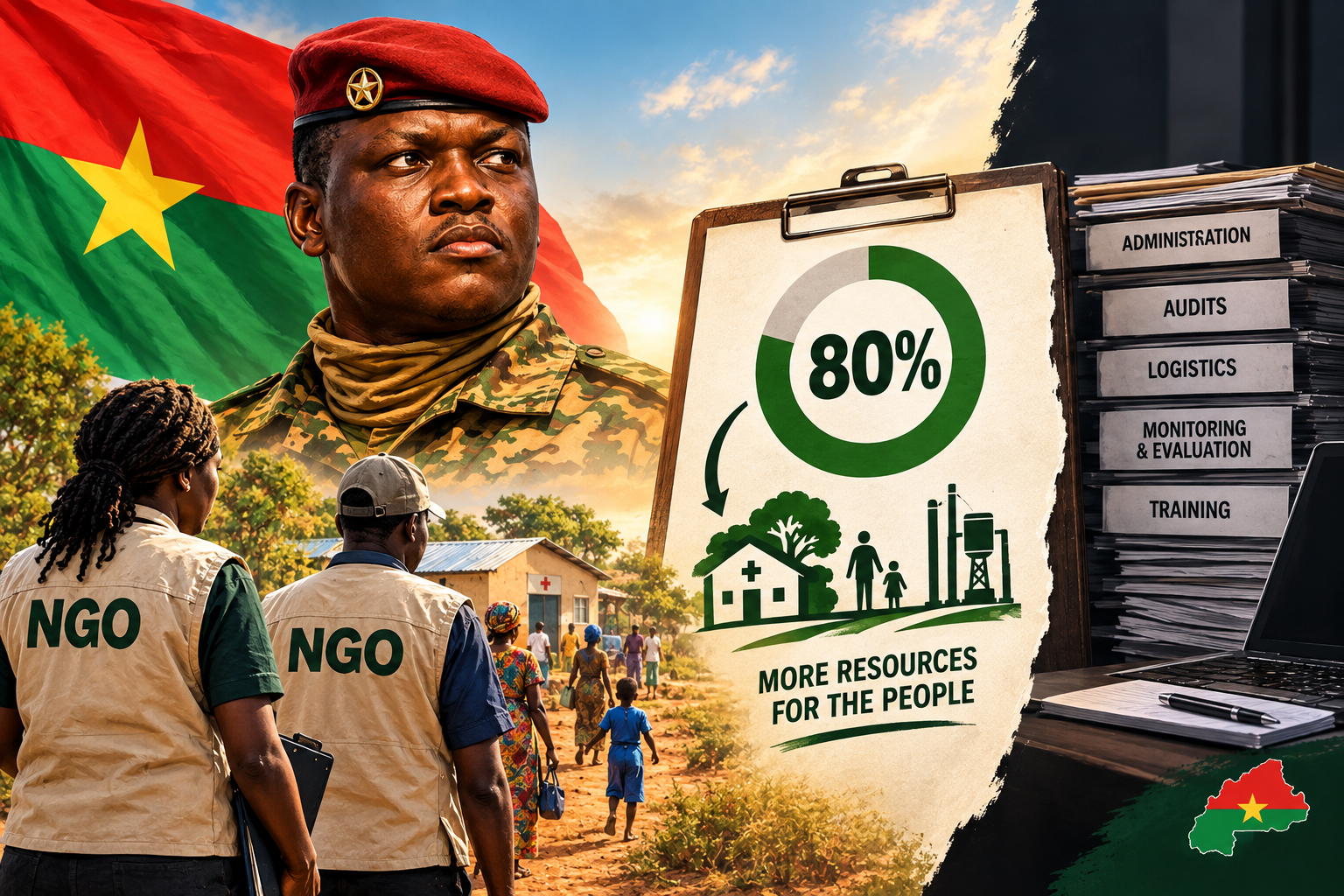
When Burkina Faso’s transitional government unveiled its latest directive governing non-governmental organizations (NGOs) in late September 2026, it framed the policy as both a transparency milestone and a leap toward greater operational efficiency. At the heart of the regulation is a sweeping mandate: all NGOs operating within the country must now allocate no less than 80% of their total resources to direct field-based expenditures. The stated goal is clear channel more funding to frontline interventions where it can tangibly support local communities.
Beyond the headline: what 80% really measures (and what it doesn’t)
The 80% requirement has been presented as a simple arithmetic target, yet its implications extend far deeper than budget lines. At its core, the rule seeks to curb administrative overheads and ensure that donor funds reach intended beneficiaries without costly detours. But beneath the surface, the measure risks conflating fiscal discipline with developmental effectiveness.
Consider the infrastructure of humanitarian aid it is not built solely from concrete and medicine. Behind every clinic, school, or vaccination campaign lies an ecosystem of financial audits, procurement logistics, human resource development, and ongoing project monitoring. These functions, though often invisible in annual reports, are the safeguards that prevent mismanagement and ensure accountability. An auditor does not build a health center, yet their work may prevent financial embezzlement that could derail an entire year of healthcare delivery. Similarly, a logistics specialist does not administer vaccines, but without them, medical supplies never arrive on time.
When the government compresses these operational pillars to meet a rigid percentage, it may inadvertently weaken the very systems that protect aid integrity.
The ambiguity of “direct investment”: where the rule leaves room for interpretation
The most pressing unanswered question is how “direct investment” is defined. The government’s framing suggests a narrow interpretation capital goods, construction, and on-site service delivery. Yet the reality of humanitarian and development work complicates this binary.
Does the salary of a nurse working in a newly built health center count as a direct expense? What about the fuel used to transport medical supplies from Ouagadougou to rural districts? Or the training workshop that prepares community health workers to manage disease outbreaks? Without explicit, comprehensive guidelines, NGOs are left to navigate a gray zone where legitimate operational costs risk being reclassified as administrative bloat.
Same rule, diverse missions: why one size does not fit all
NGOs are not monolithic entities. Organizations dedicated to infrastructure development naturally incur higher material costs bricks, steel, and machinery dominate their budgets. In contrast, entities focused on education, legal advocacy, or social protection often invest more in human capital: training, salaries, and community engagement. Applying the same 80% threshold universally fails to acknowledge these operational realities.
Under this policy, a legal aid NGO that spends 40% of its budget on staff salaries to provide free representation to marginalized groups may be deemed non-compliant, even though its work directly transforms lives through access to justice. The rigidity of the rule risks penalizing organizations whose missions do not align with capital-intensive models, undermining the very diversity of solutions needed to address Burkina Faso’s complex humanitarian challenges.
The danger of gaming the system: when compliance overshadows impact
History shows that when organizations face arbitrary numerical targets, creativity in meeting those targets can eclipse the original intent. An NGO struggling to reach 80% might be tempted to reallocate funds from critical but less visible functions such as monitoring and evaluation, internal audits, or staff retention programs toward easily quantifiable expenditures like food distribution or temporary shelter construction. While these activities deliver immediate, tangible results, they do not necessarily foster long-term sustainability or systemic change.
The true measure of an NGO’s success lies not in how much it spends on direct interventions, but in the quality of those interventions: the number of beneficiaries reached, the durability of outcomes, the cost per positive impact, and the resilience of communities after external support ends. A policy that prioritizes a percentage over these outcomes risks creating a compliance culture at the expense of meaningful development.
Transparent oversight: alternatives that don’t rely on arbitrary ratios
If the government’s objective is to enhance accountability and prevent fund misappropriation, there are proven, targeted tools available tools that do not hinge on arbitrary budget divisions. Independent financial audits, real-time fund tracing through blockchain-based ledgers, mandatory public disclosure of expenditure reports, and on-site project verifications provide far greater assurance of responsible stewardship. These mechanisms allow regulators to verify that funds are used as intended without forcing organizations into artificial financial contortions.
The 80% rule, by contrast, is a blunt instrument. It measures the distribution of funds, not their effective use. It may curb inefficiency in some cases, but it risks stifling innovation, underfunding essential support functions, and ultimately diluting the impact of aid.
Will the policy deliver on its promise?
Transparency and efficiency are laudable goals especially in a country grappling with security threats, climate shocks, and chronic underdevelopment. But the true test of this policy will not be the percentage of funds spent on the ground; it will be whether Burkina Faso’s most vulnerable communities receive more effective, sustainable, and accountable support than they did before.
Six months from now, when NGOs submit their compliance reports, the government will face a critical decision. Will it celebrate organizations that met the 80% target, even if their programs failed to deliver lasting change? Or will it assess the policy’s real-world outcomes measuring not just spending, but lives improved, rights upheld, and systems strengthened?
The answer will reveal whether Burkina Faso’s groundbreaking rule was a bold step toward accountable aid or simply a numbers game hiding behind well-intentioned rhetoric.
By Yacouba Boukari — Analyst