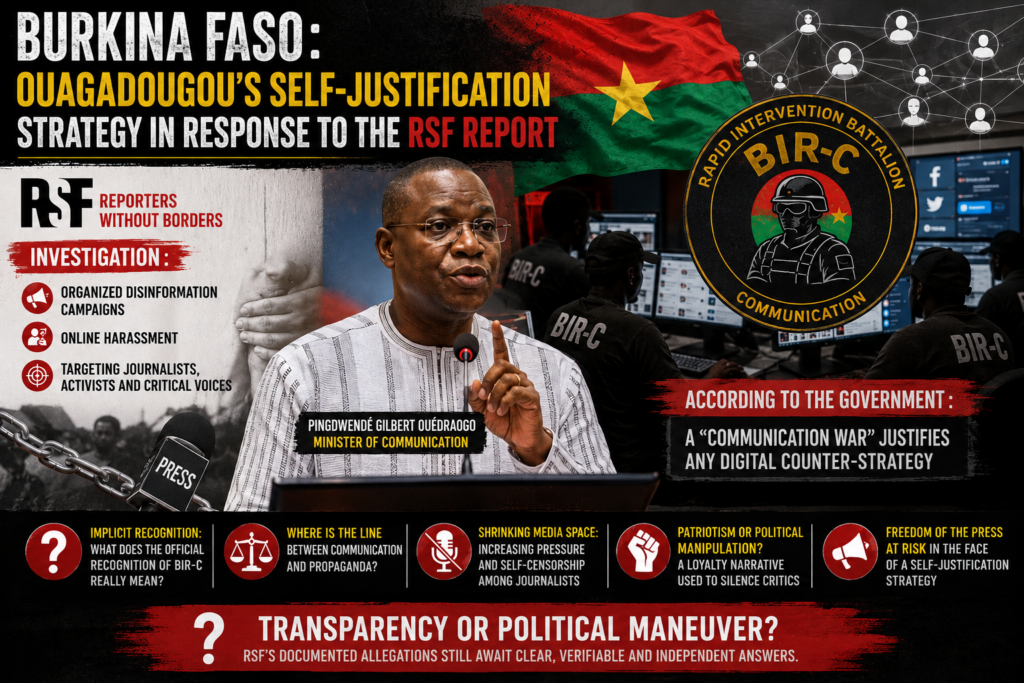
The Burkinabè authorities appear once again to favor a strategy of justification over genuine transparency when addressing criticism. Speaking on August 3 during the flag-raising ceremony, Communication Minister Pingdwendé Gilbert Ouédraogo sought to deflect accusations leveled by Reporters Without Borders (RSF). His public tribute to the Rapid Intervention Battalion-Communication (BIR-C), framed as a defensive information tool, raised more questions than it answered.
Recognition of a controversial structure
By publicly acknowledging the BIR-C, the government implicitly admits its existence and role within Burkina Faso’s digital ecosystem. This recognition coincides with an RSF investigation exposing a coordinated network accused of spreading disinformation, online harassment, and systematically targeting journalists, activists, and critics of the military transition. Rather than launching an independent inquiry or refuting the documented evidence, authorities chose to publicly endorse the BIR-C, deepening suspicions about its true function.
Digital campaigns under scrutiny
The RSF report details a coordinated operation involving the mobilization of social media accounts to shape narratives, discredit dissenting voices, and exert constant pressure on media professionals. While the government dismisses these claims, its decision to defend the organization publicly rather than address the documented facts fuels debate over the line between institutional communication and political propaganda.
The official narrative frames Burkina Faso as the target of a « communication war » waged by external actors seeking to destabilize the country. Under this logic, any digital strategy aimed at defending authorities is framed as an act of patriotism. Yet this argument raises a critical question: where does legitimate crisis communication end, and where does the suppression of press pluralism begin?
Freedom of expression vs. national security
In a climate of intense political and security polarization, combating manipulation campaigns is a valid concern for any state. However, international free speech principles make clear that such efforts must never justify targeted harassment, smear campaigns, or intimidation of journalists. When criticism is systematically equated with national betrayal, public discourse risks being severely narrowed.
This controversy unfolds against a backdrop of suspended international media outlets, mounting pressures on journalists, and a shrinking domestic media space. Observers warn that the resulting climate fosters self-censorship among information professionals. In this context, the existence of an organized digital communication structure particularly if its role exceeds mere government messaging raises concerns about the balance between national security and fundamental freedoms.
Patriotism as a shield against criticism
The minister’s remarks reflect less an exercise in transparency than a political counter-offensive. By emphasizing the « patriotism » of BIR-C members, authorities shift the debate from factual scrutiny to national loyalty. This tactic reframes criticism not as inquiry into methods, but as an attack on the state itself.
A democracy facing severe security challenges is also measured by its ability to tolerate scrutiny from the press and rights organizations. Responding to an investigation with public support for the accused structure does not dispel doubts it may instead be seen as political endorsement of its role within the government’s communication apparatus.
The broader challenge of information governance
The stakes now extend beyond the BIR-C case. They concern how Burkinabè authorities manage information in the digital age. As social media becomes a new battleground for political confrontation, any use of these platforms by structures close to power must operate within a transparent framework that respects fundamental rights and press freedom.
Rather than engaging in contradictory debate or clarifying facts, the government has chosen a strategy of patriotic mobilization in response to criticism. Until the documented accusations from RSF receive precise, verifiable, and independent responses, official statements risk being perceived not as denials, but as attempts at self-justification by a communication system whose contours continue to fuel concerns about press freedom in Burkina Faso.


More Stories
Niger’s August crisis: how Tiani’s reliance on Russia exposed deeper fractures in the military
Peering behind the curtain: how Benin’s CCI budget 2027 reshapes local economies
Burkina Faso’s military push raises urgent questions amid mass displacement crisis