
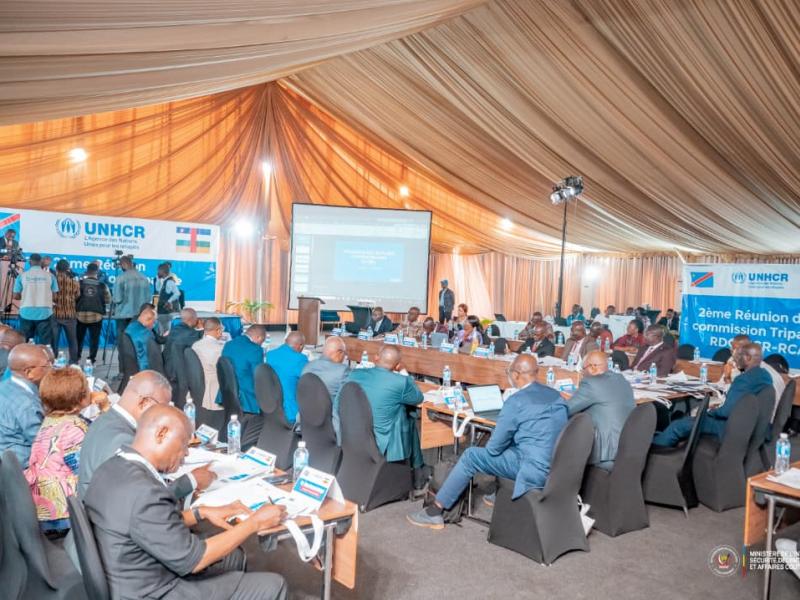
The capital of the Democratic Republic of the Congo, Kinshasa, is hosting a pivotal three-day tripartite meeting from June 9 to 11, bringing together Congolese officials, Central African delegates, and representatives from the United Nations High Commissioner for Refugees (UNHCR). The primary focus? Accelerating the voluntary repatriation of over 22,600 Central African refugees currently residing in the DRC.
The gathering follows a landmark 2019 agreement between the DRC, the Central African Republic (CAR), and the UNHCR, which was further reinforced by the 2022 Yaoundé Declaration. This regional initiative aims to create sustainable solutions for displaced persons affected by the Central African crisis.
Progress and challenges in refugee repatriation
According to Pierre Atchom, UNHCR Representative in the DRC, 22,604 Central African refugees have been biometrically registered in the country, with the majority concentrated in Nord-Ubangi, Sud-Ubangi, and Bas-Uélé provinces. Additionally, over 65,000 new asylum seekers arrived in May 2025 in Zapaï, Bas-Uélé.
Éric Mukandila, Permanent Secretary of the National Commission for Refugees (CNR) and head of the DRC delegation, emphasized that the voluntary repatriation process resumed after conflict-affected areas stabilized. He highlighted that 40,000 Central Africans have already returned to CAR since 2019, facilitated by the UNHCR in collaboration with both governments, ensuring safety and dignity throughout the process.
However, Mukandila noted growing frustration among refugees awaiting repatriation. He called for an in-depth review to identify solutions that guarantee secure and dignified returns, stating, «A thorough assessment is essential to address the challenges and pave the way for a successful return.»
CAR’s ambitious repatriation targets
Mesmin Guenguebe Mbari, CAR’s Territorial Development Advisor and delegation leader, outlined the country’s ambitious plans for 2025: the potential return of nearly 60,000 refugees from various host nations. He introduced an innovative strategy involving the creation of development poles in return zones to support reintegration.
Mbari stressed the need for pragmatic and transparent discussions, urging a scientific evaluation of the returnees’ experiences. He said, «We must pause to assess the realities of those who have already returned, analyze their integration into communities, and measure the impact of the support they received.»
The tripartite meeting underscores the commitment of all parties to resolve one of the region’s most pressing humanitarian challenges, balancing urgency with sustainable solutions.


More Stories
Mamadi Doumbouya de retour à Conakry après sa visite d’État en Côte d’Ivoire
Elversberg vs Bayern Munich: where to watch the Bundesliga clash
Mali: près de 80 soldats tués dans l’attaque de Dioura