
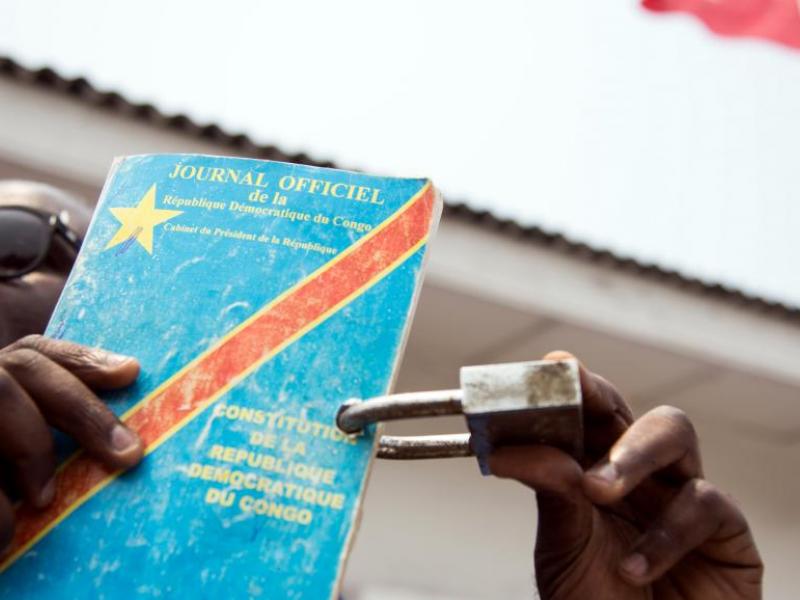
The Democratic Republic of the Congo (DRC) is witnessing a surge in academic debates centered on the country’s Constitution, just as the government ramps up efforts to push through sweeping reforms. From June 10 to 12, universities across Kinshasa, Kisangani, and Lubumbashi will host high-level scientific colloquia, organized by the Ministry of Higher Education, Scientific Research, and Innovation. The initiative aims to foster rigorous academic analysis of the 2006 Constitution, evaluating its strengths, weaknesses, and potential adaptations to modern realities.
The three-day event will unfold under three distinct thematic clusters: Kinshasa will focus on geostrategic matters, Kisangani on sociological and environmental challenges, while Lubumbashi will examine industrial and energy transition issues. Participation is open to academics, constitutional law experts, social scientists, researchers, and advanced-level students, with a call for widespread mobilization to ensure robust contributions.
In addressing participants, Minister Sombo Ayanne Safi Mukuna Marie-Thérèse emphasized the critical role of universities as incubators of ideas and policy recommendations. “This colloquium is not just an academic exercise; it is a national imperative to strengthen democratic governance, uphold the rule of law, and accelerate sustainable development,” she stated. The minister underscored the urgency of formulating actionable recommendations to guide future constitutional discussions.
The timing of these scholarly gatherings is particularly significant. Earlier this week, the National Assembly approved a referendum bill, reigniting the long-standing debate over constitutional amendment or replacement. The ruling coalition, including the UDPS (Union for Democracy and Social Progress), argues that the 2006 Constitution is outdated and ill-suited to the country’s current challenges. Critics highlight issues such as ambiguous nationality clauses, governance inefficiencies, and the need to align the document with national priorities. Some proponents even cite the upcoming 2028 elections as a reason to revisit the Constitution, though the feasibility of such a process remains widely debated.
Opposition voices, however, view the government’s push for reform with deep skepticism. They accuse authorities of attempting to circumvent term limits and consolidate power under President Félix Tshisekedi, whose second and final mandate is set to conclude in January 2029. “This is not about reform; it is about entrenching a third-term agenda,” argued a coalition of civil society groups opposing the constitutional changes. The debate has divided the political landscape, with civil society organizations and opposition parties rallying under platforms such as the Coalition Article 64 for the Defense of Constitutional Order (C64) and the Coalition of Congolese for Constitutional Change (C4).
Meanwhile, the security situation continues to cast a shadow over the constitutional discourse. The resurgence of the M23 rebellion, backed by Rwanda according to DRC officials, has led to the loss of vast territories and displaced hundreds of thousands. This has prompted renewed diplomatic efforts to address the crisis, further complicating the political environment in which constitutional reforms are being deliberated.
The university colloquia represent a rare convergence of academic rigor and political urgency, offering a platform for evidence-based discussions on the nation’s foundational charter. Whether these debates will translate into meaningful reforms—or further entrench divisions—remains to be seen as the DRC navigates one of its most contentious political periods in recent history.

More Stories
Gabon : la participation citoyenne devient un enjeu de gouvernance
Gabon : Force ouvre sa rentrée associative à Akanda sur des propositions citoyennes
Dakar 2026 : Diomaye Faye invite la jeunesse sénégalaise à incarner l’Afrique