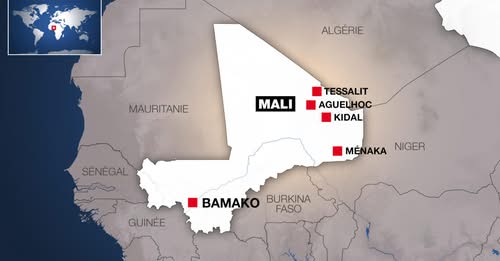
A profound sense of urgency has gripped northern Mali as the regional security landscape undergoes a dramatic transformation. Following the symbolic fall of Kidal, insurgent coalitions have maintained a rapid pace of advancement. Simultaneously, the Groupe de soutien à l’islam et aux musulmans (JNIM) has launched an unprecedented political offensive, advocating for the dissolution of the current transition administration.
Military setbacks and the fall of strategic outposts
The deteriorating situation echoes the historical instability of 2012. On May 1, 2026, combatants from the JNIM and the Front de libération de l’Azawad (FLA) successfully seized the critical military installations at Tessalit and Aguelhoc. These takeovers occurred following the withdrawal of the Malian Armed Forces (FAMa) and their Africa Corps partners, enabling the insurgents to occupy the sites without direct confrontation.
The gravity of the situation was underscored by verified imagery featuring Seidane Ag Hitta, a prominent JNIM commander, displaying the keys to the Tessalit base. This event, occurring five years after the departure of the French Barkhane force, marks a significant turning point. Since late April, several localities including Ber, Tessit, Hombori, and Gourma Rharous have been reclaimed by armed groups, placing the residents of Gao and Tombouctou in a state of heightened apprehension.
The response from Bamako and continued Russian cooperation
Despite these significant territorial losses, the administration at the Koulouba palace remains resolute. General Assimi Goïta has issued a call for national mobilization, asserting that the state will not be deterred by external intimidation. The government’s strategy currently focuses on two primary areas:
- Aerial and ground operations: The Malian military has intensified precision strikes in Kidal, targeting administrative buildings and supply hubs. While the FLA disputes official casualty figures, Bamako maintains that numerous insurgents have been neutralized.
- Logistical resilience: To counter a jihadist-led blockade of major transit routes, a significant convoy of 800 fuel tankers successfully reached the capital this past Friday, supported by air cover and ground troops.
From Moscow, the Kremlin reaffirmed through Dmitri Peskov its unwavering commitment to the transition authorities, dismissing any speculation regarding a potential Russian withdrawal following the incidents in Kidal.
The political evolution of JNIM
A notable development in this conflict is the shifting communication strategy of the JNIM. In a statement released on April 30, the group adopted a political lexicon similar to that of its opponents, moving away from purely militant rhetoric. By utilizing concepts such as “sovereignty” and “national dignity,” the organization is attempting to forge a “common front” with political parties and religious leaders to establish a “peaceful transition” and end the current military rule. However, their ultimate objective remains the implementation of Sharia law.
This ideological shift has created a complex dilemma for the Malian political class, as some leaders weigh the risks of potential dialogue against the ongoing territorial erosion.
Internal pressures on the transition government
The crisis has also manifested within the state’s internal structures. The public prosecutor in Bamako recently announced the detention of several Malian soldiers suspected of collaborating with insurgent forces during recent hostilities. With the combination of territorial losses, the JNIM‘s new political overtures, and the economic strain of the blockade, the transition government is facing its most critical trial to date. The future of Mali is now being contested through both military force in the north and political legitimacy in the capital.