
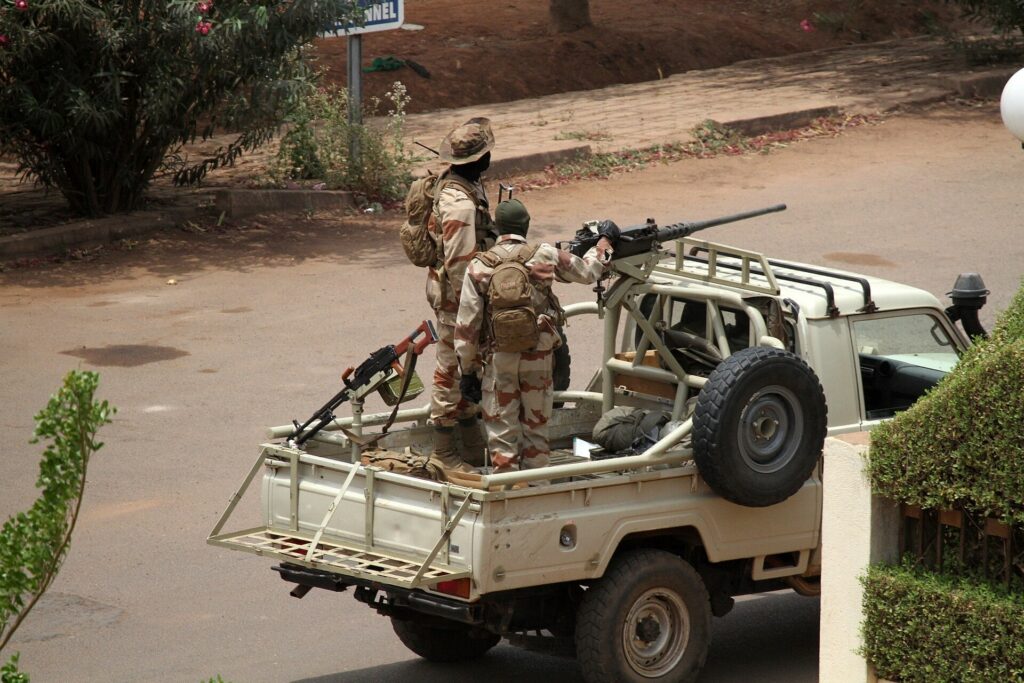
The coordinated attacks launched throughout Mali on April 25 represent more than just a continuation of the country’s long-standing turmoil; they mark a critical turning point. By targeting military sites and urban hubs simultaneously, Islamist insurgents and Tuareg rebels forced Russian-supported government troops out of the strategic northern town of Kidal. This move highlights an operational capacity that now poses a direct threat to Bamako. For the Sahel region, and specifically for Algeria, the concern has shifted from whether stability is possible to whether anyone can actually prevent a total collapse.
The failed gamble of the military junta
To grasp the current state of Mali, one must look at the political path taken after the 2021 coup. Under Colonel Assimi Goita, the military leadership expelled French troops and ended the UN’s MINUSMA mission, choosing instead to rely on the Wagner Group—now under direct Russian state oversight. While Western observers warned this would create a dangerous security gap, the junta dismissed such concerns as neocolonial interference. The recent April offensive has proven those warnings correct.
The Russian forces, marketed as an elite counter-insurgency solution, have failed to hold Kidal, a city of deep symbolic importance to the Tuareg movement. Rather than being suppressed by Russian power, militants have refined their tactics and expanded their reach. The trade-off—losing French logistics and regional expertise for Russian support—is proving insufficient against an increasingly capable insurgency.
The tactical alliance between Islamist groups and Tuareg rebels is particularly alarming. Historically at odds, their current cooperation suggests they both view the junta as vulnerable. Their recent successes indicate this assessment is likely accurate.
Algeria’s precarious security position
No neighbor is more concerned about the situation in Mali than Algeria. Sharing an expansive and porous southern border, Algiers has long dealt with the flow of contraband, weapons, and militants. Experience has taught Algerian leaders that instability in the Sahel quickly spills over into their own territory.
Algeria’s current predicament is ironic. For years, it acted as the primary mediator, facilitating the 2015 Algiers Peace Agreement. However, that deal fell apart when Goita officially abandoned it in early 2024. Relations worsened in March 2025 after Algerian forces downed a Malian drone near the border, leading to a diplomatic break with Bamako and its partners in the Alliance of Sahel States, including Niger and Burkina Faso.
Now, Algeria finds itself isolated from a crisis that directly threatens its safety. It lacks the influence to dictate terms to a hostile junta and cannot ignore the possibility of armed groups establishing permanent bases along its southern frontier—a scenario that poses an existential threat to Algeria’s internal peace.
While Foreign Minister Ahmed Attaf has reaffirmed support for Mali’s unity and condemned terrorism, these diplomatic gestures cannot replace the broken communication channels between the two nations.
The consequences of American disengagement
The unraveling of the Sahel is also linked to the reduced presence of the United States. As Washington scaled back its counter-terrorism efforts in West Africa amid pressure from Moscow-aligned regimes, a power vacuum emerged. Russia has stepped in with military contractors, while extremist networks have filled the void by providing governance and recruitment in neglected territories.
The situation in Mali serves as a warning: security partnerships and intelligence sharing are essential for regional stability. Without them, the resulting vacuum is quickly filled by hostile actors.
Potential paths forward
Three possible futures are emerging. The Malian junta may seek a political deal with Tuareg groups, sacrificing territory for peace. Alternatively, they might escalate military efforts with Russian support, though the outcome remains doubtful. Finally, the current trend of tactical retreats could continue until Bamako itself is under siege.
Algeria views these possibilities with deep concern. The crisis in the Sahel is no longer a distant problem; it has reached the very edge of its borders.

More Stories
Stratégie préventive du Bénin pour protéger l’éducation face à l’insécurité au Nord
Niger: why general Salaou Barmou’s exit raises hard questions about sovereignty
Niger: the widening gap between transition rhetoric and the reality on the ground