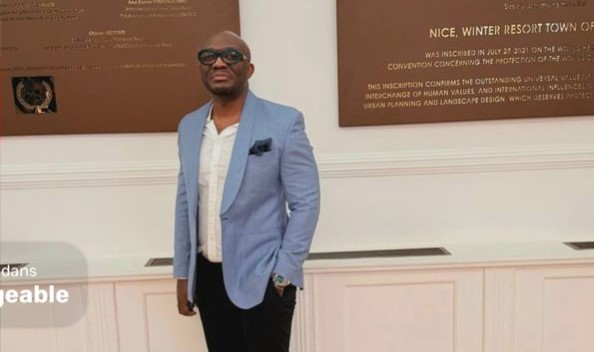
The recent wave of insults targeting Gabonese President Brice Clotaire Oligui Nguema, his mother, and his wife has prompted a strong reaction from Hugues Ongoundou. In a sharply worded opinion piece, he emphasizes that this issue transcends mere political alignment or opposition to the government’s policies. For Ongoundou, attacking a mother and grandmother who has no involvement in politics, or the spouse of a public figure, crosses a fundamental line that goes beyond individual personalities.
Highlighting what he terms the ‘verbal filth’ and the growing normalization of obscenity in Gabon’s public discourse, Ongoundou underlines the urgent need to separate legitimate criticism from vulgarity. He has announced plans to explore legal avenues to address these concerns, signaling a commitment to upholding dignity in national conversations.
When insults target what matters most
Ongoundou’s stance is rooted in a deep concern for the erosion of societal values. He expresses shock at the attacks on the President’s mother—a woman of quiet dignity, far removed from political life—as well as the First Lady and the Head of State himself. These insults, he argues, are not just personal affronts but symbolic attacks on the very fabric of Gabonese society.
‘It’s not just three people being insulted,’ he writes. ‘When a mother, grandmother, or wife is publicly degraded, it’s our mothers, grandmothers, sisters, and daughters who are dragged through the mud. It’s our national identity that takes the hit. It’s our values that dry up.’
The deeper damage: A nation losing its soul
Ongoundou goes beyond the immediate outrage to highlight a broader crisis: the symbolic destruction of Gabon’s moral foundation. He points out that mothers represent tradition, grandmothers embody memory, and women are pillars of family and society. Fathers, too, are part of this unbroken chain of transmission across generations.
‘When these figures are publicly humiliated, it’s not just them being attacked—it’s our moral heritage that is trampled upon,’ he states. ‘It’s the symbolic power of our nation that is broken—not in the crude sense, but in what it represents: strength, dignity, and the collective ability to stand tall.’
From social media to a national malaise
Ongoundou warns that these incidents are not isolated online outbursts but symptoms of a deeper societal sickness. He laments the fading of once-cherished values like patriotism, respect for elders, and personal honor—values that were once central to civic education and cultural transmission.
‘There was a time when decency, reverence for ancestors, and honor were taught as core principles,’ he reflects. ‘Today, some of that wisdom seems to have vanished. And where virtue fades, vice prospers.’
He draws a stark contrast between those who build and those who destroy: ‘When insults become entertainment, when humiliation becomes a spectacle, and when those who degrade others gain popularity, it’s not just a political problem—it’s a moral collapse.’
Collective responsibility in the face of vulgarity
Ongoundou makes a powerful appeal to all Gabonese citizens: ‘Every time someone laughs at such abject remarks, shares them for amusement, or normalizes their spread, they contribute—willingly or not—to this decay. Every time we allow political debate to become a contest of insults, we weaken the very foundations that should unite us.’
He acknowledges the existence of responsible opposition figures who critique policies without resorting to personal attacks. ‘There are citizens who know how to challenge power with arguments, not insults,’ he notes. ‘They recognize what is well done and denounce what is not—without dragging families into the mud.’
Activism vs. irresponsibility: Where to draw the line?
Ongoundou firmly rejects the idea that activism or opposition grants carte blanche for vulgarity. ‘Being an activist means bearing responsibility,’ he asserts. ‘Being an opponent does not mean having unlimited freedom to speak. Being free does not mean being reckless.’
He clarifies his mission: ‘I am not here to silence political criticism. I want us to reclaim a public debate where intelligence, reasoned contradiction, and responsibility replace insults, obscenity, and humiliation.’
A personal vow to uphold dignity
Ongoundou frames his stance as a deeply personal commitment. ‘I have a father. I have a mother. And I am their son,’ he writes. ‘This simple truth anchors my belief in respect—for life itself, for those who gave it to us, and for the values they instilled in me.’
He refuses to accept a future where mothers, fathers, or children become targets of political spite. ‘I will not ask my children to respect their parents tomorrow if I accept the public humiliation of parents today,’ he states. ‘I refuse to live in a society where vulgarity is rewarded more than virtue.’
In closing, Ongoundou announces his intention to take legal action to address the normalization of such insults. ‘I will consult with legal experts to explore all available avenues,’ he declares. ‘This step is mine alone—I speak as a Gabonese, as a citizen, and as a son. My goal is not to silence criticism but to restore dignity to our national discourse.’
He ends with a call to action: ‘Each of us must choose between preserving our values or watching them erode. I have made my choice. Now it is your turn.’
Hugues Ongoundou