Nigeria’s security crisis is deeply intertwined with Mali’s collapse
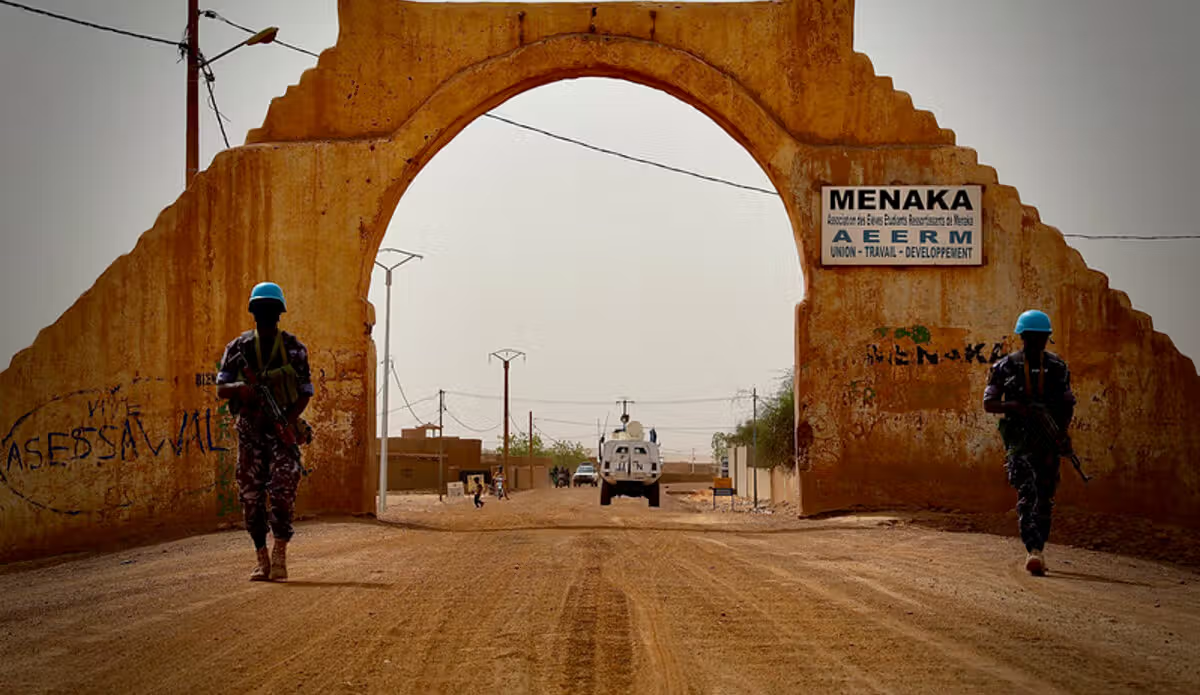
Nigeria isn’t just observing the turmoil in Mali—it’s actively experiencing its ripple effects. The crisis in Mali, along with instability in Burkina Faso and Niger, has transformed West Africa’s security dynamics. These nations now account for the majority of conflict-related fatalities in the region, with coordinated attacks in Mali—spanning from Kati to Gao and Mopti—highlighting a strained regional security framework.
For Nigeria, the threat isn’t merely spillover; it’s a reinforcement of existing dangers. The Sahel’s instability is no longer an external concern but a critical factor shaping the country’s internal vulnerabilities.
A regional crisis with far-reaching domestic impacts
The Sahel’s instability is fueling Nigeria’s security challenges through multiple channels. Three dominant armed factions—Jama’at Nusrat al-Islam wal-Muslimin (JNIM), affiliated with al-Qaeda, Islamic State–linked groups operating in the Lake Chad basin, and Tuareg separatist coalitions in northern Mali—are redefining conflict in the region.
These groups operate across porous borders, extracting resources through informal taxation and replacing state authority in rural zones with coercive governance. Their influence extends into Nigeria not through territorial expansion but via arms trafficking, tactical adaptations, economic networks, and mass displacement. As a result, Nigeria’s security must be viewed through a transnational lens, not confined to national boundaries.
The Lake Chad basin: A hotspot of regional insecurity
The Lake Chad basin epitomizes the intersection of Nigeria’s internal threats and broader Sahel instability. Groups like ISWAP operate seamlessly across Nigeria, Niger, Chad, and Cameroon, exploiting shared ecological and economic systems. Weak rural governance has enabled armed actors to regulate trade, impose taxes, and control movement, creating parallel systems of authority.
Research indicates ISWAP generates approximately $191 million annually from taxing farmers and fishers—far surpassing Borno State’s official revenue of $18.4 million in 2024. This isn’t just insurgency; it’s a form of competing governance. Instability in Mali and Niger further weakens border controls, facilitating arms trafficking and displacement into already fragile regions.
Nigeria’s northwest: A microcosm of Sahel-style insecurity
In states like Sokoto, Zamfara, and Katsina, armed groups have merged criminal enterprises with insurgent-style governance. In Zamfara, reports and anti-corruption investigations reveal structured rural taxation systems generating hundreds of millions of naira annually across multiple local governments. This reflects embedded local economies rather than sporadic crime.
In contrast, Boko Haram’s financing, previously linked to Gulf-based facilitators, has become fragmented and limited, involving smaller transfers rather than sustained revenue streams. Nigeria’s insecurity is increasingly sustained by domestic coercive economies, including kidnapping-for-ransom and illicit gold mining, which generate ₦200–300 million weekly in Zamfara alone. These patterns mirror trends in Mali and Burkina Faso, where insurgents finance operations through extraction and taxation. Recent reports of Islamic State–linked infiltration in Kebbi and Sokoto underscore this convergence.
ECOWAS fragmentation and the erosion of regional coordination
The withdrawal of Mali, Burkina Faso, and Niger from ECOWAS and the formation of the Alliance of Sahel States (AES) have weakened intelligence-sharing and joint operational capabilities. Though Nigeria remains West Africa’s central military and diplomatic force, the region’s security architecture is more fragmented than in decades. Abuja’s efforts to re-engage Sahelian states underscore the challenges of maintaining cohesion amid such division. This fragmentation is particularly concerning as insurgent networks grow increasingly transnational at a time when regional coordination is declining.
A triple crisis: governance, economy, and survival
The consequences of insecurity extend beyond security metrics. They are reshaping livelihoods across northern Nigeria, disrupting farming cycles, reducing food production, and driving unemployment. Projections suggest over 20 million Nigerians may require food assistance during the 2026 lean season, partly due to conflict-related disruptions. Armed groups are targeting rural economies because they recognize their strategic value better than the state. Controlling food systems, livestock routes, and local markets translates into both revenue and influence. The crisis has escalated to the point where President Bola Ahmed Tinubu declared poverty and insecurity national emergencies—a reflection of systemic strain.
External pressures and tightening operational margins
Nigeria’s security response is under growing strain, with potential reductions in Western security assistance—whether in intelligence, humanitarian aid, or governance programs—impacting operational flexibility. While these changes alone may not dictate outcomes, they reduce the system’s resilience. In a landscape where insurgent networks are becoming more mobile and adaptive, even minor reductions in coordination or funding can have cumulative effects. The challenge isn’t dependency; it’s elasticity—the capacity of Nigeria’s security system to absorb pressure without collapsing.
Why military action alone falls short
Nigeria has made progress in degrading insurgent capabilities, particularly in the northeast. Yet three structural weaknesses persist: cleared territories often lack stabilization, insurgents adapt faster than institutions can reform, and rural economies remain vulnerable to coercive capture in sectors like mining, agriculture, and livestock. These factors create a cycle where insecurity regenerates faster than it is resolved.
Rethinking the response: systemic disruption over containment
A more effective strategy requires shifting from reactive measures to systemic disruption. Key steps include:
- Intelligence-led border security: Move beyond static defenses to control movement systems that bypass borders.
- Rural governance as security infrastructure: Strengthen justice systems, dispute resolution, and local administration to deny armed groups legitimacy.
- Address insurgency and banditry as interconnected systems: Avoid artificial policy divisions that weaken response coherence.
- Target financial networks: Disrupt illicit mining, ransom economies, and informal taxation systems that sustain insurgent groups.
- Stabilize the Lake Chad basin as a regional system: Recognize that no single nation can resolve the crisis alone.
Turning the tide: breaking the Sahel-Nigeria insecurity loop
The defining shift in West African security today isn’t the rise of a single group—it’s the convergence of insecurity systems across borders. Mali’s crisis serves as a stark example of what occurs when governance gaps, insurgent adaptation, and regional fragmentation intersect. For Nigeria, this intersection reveals where leverage lies. By disrupting the internal-external feedback loop through stronger governance, financial pressure, and regional coordination, insecurity can be contained and outcompeted rather than allowed to flourish.