In a Senegal where secularism coexists with deep-rooted Sufi traditions, religious fervor often intersects with the political agenda. The historical figures of Senegalese Islam are now at the heart of sovereignist rhetoric, with political leaders drawing from their legacy to forge a national identity free from foreign influence while securing the allegiance of spiritual leaders.
Political leaders embrace the anticolonial legacy of Sufi guides
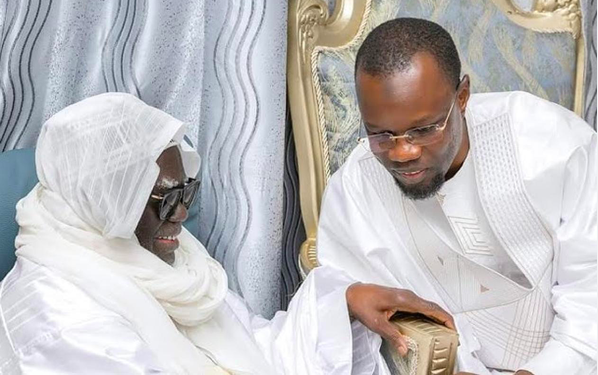
From Bassirou Diomaye Faye to Ousmane Sonko, the political elite are increasingly turning to the history of these religious leaders to craft a narrative of resilience and self-determination. The shared conviction between the president and the president of the National Assembly—despite their political rift—lies in the necessity to publicly align with religious dignitaries. Just days before the Grand Magal pilgrimage on July 26, the head of state traveled to Touba to meet Serigne Mountakha Mbacké, the general khalif of the Mouride brotherhood. Ousmane Sonko followed suit four days later, highlighting the immense influence of these spiritual guides, who remain “a unifying force in the nation” amid regime crises.
During his visit, Ousmane Sonko took a significant ideological step by claiming the legacy of Cheikh Ahmadou Bamba, the founder of the Mouride brotherhood and a towering figure of peaceful resistance against French colonial rule. The president of the National Assembly drew parallels between his policies and the model championed by the marabout, renowned for rejecting French funding to “ensure the independence of the faithful communities.”
Nationalist awakening through a religious lens
This revival is not coincidental. It reflects a broader intellectual movement rediscovering the anticolonial past of religious leaders. Cheikh Gueye, a researcher and Mouride disciple, explains this phenomenon: “More and more people are rediscovering the great figures of Senegalese Islam through an anticolonial and political prism.”
The movement invokes not only Cheikh Ahmadou Bamba but also El Hadj Oumar Tall, a leader of the Tidjaniya brotherhood, and Thierno Souleymane Baal, who founded a theocratic state in the 18th century. These figures are championed by sovereignist activists, such as those in the Frapp movement, as “sources of political inspiration without sacralizing them.”
Historical complexity meets modern youth
Yet this unifying national narrative sometimes clashes with historical complexities. Some religious leaders later facilitated the recruitment of tirailleurs for the French army, a duality that today’s youth, with their independent mindset, appear ready to acknowledge. Mamadou Fall, editor of the upcoming General History of Senegal, emphasizes the need to integrate this religious pantheon into school curricula while acknowledging these nuances. He notes that some of these anticolonial heroes are also perceived in other regions as “violent conquerors who arrived armed.”
More Stories
Behind the Bambali agro-industrial park launch: what Sonko and Mané’s vision reveals about Senegal’s rural transformation
Senegal’s upcoming local elections: what is Diomaye Faye hiding about the 2027 vote?
Senegal’s shadow budget: why unchecked special funds drain public trust and budgets