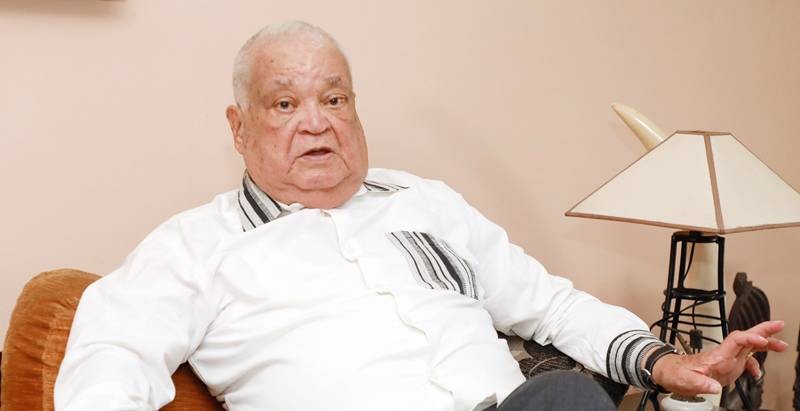
In a candid conversation marking the release of his biography, « Auguste Miremont: From Houphouët to Ouattara, With Unfiltered Honesty… », the former Ivorian Communication Minister shared profound insights on Côte d’Ivoire’s political evolution. Now 85, Auguste Miremont, who also served as Director-General of Fraternité Matin, reflected on decades of leadership, crises, and national resilience.
a journey through ivory coast’s modern history
Auguste Miremont, the first-ever Minister of Communication in Côte d’Ivoire (then Information) from 1989 to 1993, has spent a lifetime immersed in the country’s political and media landscape. His new memoir, co-authored with journalist Michel Koffi over 18 months and 30 hours of interviews, offers an intimate look at the nation’s transformation under successive leaders.
« At first, I hesitated,» Miremont admitted. « But many urged me to share my experiences—not for personal glorification, but for posterity. The people want to understand how we built this country and where we went wrong.» His reluctance gave way to a collaborative effort that blended professionalism and deep mutual trust, rooted in decades of shared work in Ivorian media and governance.
lessons in leadership: houphouët’s enduring influence
Miremont’s reflections center on the leadership styles of Côte d’Ivoire’s late President Félix Houphouët-Boigny and his successors, particularly current President Alassane Ouattara. He attributes Ouattara’s political acumen to the mentorship of Houphouët-Boigny, praising his ability to listen, mediate, and act decisively during crises.
« Houphouët-Boigny governed through crisis management,» Miremont explained. « He knew when to delay, when to compromise, and when to act firmly. His successors faced far greater challenges, not least the violent political fractures that followed his era.»
Among the most painful periods for Miremont was the 1999 military coup that ousted President Henri Konan Bédié, a man he described as a personal friend. « To see our stability crumble was heartbreaking,» he said. « Côte d’Ivoire was once a beacon in West Africa—welcoming refugees, mediating conflicts, and fostering development. Suddenly, we became a cautionary tale in international media.»
The crisis deepened during the transitions to Robert Guéï and Laurent Gbagbo, though Miremont maintained cordial relations with all three. He recalled Gbagbo’s efforts to unite political factions during economic hardship: « He supported a grand coalition government, including the PDCI. If not for the subsequent turmoil, we might have achieved national reconciliation.»
ouattara’s presidency: continuity and change
Miremont reserves high praise for President Ouattara, whom he credits with absorbing Houphouët-Boigny’s pragmatic leadership while adapting to modern challenges. « Ouattara learned patience, tact, and timing from Houphouët,» he noted. « Yet as Prime Minister, he was far more rigorous—relentless in enforcing discipline. Today, he balances firmness with compassion, a maturity born of experience.»
He highlighted Ouattara’s achievements: « His infrastructure projects—from universities to highways—are transforming the interior. In my hometown, Bin-Houyé, roads now connect communities that were once isolated. These are tangible signs of progress.»
Still, Miremont cautioned against overlooking social disparities. « Economic growth is real, but so is the cost of living. The government’s response—through social safety nets and vocational training—shows awareness. Initiatives like the ‘Second Chance Schools’ give hope to those left behind.»
legacy and the path forward
As Ouattara begins his final term, Miremont urged patience: « He remains firmly at the helm, and we must let him complete his mandate. His vision—a united, prosperous Côte d’Ivoire—is within reach.»
Reflecting on his own role, Miremont emphasized the book’s purpose: « This isn’t about me. It’s about preserving the lessons of our past for the next generation. If my story helps them avoid our mistakes, then it has served its purpose.»