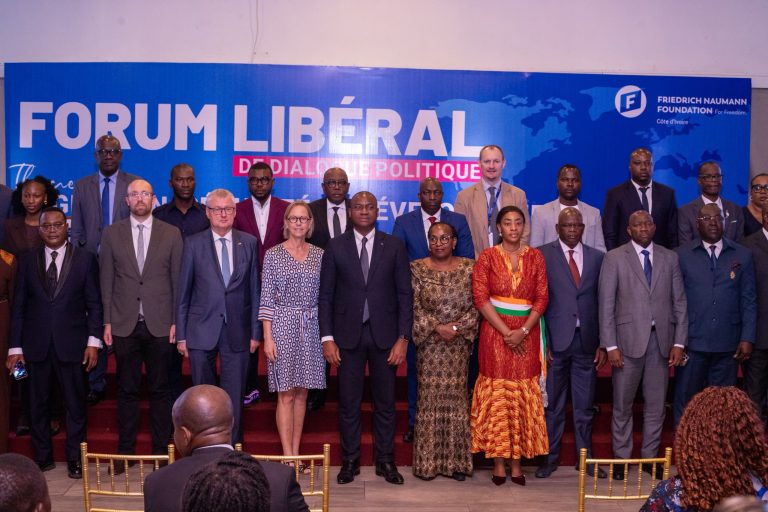
Abidjan — Key voices in Côte d’Ivoire’s political and civil society spheres have underscored the need for a fresh approach to Africa-Europe collaboration on migration matters. Speaking at the opening of the Liberal Political Dialogue Forum held in Abidjan from July 15 to 16, 2026, Sidi Touré, Vice-President of the Liberal International and Côte d’Ivoire’s Minister of Animal and Fisheries Resources, and Alexandra Heldt, Regional Director for West Africa at the Friedrich Naumann Foundation, jointly advocated for a shift away from restrictive narratives.
Migration as a matter of freedom, not just policy
Sidi Touré challenged the dominant security-focused discourse, framing migration as a fundamental human freedom rather than a problem to be contained. Citing United Nations data, he noted that migrants constitute just 3.7% of the global population. “Over 96% of people live in the country of their birth. The world is not being overwhelmed,” he stated, urging policymakers to move beyond fear-based rhetoric.
The minister highlighted the everyday reality of African migration, pointing out that 70% of movements on the continent occur within Africa itself. He described the constant flow of travelers at Adjamé’s main bus terminal in Abidjan not as a crisis, but as a natural part of life. Emphasizing Côte d’Ivoire’s tradition of openness symbolized by the greeting *Akwaba*—“welcome”—he stressed that hospitality is not a sign of weakness, but a strategic asset.
Regional solidarity in the face of political shifts
Sidi Touré also expressed concern over recent political developments in Mali, Burkina Faso, and Niger, particularly their withdrawal from the Economic Community of West African States (ECOWAS). “Despite political differences, our peoples remain brothers and sisters, our economies are intertwined, and the principle of free movement must be preserved as a shared heritage,” he declared. He expressed hope that the forum would yield actionable policy recommendations, to be compiled in a comprehensive policy paper.
Rejecting xenophobia and building bridges
Alexandra Heldt took aim at rising xenophobic sentiments on both sides of the Mediterranean. She recalled the recurring waves of violence against migrants in South Africa since 2008, warning that no nation can achieve sustainable progress by scapegoating migrants for economic challenges. “Blame does not build economies—cooperation does,” she asserted.
She also spotlighted a growing contradiction in Europe, where labor shortages coexist with increasingly hostile immigration rhetoric. “Migration is not about building walls—it’s about constructing bridges,” she said. “It fosters exchange, innovation, and entrepreneurship. It connects people in ways that no policy ever could.”
Advocating for an “equitable partnership” between Africa and Europe, she called on leaders to prioritize mobility, shared responsibility, and core values of liberty. “We must speak less of fear and more of trust. Less of exclusion and more of cooperation,” she urged.
Toward a shared future through migration
Sidi Touré closed by reaffirming his conviction that “hospitality is a strength—and a policy.” He emphasized his commitment to positioning migration not as a challenge, but as a catalyst for inclusive development across both continents.
The forum continued with in-depth discussions across multiple panels, examining the legal, geopolitical, and humanitarian dimensions of migration.