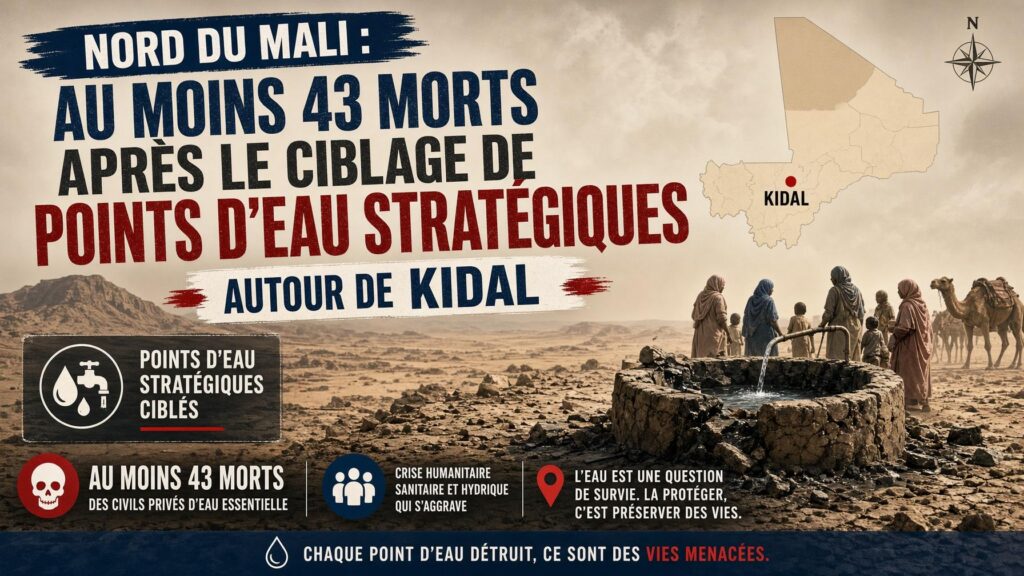
The strikes that tore through the arid expanse around Kidal on 15 and 16 September 2026 did more than kill at least 43 people. They severed the single thread keeping thousands of nomadic families and their herds alive in northern Mali. With water infrastructure reduced to rubble, the consequences are rippling outward: livestock collapsing, local markets shutting down, and entire communities facing a future they never chose.
A two-day offensive that turned water into a weapon of war
On the morning of 15 September, a Su-24 bomber struck the settlement of Amassine in the Kidal region. The target was the village well — the only watering point for the herds of surrounding nomadic groups. The following day, the pressure shifted to Tassik, where Malian armed forces, backed by Russian paramilitary elements, hit hydraulic infrastructure once again. By nightfall on 16 September, the combined toll stood at no fewer than 43 dead, with many more civilians wounded while they were simply drawing water or tending animals near these lifelines.
Asphyxiation as a strategy: what the well strikes really aim to do
These attacks are not random acts of war. They fit a pattern observed over recent months across the Kidal periphery: deliberately cutting off potable water to make pastoral life impossible. The same logic has already scarred the city of Kidal itself, where public water and electricity networks have suffered repeated damage, and mosques have been hit during military security operations.
From rural wells to urban collapse: a widening circle of harm
When wells are destroyed outside towns, families flee inward. When urban infrastructure fails, those same families find no refuge. The result is a slow-motion humanitarian emergency that touches every layer of society, from herders to shopkeepers to the already strained services of regional towns.
The human and economic fallout: pastoralism on the edge of extinction
In the Malian far north, water is not merely a drink. It is the foundation of an entire economic model. Without wells, pastures become unreachable and livestock — the principal wealth of families — dies within days under extreme heat. The table below shows how the loss of water access translates directly into human suffering.
| Impact area | Direct consequences for communities |
|---|---|
| Access to drinking water | Immediate shortage for thousands of people and heightened health risks |
| Pastoral economy | Irreversible loss of livestock through dehydration, collapse of local markets |
| Population movements | Forced displacement of nomadic families toward already overcrowded urban areas |
Without water points, cattle perish in a matter of days. Generations of herders lose their savings, their food supply and their identity. Many households now face an impossible choice: stay and risk starvation, or abandon their traditional way of life for precarious shelter in tense urban centres.
A humanitarian crisis at breaking point
As military tensions remain high across northern Mali, access for international organisations and relief teams on the ground is severely restricted. The destruction of basic civilian infrastructure raises a fundamental question about respect for international humanitarian law, which strictly protects objects indispensable to the survival of civilian populations.
If the targeting of wells and water networks continues, the Kidal region could see mass displacement and the spectre of pastoral famine in the weeks ahead. The 43 dead are not just a death toll — they are a warning that an entire way of life is being erased, one well at a time.


More Stories
Niger’s youth answer the FPL call: the real consequences for families, farms and businesses
Chad: 150 Klessoum inmates freed under collective sentence relief — what it means for families and local livelihoods
Benin’s sovereign rating jumps to AA-: real-world consequences for businesses and households