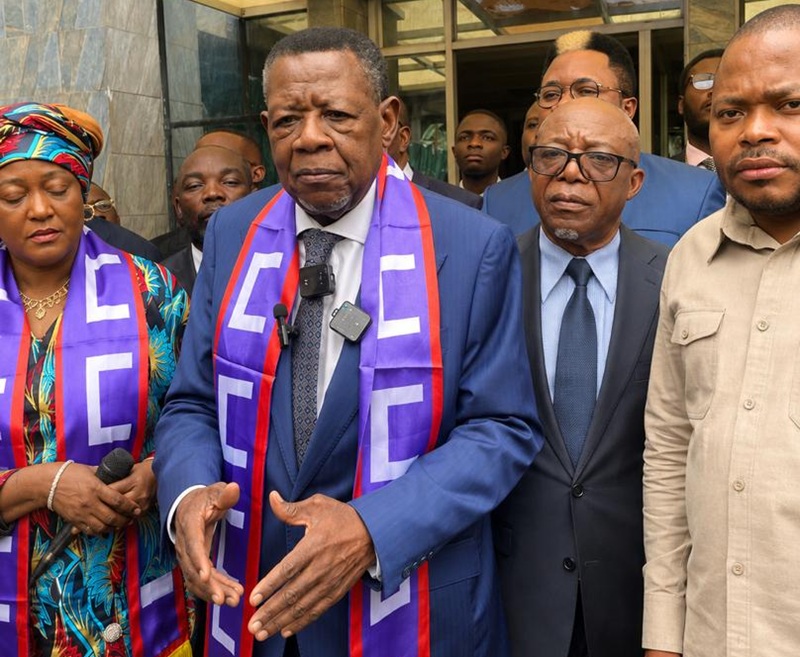
A sharp-witted Lambert Mende, leader of the United Congolese Convention (CCU), delivered a fiery political address during a Monday morning gathering in Kinshasa. The speech, framed as a clarion call from the ‘Lumumbist wing of the CCU to the Nation,’ dissected the deepening security and humanitarian crisis gripping the Democratic Republic of the Congo.
At the heart of Mende’s remarks lay a probing question: ‘What will tomorrow bring?’ He framed the existential threat facing the DRC as a clarion call for national unity, urging Congolese citizens to set aside political divides in the face of what he described as a coordinated aggression by Rwanda.
Kigali’s hand in DRC’s turmoil
Mende pulled no punches in assigning responsibility for the persistent instability in eastern DRC to Kigali. He alleged that multiple armed factions operating in the region act as proxies for Rwanda, echoing long-standing accusations of foreign interference. According to Mende, the justifications offered by Rwandan President Paul Kagame—ranging from the presence of the FDLR rebels to the protection of Kivu’s Tutsi community—have gradually morphed into territorial ambitions that threaten the DRC’s sovereignty.
The CCU leader dismissed these claims as fig leaves for a broader agenda, emphasizing that Rwanda’s actions undermine the Congolese state’s territorial integrity.
Signs of hope amid crisis
Despite painting a grim picture, Mende struck an optimistic note, pointing to international pressure on Kigali as a silver lining. He highlighted U.S. sanctions against Rwanda as a critical factor in constraining its regional ambitions. Additionally, he praised the voluntary disarmament of FDLR combatants, calling it a pivotal step toward dismantling one of Kigali’s primary pretexts for intervention.
National dialogue: CCU sets red lines
The question of an inclusive national dialogue loomed large in Mende’s speech. While acknowledging early consensus among political factions, the CCU insisted that the agenda must prioritize countering Rwanda’s aggression and bolstering national cohesion. Mende cautioned against including individuals with ties to Rwanda or those convicted of collaborating with the aggressor, stressing that only those who unequivocally reject foreign interference should participate.
Constitutional reform: navigating controversy
Mende also weighed in on the contentious issue of constitutional reform, drawing a distinction between the legislative process and a referendum. He argued that extraordinary circumstances—citing the United States during the 20th century and Ukraine’s wartime resilience—could justify adjustments to a nation’s political calendar. For Mende, the DRC’s current crisis demands flexibility in governance to ensure stability.
Tshisekedi’s leadership under scrutiny
The CCU’s stance on President Félix-Antoine Tshisekedi’s tenure was unequivocal: he must remain in office for the duration of Rwanda’s aggression. Mende praised Tshisekedi as the only Congolese leader since 1996 to have taken decisive political, military, and diplomatic measures against Rwanda’s incursions. This position comes amid heated debates over constitutional reform and the country’s institutional future.
A call for unity over politics
Mende’s closing remarks echoed a plea for national unity, urging Congolese to prioritize the country’s survival over political squabbles. He referenced the Ebola epidemic raging along the frontlines of the Rwandan-Congolese conflict, framing the crisis as both humanitarian and existential. His final words—‘Long live the Democratic Republic of the Congo, one and indivisible!’—capped a speech that positioned the CCU as a vanguard for resilience against external aggression.

More Stories
Behind the Bambali agro-industrial park launch: what Sonko and Mané’s vision reveals about Senegal’s rural transformation
Senegal’s upcoming local elections: what is Diomaye Faye hiding about the 2027 vote?
Senegal’s shadow budget: why unchecked special funds drain public trust and budgets