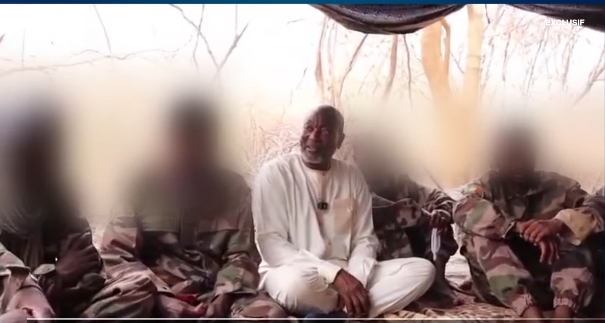
In a development that has sent shockwaves through Mali’s political landscape, the sight of exiled opposition leader Oumar Mariko standing alongside fighters from the Group for the Support of Islam and Muslims (JNIM) to secure the release of 17 hostages has exposed deep fractures in the nation’s fragile transition.
The striking image, which spread rapidly across Malian social media, has become more than a humanitarian milestone—it has become a symbol of the state’s alarming loss of control. While the freed hostages represent a moment of relief for their families, the episode underscores a troubling reality: the Malian government’s inability to assert its authority over vast swathes of territory.
The state’s absence in a time of crisis
The central question emerging from this incident is stark: How did an opposition figure, living in exile and openly critical of Bamako’s transitional authorities, manage to negotiate and secure the release of captives in regions where the national security apparatus has repeatedly failed?
This unofficial mediation lays bare a critical erosion of state sovereignty. In many parts of Mali, the ability to move freely and engage in dialogue appears to rest not with government institutions but with informal actors. Analysts warn this signals a dangerous shift—one where the Malian state is losing its grip on power, leaving a dangerous void that non-state entities are swiftly filling.
The JNIM’s calculated propaganda victory
For the JNIM, this was no humanitarian gesture. It was a meticulously planned propaganda operation designed to serve two key purposes. First, it allowed the group to reframe its image, presenting itself as a rational negotiating party capable of delivering outcomes in stark contrast to the perceived inefficiency of the Malian state. Second, by stepping into the role traditionally held by local officials—such as prefects and mayors—the JNIM positioned itself as the de facto authority in areas where government presence has collapsed, further undermining the legitimacy of Bamako’s institutions.
“Sovereignty is not proclaimed in speeches from Bamako; it is proven when the state can protect its citizens without intermediaries,” noted a regional security analyst.
The hidden costs of shadow diplomacy
Beneath the surface of relief lies a darker truth. The informal resolution of hostage crises carries grave long-term consequences for Mali’s stability:
- Fueling terrorism: Although never officially acknowledged, the payment of covert ransoms—directly or indirectly—provides financial resources that sustain future attacks against Malian armed forces and civilian targets.
- Legitimizing insurgents: Engaging with armed groups in negotiations tacitly acknowledges their control over territory, reinforcing their influence among local populations and emboldening their operations.
The fractured reality of modern Mali
The hostage release has laid bare a stark divide within the country:
- The institutional Mali: In the capital, Bamako, official rhetoric continues to emphasize military progress and the imminent recapture of rebel-held zones.
- The rural Mali: In the countryside, where government reach is minimal, communities are forced into a grim calculus of survival—often relying on uneasy coexistence with armed groups to navigate daily life.
A call for urgent state restoration
The episode is more than a humanitarian footnote; it is a red flag. By allowing private actors and opposition figures to handle matters as critical as national security, Mali risks deepening fragmentation and instability. The challenge now facing Bamako is no longer just military—it is existential. Restoring the state’s authority will require more than battlefield victories; it demands reclaiming legitimacy in regions where dialogue today is brokered under the shadow of armed men, not the rule of law.