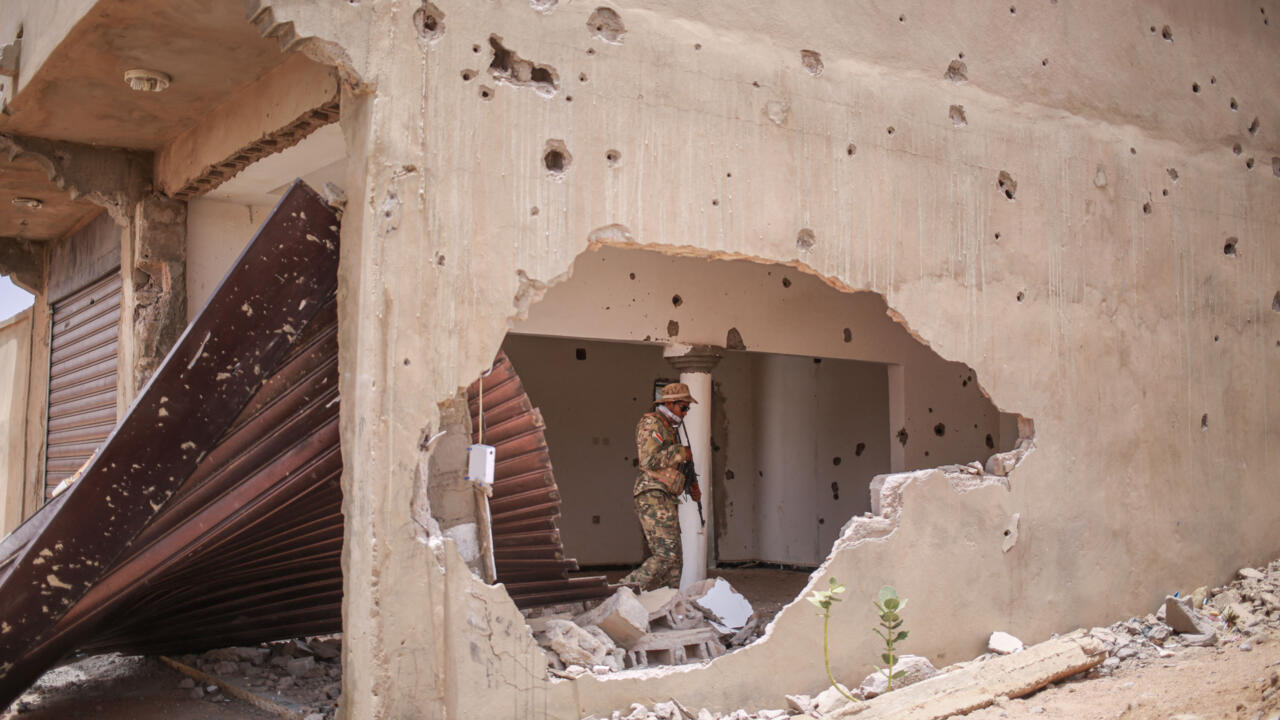
In a recent analysis titled “Mali: anatomy of a security earthquake”, the Timbuktu Institute, an African research center for peace based in Senegal, examined the devastating consequences of the coordinated attacks carried out on April 25 by jihadist groups linked to al-Qaeda and separatist rebels. These assaults, which resulted in the death of Mali’s Defense Minister, General Sadio Camara, and the fall of Kidal in the North, have raised critical questions about the country’s security framework and its reliance on external partners.
external security partnerships under scrutiny after Kidal’s fall
The April 25 attacks exposed the failure of Mali’s security outsourcing strategy, particularly its partnership with Russian forces. Bakary Sambe, Director of the Timbuktu Institute in Dakar, emphasized that the death of General Sadio Camara and the chaotic withdrawal of Russian-backed Africa Corps troops from Kidal symbolize the collapse of the Wagner-Africa Corps approach. Unlike the Barkhane operation, which incorporated civil-military and development aspects, outsourcing security to Moscow proved ineffective against a deeply rooted local insurgency.
While attacks are inevitable when a nation faces armed groups, the Africa Corps’ presence alongside Malian forces has not prevented further setbacks. The withdrawal from Kidal and Tessalit underscores that security outsourcing has not delivered results in Mali. Despite ongoing cooperation, the strategy’s limitations are evident.
alliance of Sahel states fails to deliver on defense pact
The attacks also highlighted the weaknesses of the Alliance of Sahel States (AES), designed as a mutual defense pact. Despite the Liptako-Gourma Charter’s Article 5—comparable to NATO’s collective defense clause—neither Niger nor Burkina Faso provided military support. While leaders like Burkina Faso’s President Traoré condemned the attacks as a “monstrous conspiracy,” no concrete mobilization followed. Burkina Faso’s own security challenges and internal instability limited its ability to respond.
public opinion and the paradox of national unity
The attacks have had a paradoxical effect on Malian public opinion. While the regime’s security promises remain unfulfilled, the crisis has temporarily strengthened national unity. Bakary Sambe noted that the legitimacy of the transitional government now hinges almost entirely on its security narrative. The attacks, reminiscent of the 2012 jihadist takeover, have paradoxically rallied citizens around the flag, reinforcing the regime of General Assimi Goïta—at least in the short term.
jihadist-separatist alliance: a fragile coalition
The unprecedented coordination between the Group for the Support of Islam and Muslims (JNIM), linked to al-Qaeda, and the Azawad Liberation Front (FLA) presents a new strategic challenge for Bamako. While the alliance demonstrates tactical convergence—uniting against a common enemy and pursuing shared interests such as trafficking—its long-term viability is questionable. Fundamental differences persist: JNIM seeks to impose Sharia law, while the FLA demands Azawad’s autonomy. Additionally, the dominance of Katiba Macina elements within JNIM raises doubts about their commitment to the FLA’s separatist goals.
However, the alliance may serve as a catalyst for JNIM’s evolution. By collaborating with figures like Bina Diarra, JNIM is attempting to shed its image as an external movement and position itself as a national political player. This shift could pave the way for future negotiations, though Bamako’s authorities remain opposed to such talks.
the inevitability of dialogue in Mali’s crisis
The question of negotiating with armed groups has gained urgency. While the transitional government insists on a military solution, opposition figures like Imam Dicko’s Coalition of Forces for the Republic (CFR) advocate for inclusive national dialogue. Bakary Sambe argues that dialogue is now unavoidable. With jihadists increasingly rooted in local communities, many Malians believe it is time to engage even with those considered lost. The endogenization of jihadism—where fighters are no longer seen as foreign invaders but as Malians—has made dialogue a necessity to silence the guns.