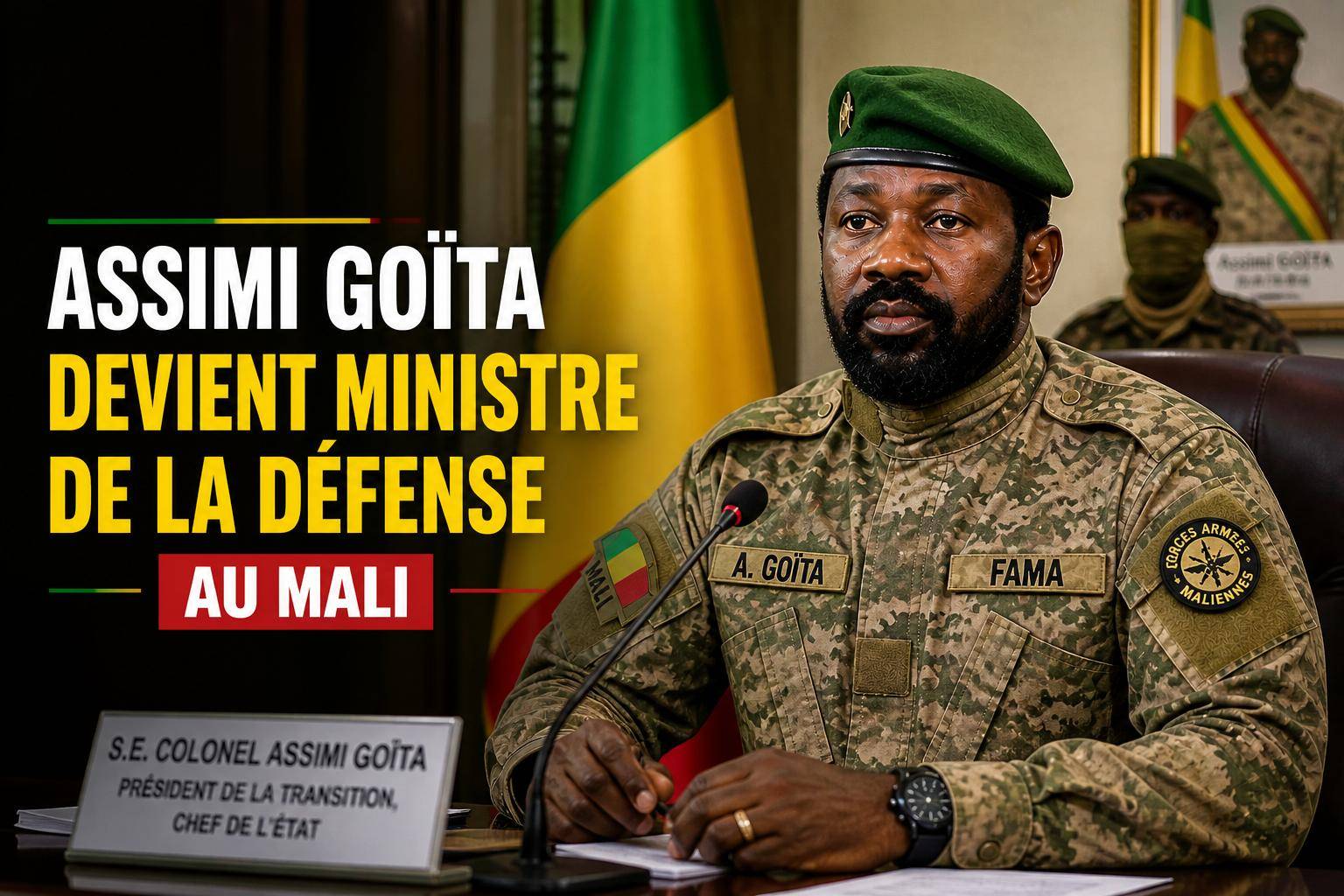
In a bold move that further consolidates his authority, Colonel Assimi Goïta has officially assumed the role of Defense Minister in addition to his presidential duties. This strategic pivot in Bamako marks a significant shift in Mali’s political and military landscape. Far from a routine administrative adjustment, this decision signals deep-seated concerns over a faltering command structure and an increasingly ineffective military strategy.
Centralization of power: a risky gambit
By merging the presidency with the defense portfolio, Assimi Goïta has taken direct operational control of the Malian armed forces. This unprecedented concentration of power places him at the forefront of the country’s security challenges. For regional observers, this move reflects growing mistrust within Mali’s power circles and raises critical questions about governance and accountability.
The implications are stark: how can a single leader effectively manage state affairs, regional diplomacy, and the tactical demands of an asymmetric war? By eliminating intermediary layers of leadership, Goïta has placed himself directly in the line of fire. Every setback on the battlefield will now be directly attributed to him, turning the tide of public opinion against his leadership with each failure.
The fall of Kidal: a strategic and symbolic blow
Once hailed as a symbol of restored national sovereignty, the loss of Kidal has exposed the fragility of Mali’s military gains. The city, a crucial stronghold in the North, has fallen back into the hands of armed groups, including the Jama’at Nusrat al-Islam wal Muslimin (JNIM) and the Coordination of Azawad Movements (CMA/FLA).
This reversal is not merely symbolic—it is a tactical setback. The rapid reoccupation of Kidal by insurgents underscores the inability of the Malian army to sustain control over recaptured territories. The absence of a functional civilian administration and persistent security vacuums have created fertile ground for jihadist and rebel groups to regroup. The JNIM, in particular, has demonstrated a refined strategy, isolating garrisons and severing supply lines, turning what were once perceived as victories into fleeting successes.
The Wagner effect: a partner struggling to deliver
Russia’s paramilitary presence, operating under the banner of Africa Corps, has been touted as a sovereign alternative to former colonial ties with France. However, the security dividends of this partnership remain elusive. While Russian forces are active in key conflict zones, their tactics—often characterized by scorched-earth policies—have done little to stabilize the region and, in fact, risk radicalizing local populations.
Reports of human rights abuses are on the rise, providing fertile ground for terrorist recruitment. Worse still, the technical effectiveness of these instructors has been called into question, as Malian military convoys continue to fall prey to devastating ambushes. With Russia embroiled in its own geopolitical struggles in Europe, the question remains: can Moscow truly deliver the aerial and technological support Mali desperately needs to counter the mobility and resilience of the JNIM?
Regional isolation: the high cost of self-reliance
Mali’s decision to withdraw from the Economic Community of West African States (ECOWAS) and form the Alliance of Sahel States (AES) was framed as a move toward self-sufficiency. Yet, the harsh reality is that terrorism does not respect national borders. Without regional cooperation, Bamako is deprived of critical intelligence-sharing and logistical support from neighboring countries.
The concentration of power under Goïta is perceived by regional capitals as an authoritarian stance that further complicates diplomatic engagement. Mali now finds itself in a paradoxical position: it seeks to assert its sovereignty through military force, yet it remains dangerously dependent on opaque external forces and a command structure entirely vested in one individual.
The looming specter of stalemate: what lies ahead for Mali?
The security situation continues to deteriorate, particularly in central and northern regions. Civilian and military convoys face near-daily attacks, and the humanitarian toll is mounting. With Assimi Goïta now wagering his political future on military outcomes, the stakes could not be higher.
If the security crisis persists, the simmering public discontent—currently suppressed by heavy-handed security measures—could erupt into widespread unrest. History in Africa has shown that excessive centralization of power often precedes major instability. For Mali to break free from this downward spiral, a fundamental reassessment of its overarching strategy is essential. Reliance on brute force and mercenary alliances has proven insufficient. Without inclusive governance and a robust plan for reoccupying and stabilizing territory, Colonel Goïta’s sword may soon find itself blunted by the resilience of armed groups.
The time for war rhetoric is over. What Mali needs now is urgent political realism. Behind the headlines and uniforms, the very existence of the Malian state hangs in the balance on the shifting sands of the North.