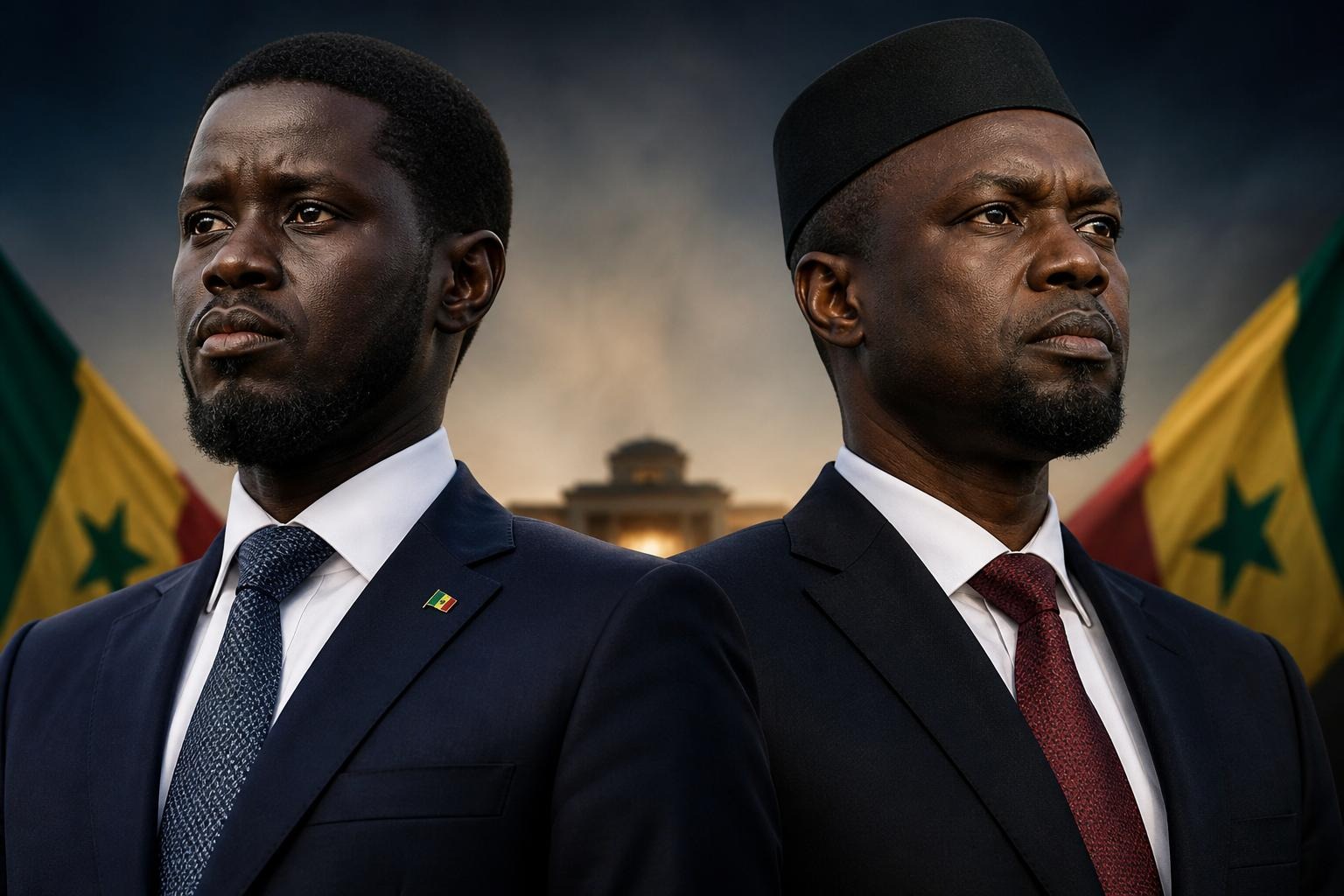
The political landscape in Senegal is undergoing a significant shift as President Bassirou Diomaye Faye asserts his authority in a bold move that challenges the long-standing alliance with Prime Minister Ousmane Sonko. This development, marked by a public declaration of potential separation, signals a break from the once-unified narrative of their leadership.
a turning point in senegalese politics
The weekend of May 2-3, 2026, became a defining moment in the relationship between Faye and Sonko. During a press interview, the President addressed the growing rifts between the government’s policies and the Pastef party’s rhetoric, emphasizing his detachment from partisan politics. He stressed that while his loyalty to the national project remains unwavering, his ultimate responsibility is to the Senegalese people—a statement that underscored his intention to govern independently.
The President’s remarks were a stark contrast to the earlier portrayal of a united leadership duo. His willingness to consider a separation if partisan interests conflict with national priorities sent shockwaves through Dakar’s political circles, signaling a new phase in Senegal’s governance.
the shadow of ousmane sonko: a dominant figure
The friction between the two leaders did not emerge overnight. Their partnership, born from a campaign slogan that equated voting for Faye with endorsing Sonko, has faced mounting strain due to differing strategic visions. While Sonko, the charismatic leader of Pastef, remains a prominent public figure, Faye is pushing for a more centralized and institutionalized leadership style.
Key areas of contention include debt management and international relations, where Sonko advocates for a radical break from traditional approaches, while Faye favors diplomacy and pragmatism. Additionally, disputes over ministerial appointments—between technocratic competence and partisan loyalty—have exacerbated tensions. The contrast in leadership styles, with Sonko’s impassioned rhetoric and Faye’s measured approach, has become increasingly apparent.
is separation inevitable?
While an immediate split seems unlikely, the possibility is now a tangible reality. Faye’s public stance suggests he is determined to carve out his own path, free from the constraints of party directives. Insiders from the Prime Minister’s office downplay the remarks as mere role differentiation, but the President’s message carries deeper implications: the presidency will not be held hostage by any faction.
This unfolding scenario has cast a shadow of institutional uncertainty over Senegal. Past experiences of strained executive duos have raised concerns about potential governmental paralysis. Should a rupture occur, Faye would need to navigate governance without the full support of Pastef’s machinery, compelling him to seek new alliances or rely on decree powers.
the stakes of presidential autonomy
For Faye, the challenge lies in balancing international reassurance with domestic credibility. Public opinion is sharply divided—youthful supporters of Sonko may view the President’s moves as a betrayal, while legalists applaud his assertion of constitutional authority. The delicate task ahead involves consolidating power without provoking a social crisis that opponents could exploit.
The political chess game extends beyond personal dynamics. It revolves around whether Senegal’s governance structure can sustain two competing power centers. Faye’s recent actions reflect a broader shift: governance must prioritize the state over the party, and the presidency is now asserting its independence. This moment marks a maturation of Senegal’s political landscape, where institutional stability takes precedence over partisan loyalty.