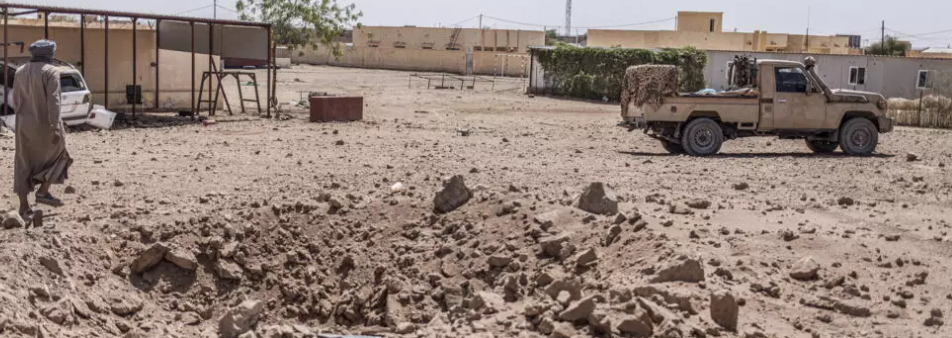
The Malian state’s acquisition of cutting-edge weaponry is yielding no dividends without a doctrinal mastery of warfare. The prolonged standoff around Kidal, despite Bamako’s deployment of advanced aerial assets, underscores a critical reality: an inadequately trained military command converts firepower into a futile financial burden.
the illusion of technological supremacy in Mali’s military strategy
Modern Malian defense doctrine appears to hinge on a fundamental misconception—that the mere possession of high-tech equipment such as surveillance drones, tactical bombers, and precision-guided munitions guarantees operational dominance. Yet, the effectiveness of any weapon system is entirely contingent upon the strategic framework guiding its deployment. When Mali’s military hierarchy operates with critically low educational standards, even the most sophisticated technologies become little more than political symbols for Bamako, devoid of real-world combat utility.
Kidal: a case study in military doctrine failure
The security landscape in northern Mali, particularly around the strategic city of Kidal, serves as an unmistakable case study in this phenomenon. For months, the Malian armed forces have escalated aerial bombardment campaigns, intensified drone strikes, and employed heavy artillery. Yet, the terrain tells a different story: the fighters of the Front de Libération de l’Azawad (FLA) continue to hold their ground, effectively neutralizing Bamako’s military strategy.
Why does Mali’s near-total air superiority fail to break the resistance of lightly equipped rebel groups? The answer lies in the Malian high command’s inability to integrate these strikes into a cohesive, multi-domain operation. Bombing without synchronized ground troop deployment, without real-time tactical adjustments, and without a nuanced understanding of the desert landscape amounts to little more than indiscriminate expenditure. No amount of advanced weaponry can compensate for strategic illiteracy within the command structure.
the cost of strategic illiteracy in asymmetric warfare
Contemporary warfare in Mali, especially in its asymmetric and desert-based form, demands a level of intellectual adaptability far beyond conventional conflict paradigms. Mali’s poorly educated military leadership tends to rely on rigid, brute-force tactics that lack flexibility and depth. The repetitive nighttime air raids conducted by the Malian army near Kidal exemplify this lack of tactical innovation. In stark contrast, rebel forces demonstrate superior cognitive agility—dispersing rapidly, camouflaging effectively, leveraging local geography, and maintaining psychological resilience.
This strategic illiteracy also manifests in an inability to learn from operational feedback. When the Malian high command persists in repeating the same tactical errors week after week—squandering valuable equipment and maintaining a stalemate—the issue transcends logistics. It becomes fundamentally conceptual. The inadequately trained Malian officer treats weaponry as a magical fetish, expecting it to resolve security challenges through sheer presence alone. This overlooks a critical truth: defense is not a technological endeavor but a human science requiring method, calculation, and refined strategic thinking.
the human factor: why Mali’s military command remains the weak link
Ultimately, the events unfolding in northern Mali serve as a stark reminder of the immutable laws of warfare. Financial resources poured into advanced aerial platforms are rendered futile when the minds responsible for operational design in Bamako lack even basic educational prerequisites. Until the strategic command ceases to be the weakest link in Mali’s military training ecosystem, frontlines such as that around Kidal will remain frozen in place. For Mali, raw firepower without intelligence is nothing short of a recipe for military failure.