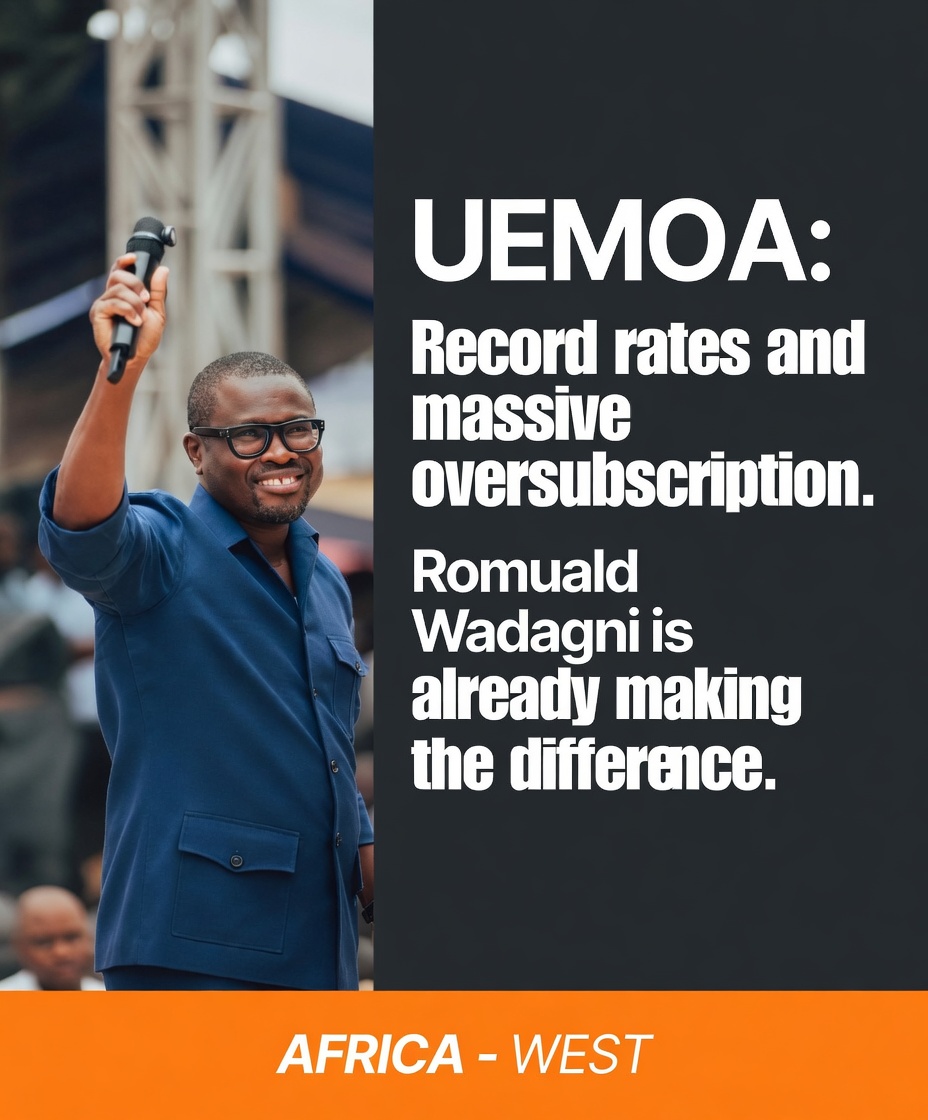
The elevation of Romuald Wadagni to the presidency represents a definitive historical shift for the financial sector in Cotonou. As the nation transitions, domestic and international investors are closely analyzing the initial indicators of a mandate defined by technical proficiency and a commitment to industrial acceleration.
Benin has reached a significant milestone in its political evolution, prompting an immediate response from the financial markets. The rare occurrence of a former Minister of Economy and Finance assuming the presidency offers the market a highly valued asset: institutional predictability.
A confidence premium in the bond markets
Upon the release of the election results, the yields on Beninese sovereign bonds in the secondary market remained remarkably steady, with some rates even experiencing a marginal decline. Financial observers characterize this trend as a “competence premium.” Having been the architect of Benin’s success in the Eurobond market and a leader in issuing sustainable development goal (SDG) bonds, Romuald Wadagni possesses substantial credibility with international creditors and major rating agencies such as S&P and Moody’s.
Bullish sentiment at the BRVM
Optimism is evident at the Regional Securities Exchange (BRVM). Banking institutions with operations in Benin are forecasting an acceleration of large-scale infrastructure developments and an expansion of public-private partnerships (PPP). Furthermore, there is a strong expectation among investors that this new era will encourage the stock market listing of major national enterprises, which would further mature the local capital market.
Industrialization and foreign direct investment: The GDIZ focus
The financial community’s interest extends beyond fiscal data to the tangible economy. The ongoing strategy for local resource transformation within the Glo-Djigbé Industrial Zone (GDIZ) remains a central priority. The election of Wadagni is interpreted as a guarantee that the influx of foreign direct investment (FDI) will remain uninterrupted. His professional profile provides multinational entities with the necessary assurances regarding legal security and the stability of the macroeconomic framework.
Expert financial analysis
Market analysts note that financial systems generally react negatively to uncertainty. With this leadership transition, Benin is signaling a future of rigorous management and long-term vision. The upcoming challenge will be to convert this high level of financial confidence into broad-based economic prosperity while ensuring that national debt ratios remain within sustainable thresholds.
Key metrics to monitor
- Sovereign credit ratings: The possibility of international agencies upgrading the national outlook from “stable” to “positive.”
- Treasury bond yields: Forthcoming issuances by the Public Treasury in the UMOA market will serve as a critical gauge of financial popularity.
- GDIZ investment volume: The amount of capital directed into the manufacturing sector during the administration’s first hundred days.
As Benin begins this new chapter, the economic strategies associated with the new administration appear to have already gained the favor of financial markets. The focus now turns to the initial fiscal and budgetary decisions of the five-year term to confirm this positive momentum.