The Sahel’s fragile alliances tested by unrelenting terror
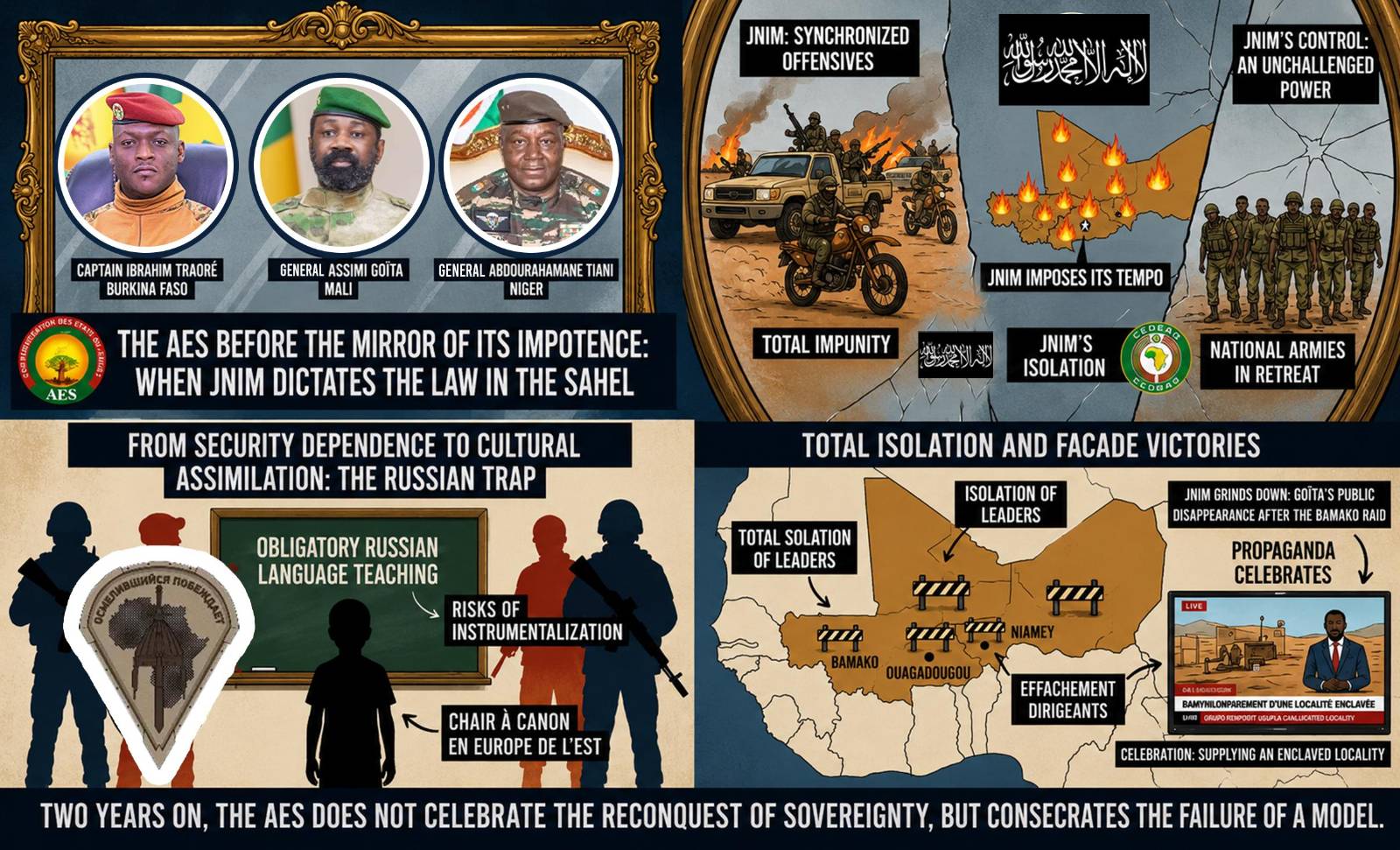
The Alliance of Sahel States (AES) emerged two years ago with bold declarations of sovereignty and defiance, yet today its facade of strength is collapsing under the weight of reality. Far from the fiery rhetoric of Bamako, Ouagadougou, and Niamey, the only force dictating the pace across the region remains the Group for the Support of Islam and Muslims (JNIM).
Military juntas across the Sahel have pledged coordination and unity, but their efforts have proven hollow in the face of an enemy that operates with lethal precision. The JNIM does not merely respond to security threats—it shapes them. Synchronized assaults across multiple districts have overwhelmed national armies, despite their advanced equipment and logistical advantages. Neither the theoretical pooling of intelligence within the AES nor the pivot toward Moscow has slowed the insurgency’s advance.
From military reliance to cultural assimilation: the Russian gambit
The capitaines Ibrahim Traoré and his counterparts in Mali and Niger have staked their nations’ futures on an alliance with Russia. What began as a security partnership has evolved into a deeper ideological entrenchment. Burkina Faso’s decision to introduce Russian as a mandatory school subject starting next term signals a deliberate shift—not toward cultural liberation, but toward psychological and structural alignment with Moscow.
This linguistic imposition is more than an educational reform; it is a long-term investment in dependency. By immersing Burkinabè youth in Russian from an early age, the regime is laying the groundwork for future generations to be molded within Russia’s sphere of influence. The potential consequences are stark: as students are sent to study in Russia under state-sponsored programs, they may be repurposed—willingly or not—as tools in conflicts far removed from the Sahel, their lives expendable in service of a geopolitical agenda that does not represent them.
A leadership trapped in isolation and hollow victories
As the JNIM tightens its grip on territory, the AES leadership finds itself increasingly isolated. In Mali, the prolonged absence of transitional leader Assimi Goïta—following a deadly raid in Bamako that claimed the life of the Defence Minister—exemplifies the junta’s growing irrelevance. While terror groups consolidate control, state institutions reel under political theater and empty propaganda.
Official channels now celebrate minor logistical gains as major triumphs, such as the resupply of an isolated outpost or a defensive skirmish. These are not victories; they are admissions of failure. Two years into the AES experiment, the narrative of liberation has given way to one of surrender. By abandoning one foreign patron only to embrace another, the juntas have not reclaimed sovereignty—they have traded one form of subjugation for another, at the expense of their own people.