Touareg and Arab separatist movements in northern Mali: who are they and what do they want?
In a fresh military push this weekend, the Front de libération de l’Azawad (FLA)—a separatist coalition—and its ally, the Jamaat Nusrat ul-Islam wal Muslimeen (JNIM), launched coordinated attacks to reclaim control of northern and central Mali from government forces. This offensive follows a dramatic alliance formed in April between the FLA and JNIM, a group affiliated with Al-Qaeda, which targeted key locations including Kati, a strategic military stronghold near Bamako, and left Mali’s Defense Minister dead and the intelligence chief severely wounded.
The FLA had previously seized Kidal in 2023—a city of high symbolic value for Malian troops and Russian-backed forces—before government forces reclaimed it in a subsequent counteroffensive. With fresh mobilization reported in northern communities and a $12.4 million bounty announced by Malian authorities on leaders of both groups, tensions are escalating across the Sahel.
Who makes up the FLA?
The Forces de Libération de l’Azawad (FLA) emerged on November 30, 2024, in Tinzaouatene, a northern Malian town bordering Algeria. Formed from the merger of several armed factions, the FLA represents a convergence of Tuareg and Arab separatist groups united by a shared goal: the creation of an independent Azawad state.
The Azawad region—encompassing Gao, Tombouctou, Kidal, and Ménaka—was first declared independent in 2012 by the Mouvement National de Libération de l’Azawad (MNLA), one of the founding members of the FLA. The coalition builds on the legacy of the Cadre Stratégique Permanent pour la Paix, la Sécurité et le Développement (CSP-PDA), which itself united various separatist movements including the MNLA, the Haut Conseil pour l’Unité de l’Azawad (HCUA), factions of the Mouvement Arabe de l’Azawad (MAA), and the Groupe d’Autodéfense Touareg Imghadien et Alliés (GATIA).
The roots of Tuareg unity trace back to 1988 in Libya, where the Mouvement Populaire de Libération de l’Azawad (MPLA) was founded by Algerian and Libyan exiles under the leadership of Iyad Ag Ghali, today a leading figure in the JNIM.
The FLA’s political leader is Bilal Ag Acherif, born in Kidal in 1977, who has played a central role in the movement’s direction. His deputy, Alghabass Ag Intalla, serves as military commander and handles reconciliation efforts and relations with the JNIM. Intalla hails from a prominent Ifoghas clan, son of the late traditional leader Intallah Ag Attaher.
Mohamed Ramadane serves as the group’s spokesperson, frequently communicating its positions to international audiences.
What does the FLA seek?
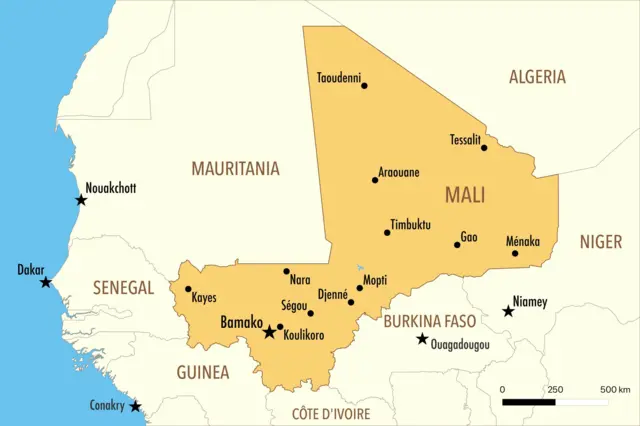
Tensions between Arab and Tuareg communities and the Malian government date back to independence in 1960, sparking rebellions in 1962, the 1990s, and again in 2012. The FLA’s stated objective is the establishment of an independent Azawad Republic, a homeland for nearly two million Tuareg people displaced across West and North Africa due to colonial fragmentation.
The group accuses Bamako of systemic political, economic, and cultural marginalization. Despite the region’s vast natural wealth—including salt, uranium, gold, diamonds, and phosphate deposits—infrastructure development has lagged, with limited access to schools, healthcare, clean water, electricity, and roads.
Acherif has repeatedly defended the independence drive, declaring that the Azawad was “annexed by Mali without regard for its history as an independent civilization.”
Malian authorities have accused neighboring countries including Algeria and Mauritania of supporting the FLA, while also pointing fingers at Ukraine, Mauritania, and France. The FLA claims to maintain a strong military presence stretching from the Mauritanian to the Algerian border, with key bases near Kidal and Tinzaouatene.
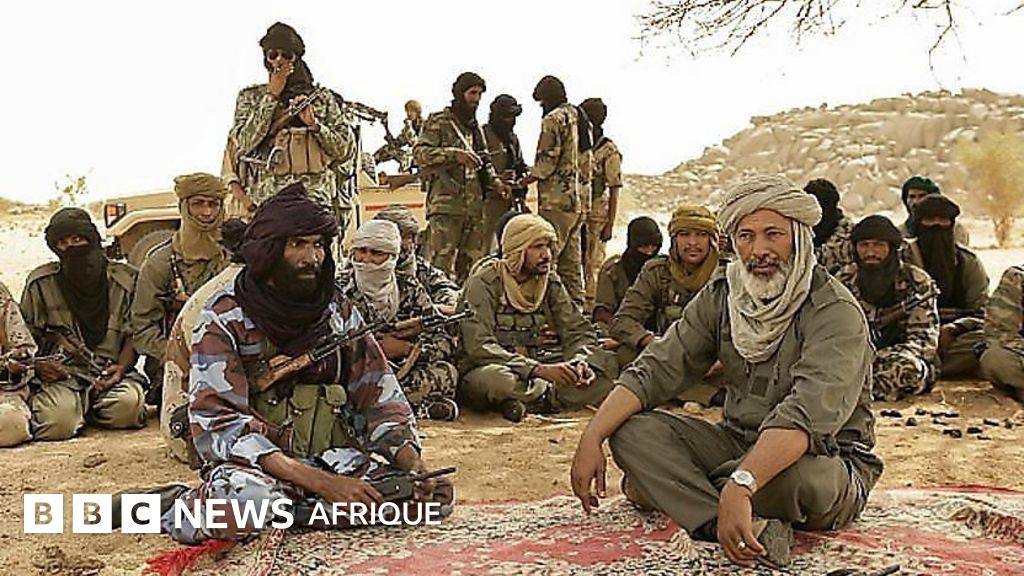
Between 2024 and 2025, the FLA reportedly deployed drone attacks, though visual propaganda often shows armed fighters patrolling the desert in long convoys of pickup trucks.
How have FLA-JNIM relations evolved?
JNIM leader Iyad Ag Ghali was once a leading figure in the Tuareg rebellion before shifting allegiance to radical Islamist groups in the late 1990s. Formal coordination between the two movements began taking shape in mid-2024.
In May 2024, Ag Intalla reportedly initiated talks between the CSP-PDA and the JNIM, leading to an informal non-aggression pact. By July, the CSP-PDA, with JNIM support, had defeated Malian and Russian Wagner Group forces at the Battle of Tinzaouatene.
Relations deepened in early 2025, as both groups agreed to joint operations against Malian and Russian troops following negotiations in late February. After the April 25 nationwide attacks, the FLA and JNIM publicly acknowledged their partnership.
The FLA framed the alliance as a “strategic convergence” aimed at toppling Mali’s military government, while the JNIM described it as a tactical union made possible after Tuareg leaders signaled openness to implementing Sharia law.
Acherif stated in an interview that while ideological differences remain, both groups share a common enemy and are discussing localized solutions. The durability of this cooperation remains uncertain amid ongoing ideological divides and competing visions for the region’s future.